Chhath Puja AI Prompt Girl: 10 Realistic Saree & Arghya Photo Ideas
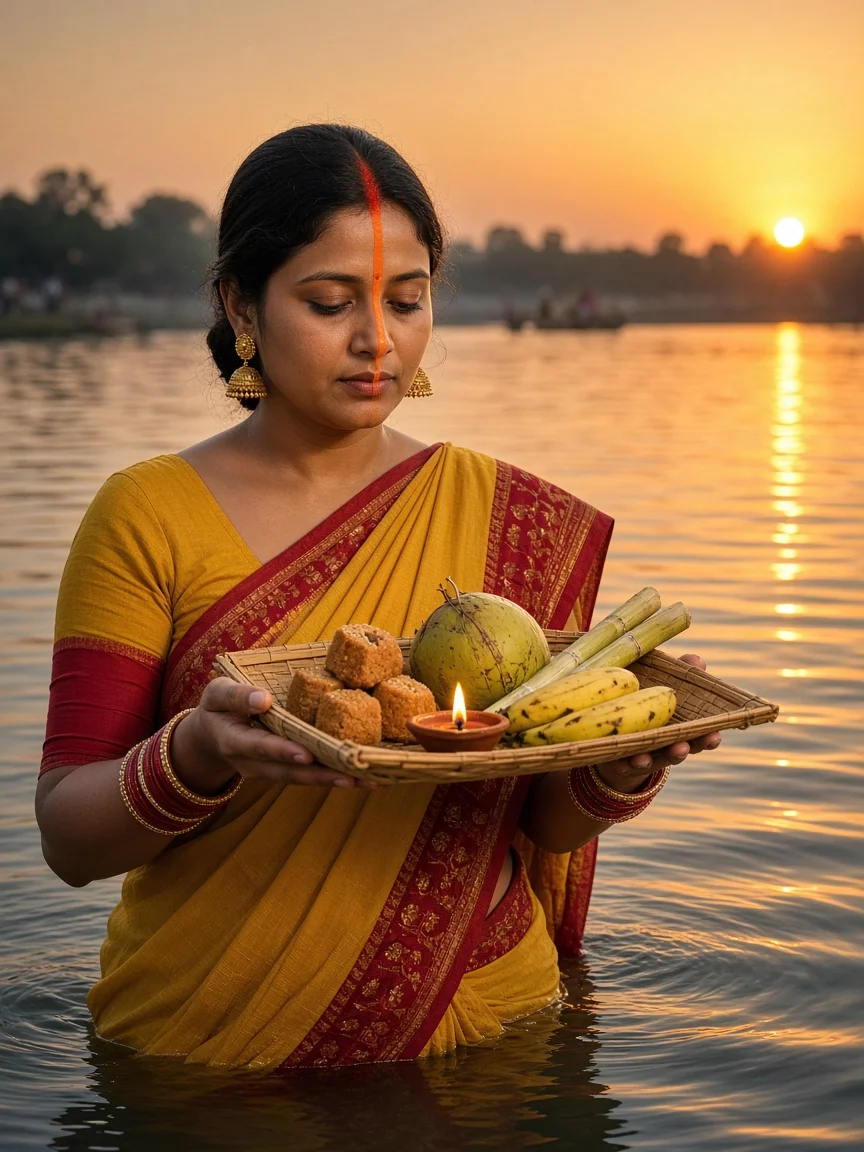
Table of contents
- Four days through the eyes of a vrati
- Day 1: Nahay Khay, the purifying bath
- Day 2: Kharna, the evening offering
- Day 3: Sandhya Arghya, the sunset offering
- Day 4: Usha Arghya and Paran
- The long orange sindoor: meaning and how to show it
- For unmarried girls: festive Chhath looks without sindoor
- Saree and jewellery styling for Chhath portraits
- Camera choices that suit each ritual moment
- 10 Chhath Puja AI prompts for women and girls
- 1. Vrati's Sandhya Arghya in Red-Yellow Saree
- 2. Usha Arghya Prayer at Dawn
- 3. Long Orange Sindoor Close-Up
- 4. Kharna Kheer on the Chulha
- 5. Banarasi Saree Daura Walk
- 6. Kosi Canopy Prayer in Emerald Silk
- 7. Nahay Khay Morning Without Sindoor
- 8. Water-Level Soop with Floating Petals
- 9. Madhubani Tussar Saree with Mogra Bun
- 10. Final Morning Mist Prayer
- Using your own face, with care
- Health, safety and respect for real vratis
- Fixing common problems in women's Chhath AI images
- Sharing your Chhath portrait
There is a reason the most shared Chhath picture every year is a woman standing in a river at sunset. She has eaten one simple meal in two days, she has not had a sip of water since the previous evening, and she is still holding a heavy bamboo tray steady against the current while she sings to the sun. The vrati is the soul of Chhath, and her saree, her long orange sindoor and her quiet strength are what people want to capture.
This guide gives you ten original Chhath Puja AI prompts for women and girls, each paired with the image it generated, along with a practical styling guide for sarees and jewellery, an explanation of the sindoor tradition, a walk through the four days from the vrati's point of view, and clear options for unmarried readers who want a festive picture without the married-woman symbols. All ten feature consenting adult Indian women, are framed in a 3:4 vertical format, and can be pasted straight into Gemini, ChatGPT, Grok or GAWKIN's own image generator.
Four days through the eyes of a vrati
Chhath runs from Kartik Shukla Chaturthi to Saptami, roughly a week after Diwali. For the woman keeping the vrat, each day has its own rhythm, food, clothing and emotion, and each one makes a very different kind of picture. Knowing the sequence helps you choose the right prompt and avoid mixing details from different days.
Day 1: Nahay Khay, the purifying bath
The vrat begins with a bath in a river, pond or at home with Ganga water, followed by a single sattvic meal, traditionally kaddu-bhat: bottle gourd cooked with chana dal, rice and ghee, seasoned with rock salt instead of ordinary salt. The house is scrubbed clean, and the vrati usually wears fresh, simple cotton. Visually this is the quietest day: wet hair, plain sarees, brass vessels and morning light. Prompt seven is set here.
Day 2: Kharna, the evening offering
After fasting from sunrise, the vrati cooks rasiaw, a kheer of rice and jaggery, along with wheat rotis on a newly made clay chulha fired with mango wood. She offers it first, then eats it in silence, and the family takes the rest as prasad. From this moment the 36-hour nirjala fast begins: no food and no water until the final morning. Firelight, steam and the vrati's concentration make Kharna one of the most intimate scenes of the festival.
Day 3: Sandhya Arghya, the sunset offering
In the afternoon the household walks to the ghat with the daura of offerings. As the sun touches the horizon, the vrati steps into the water and offers arghya with a bamboo soop holding thekua, fruit, sugarcane and a diya, while women around her sing Chhath geet. This is the moment for bright cotton sarees, gold jewellery and the boldest sindoor. That night, families with a vow raise the sugarcane Kosi and keep diyas burning.
Day 4: Usha Arghya and Paran
Before dawn the family returns to the ghat. The vrati stands in cold water, often in mist, until the first rays appear, then offers milk and water from a lota towards the rising sun. Elders bless her, married women apply sindoor to one another, and she finally breaks the fast, often with a little prasad and water. This is the most emotional picture of the four days: tired eyes, folded hands and pale golden light.
The long orange sindoor: meaning and how to show it
Ask anyone from Bihar or Purvanchal what makes a Chhath portrait recognisable and they will mention the sindoor. On the ghat, married vratis draw a long line of bright orange sindoor from the tip of the nose all the way up into the hair parting, far longer than the everyday mark in the maang. In popular belief the length of the line reflects prayers for the husband's long life and the family's wellbeing, and the warm orange colour echoes the sun the festival honours. Many women also share sindoor with other married women at the ghat after the morning arghya as a blessing.
In AI prompts this detail needs precise wording, or the model will either skip it or paint a random red streak. The phrase that works most reliably is long orange sindoor line from the tip of her nose up the forehead into the hair parting. Pair it with a small red bindi or none at all, because a large bindi competes with the line. Prompt three in this guide is built around this single detail, and the close crop shows how clean it can look.
For unmarried girls: festive Chhath looks without sindoor
Searches for Chhath Puja prompts for girls are often made by college students and young working women who are not married, and many of them do not want, or should not wear, the married-woman symbols in their pictures. Sindoor, the nath worn as a marital sign in some families, and toe rings are all specific to married women in the region. Leaving them out is not a lesser look; it is simply the correct one for an unmarried daughter, and plenty of families would find a sindoor image of an unmarried girl uncomfortable.
The easiest way to adapt any prompt in this guide is to make three small edits:
- Change authorised adult married Indian woman to authorised adult young Indian woman.
- Delete the sindoor clause entirely and, if you like, add a small red bindi.
- Swap heavy bridal jewellery for gold jhumkas, a thin chain and glass bangles.
Daughters play a real part in the festival, so you can also change the action to fit: helping her mother carry the soop down the steps, holding the lota for the vrati, lighting diyas around the Kosi or arranging thekua on the banana leaf. Prompt seven, the Nahay Khay morning, already shows a woman without sindoor and works as written. A yellow cotton salwar suit with a red dupatta is another simple, respectful outfit if a saree feels too formal.
Saree and jewellery styling for Chhath portraits
Chhath dressing values cleanliness and tradition over glamour. Vratis traditionally wear a new, unstitched saree, often cotton, because it will get wet and must be pure. The colour palette follows the sun: turmeric yellow, red, saffron, orange and the occasional festive pink or green for the evening.
- Yellow and red cotton: the classic vrati saree, a turmeric yellow body with a red border, recalls the piyari tradition of Bhojpuri rituals. Best for both arghyas and Kharna.
- Bhagalpuri tussar silk: Bihar's own silk, with a natural golden sheen and a slightly rough texture that looks beautiful in side light. Hand-painted Madhubani borders make it unmistakably regional.
- Banarasi silk: magenta, red or emerald Banarasi with zari suits the evening walk to the ghat and the Kosi night, when light is warm and low.
- Draping: the pallu drawn over the head, as many married women in Bihar wear it for rituals, instantly signals a sacred setting. Mention it in your prompt.
- Jewellery: gold jhumkas, a small nath, red and green lac lahathi bangles from Bihar, red glass bangles, payal and alta on the feet. Choose two or three items rather than listing everything.
- Hair: a neat bun with white mogra or marigold flowers for evening, loose wet hair for Nahay Khay or after a river dip.
If you love regional textile detail, the same approach to fabric and jewellery is explored for Rajasthan in our Rajputi poshak prompt guide, and for Kerala's cream-and-gold handloom in the Onam Kasavu saree prompts.
Camera choices that suit each ritual moment
You do not need to know photography to use lens terms, but they quietly shape what the AI gives you. For Chhath portraits of women, three choices cover almost everything:
- 85mm f/1.4 for close faces, sindoor details and morning prayer. It flattens features gently and blurs the crowd into soft light.
- 50mm f/1.4 for scenes with context: Kharna by the chulha, Nahay Khay on the steps, carrying the daura. The background stays readable.
- 35mm low angle near the water for dramatic arghya pictures where floating petals and ripples fill the foreground.
Light direction matters just as much. Firelight from one side suits Kharna, a low setting sun behind the subject suits Sandhya Arghya, and diffused mist with a thin rim of gold suits the final morning.
10 Chhath Puja AI prompts for women and girls
Each card shows the generated image, a title and the complete prompt with a copy button. Use them as written or apply the unmarried edits above.
1. Vrati's Sandhya Arghya in Red-Yellow Saree
The heart of the festival in one frame. A vrati stands waist-deep at sunset with a soop of thekua, coconut, sugarcane, bananas and a steady diya, in a red-and-yellow cotton saree whose hem darkens in the water. The long orange sindoor, gold jhumkas and red glass bangles catch the amber light. Keep the phrase wet at the hem; it adds realism while keeping the image graceful.
Photorealistic 3:4 vertical portrait of an authorised adult married Indian woman (vrati) standing waist-deep in a calm river during Chhath Puja Sandhya Arghya, holding a woven bamboo soop with thekua, coconut, sugarcane, bananas and a steady clay diya at chest level, traditional red-and-yellow cotton saree with red border wet at the hem, long orange sindoor line from nose tip to hair parting, gold jhumkas and red glass bangles, amber setting sun glowing on the ripples, 85mm f/1.4 devotional documentary look, natural skin pores, no text or watermark
2. Usha Arghya Prayer at Dawn
Where the first image glows, this one breathes. Eyes closed, she tips a brass lota so that a fine ribbon of milk and Ganga water falls towards a red-gold sunrise, in a saffron-and-red silk saree with a gold border. The mist and sunbeams lighting the stream make it a perfect picture for the morning of Paran.
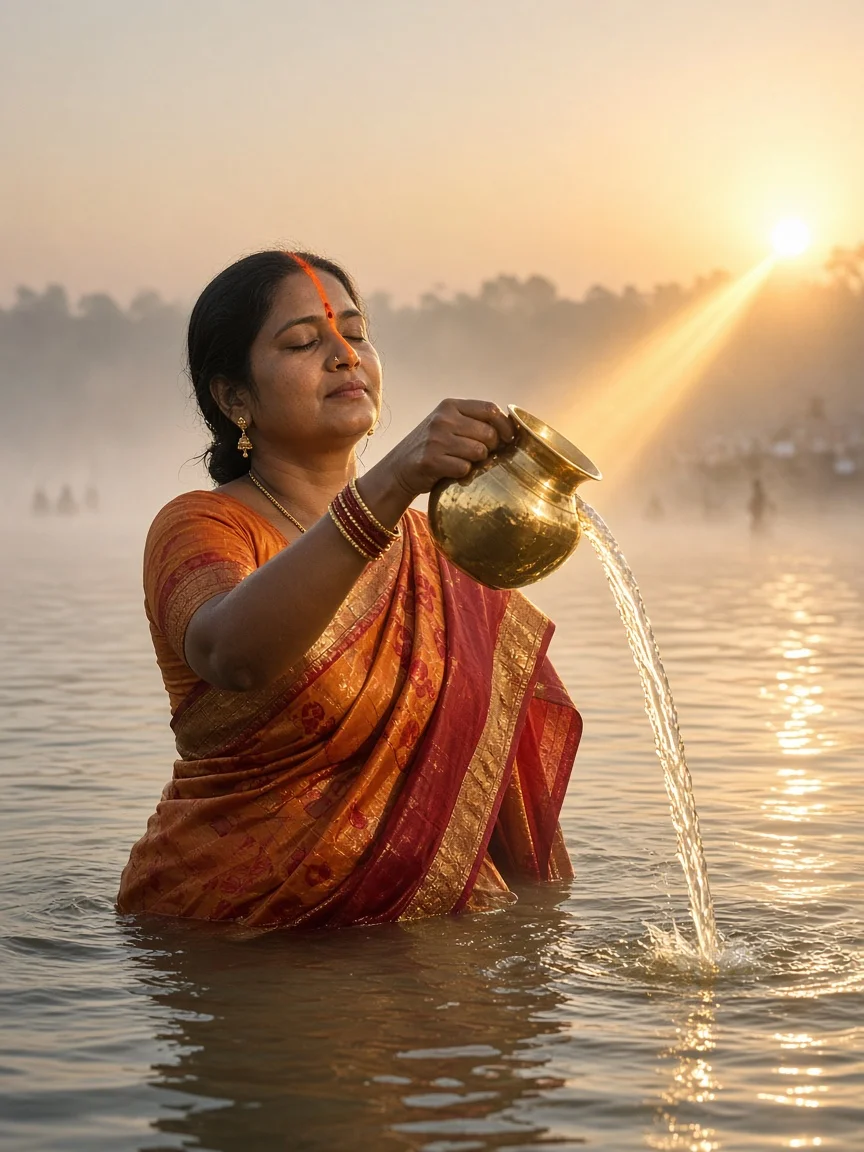
Photoreal 3:4 vertical photograph of an authorised adult married Indian woman waist-deep in a misty river at Chhath dawn, pouring a thin luminous stream of milk and Ganga water from a polished brass lota toward the rising red-gold sun, eyes gently closed in prayer, saffron-and-red silk saree with gold border wet at the hem, long orange sindoor from nose to maang, sunbeams lighting the stream, golden water ripples, serene spiritual realism, natural skin pores, no text or watermark
3. Long Orange Sindoor Close-Up
A tight beauty portrait that celebrates the defining detail of a married vrati: a thick orange sindoor line from nose tip to hair parting, a small gold nath, temple jhumkas and a yellow-and-red pallu draped softly over her head. Sharp focus on the eyes and the sindoor keeps attention exactly where it belongs. This crop also makes an elegant Chhath display picture.
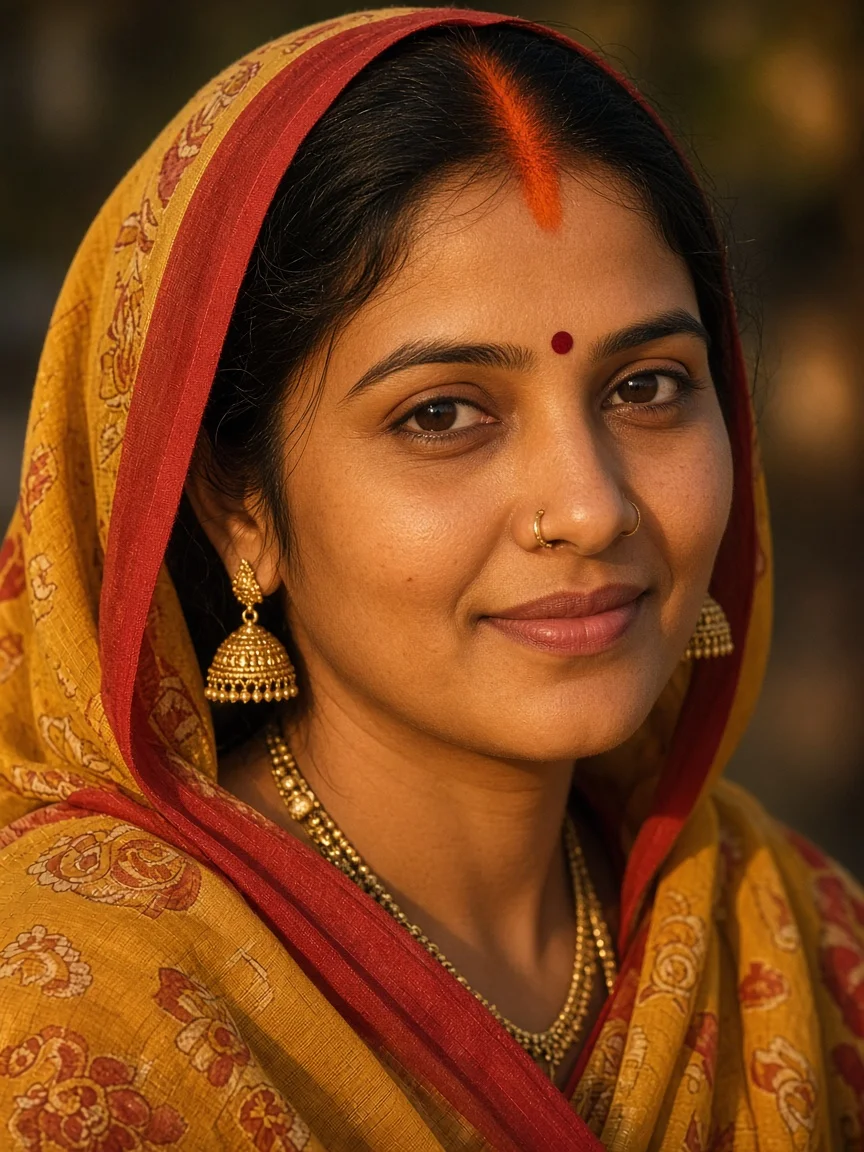
Photoreal 3:4 vertical intimate close-up beauty portrait of an authorised adult married Indian woman during Chhath, a thick traditional orange sindoor line drawn from the tip of her nose up the forehead into the hair parting, small gold nath, gold temple jhumkas, small red bindi, turmeric-yellow and red silk saree pallu draped softly over her head, gentle serene smile, golden morning light on natural skin, sharp focus on eyes and sindoor line, 85mm f/1.4, natural skin pores, no text or watermark
4. Kharna Kheer on the Chulha
Kharna is cooked by the vrati herself, and this image honours that labour. Seated beside a handmade clay chulha in a village courtyard, she stirs jaggery kheer in a heavy brass pot, with embossed thekua, wheat rotis and earthen bowls on fresh banana leaves around her. Firelight and gentle steam do all the storytelling.
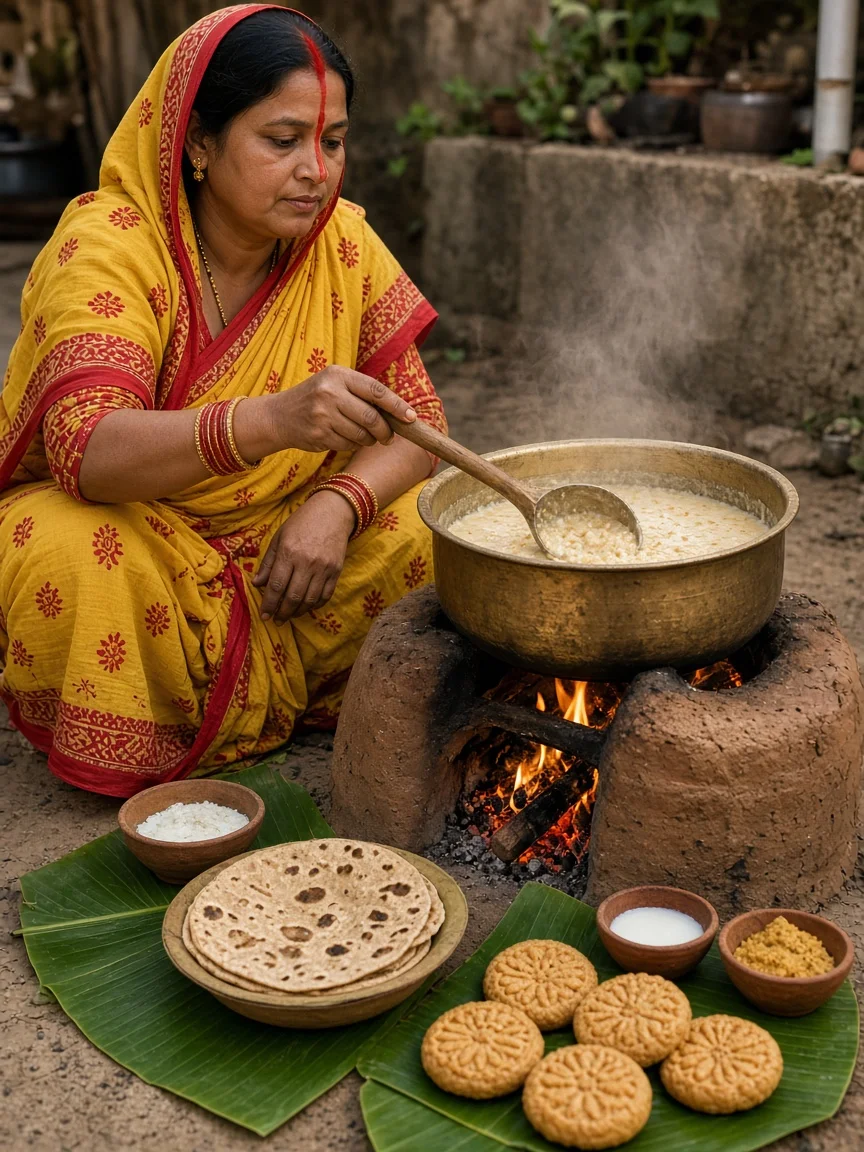
Photoreal 3:4 vertical cultural documentary photograph of an authorised adult married Indian woman sitting beside a handmade clay chulha with wood fire in a village courtyard on Chhath Kharna, stirring jaggery kheer in a heavy brass pot with a wooden ladle, embossed thekua, wheat rotis and earthen bowls on fresh banana leaves nearby, yellow cotton saree with red border and pallu over her head, orange sindoor along nose and parting, flickering firelight and gentle steam, 50mm f/1.4, natural skin pores, no text or watermark
5. Banarasi Saree Daura Walk
A colourful evening portrait for anyone who wants a richer saree. She walks down stone ghat steps carrying a red-covered bamboo daura of coconuts and fruit, wearing magenta-and-gold Banarasi silk with the pallu over her head, framed by tied sugarcane stalks and blurred twilight lamps. In many families men carry the daura, but women often carry their own basket the last few steps to the water.
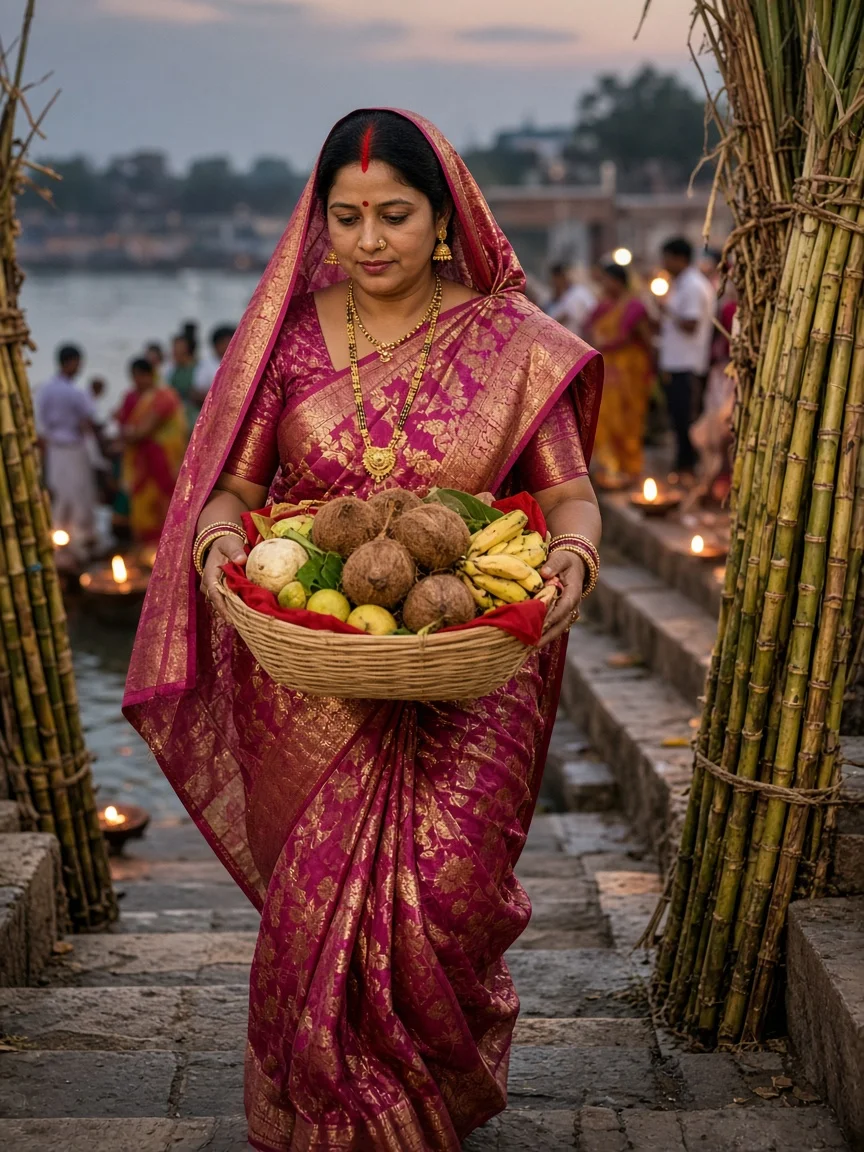
Photoreal 3:4 vertical cultural photograph of an authorised adult married Indian woman walking down the stone steps of a river ghat during Chhath, carrying a large bamboo daura covered with red cloth and filled with coconuts, banana bunches and seasonal fruit, magenta-pink and gold Banarasi silk saree with pallu over her head, gold jewellery, long orange sindoor, tied sugarcane stalks framing the path, twilight lamps and devotees softly blurred behind, 50mm f/1.4, natural skin pores, no text or watermark
6. Kosi Canopy Prayer in Emerald Silk
The night between the two arghyas has its own magic. Under a four-stalk sugarcane Kosi on river sand, she sits with folded hands before a ring of burning diyas and a handmade clay elephant, in an emerald-and-gold silk saree. The green against the orange flame is a striking colour pairing that also sets this image apart from the yellow and red of the rest of the set.
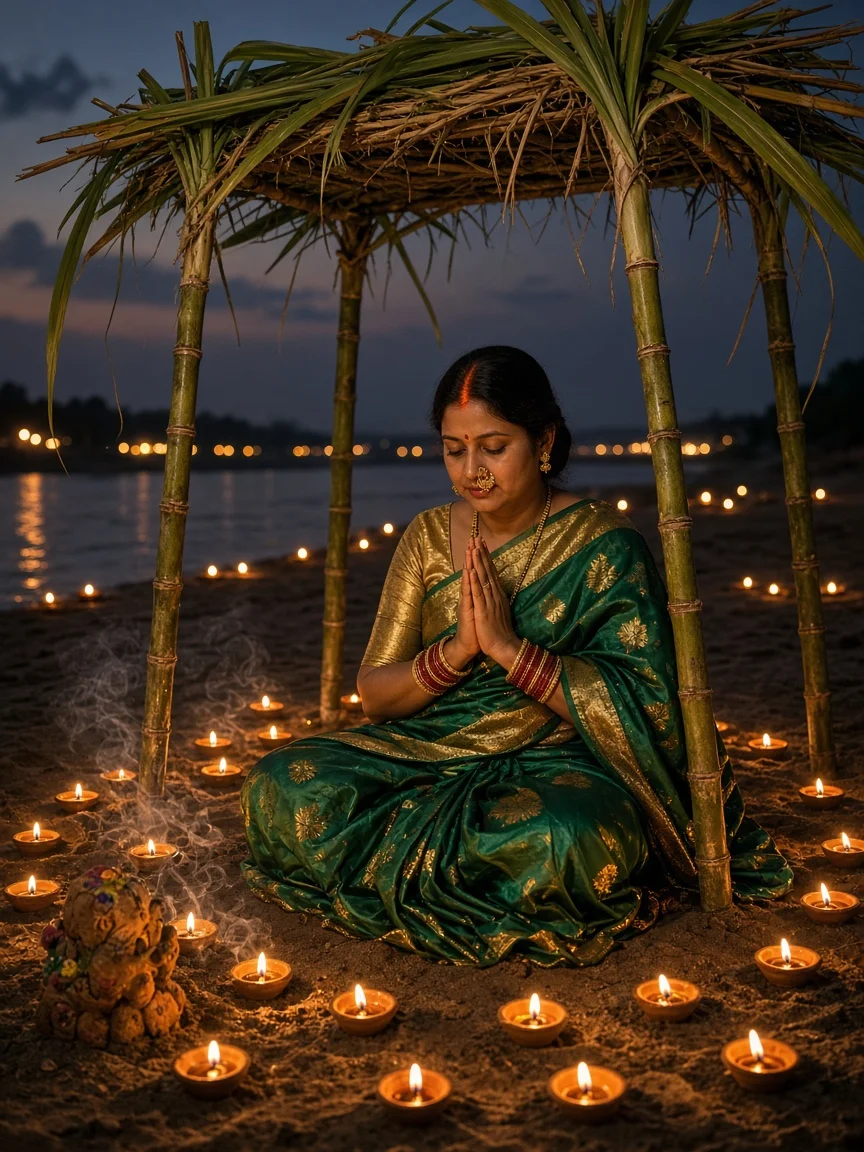
Photoreal 3:4 vertical dusk photograph of an authorised adult married Indian woman seated on river sand under a four-stalk sugarcane Kosi canopy on Chhath night, hands folded in quiet prayer before many burning earthen diyas around a handmade clay elephant, emerald-green and gold silk saree, small nath, orange sindoor, soft incense smoke, rich flickering orange glow across sand and water, deep emotional devotion, 50mm f/1.4 low-light realism, natural skin pores, no text or watermark
7. Nahay Khay Morning Without Sindoor
The ideal prompt for unmarried readers, and a beautiful one for anyone. After the ritual bath on the first morning, she stands on the bathing steps in a spotless lemon-yellow cotton saree with a thin red border, long wet hair over her shoulders, holding a brass thali with a copper lota, marigolds and tulsi leaves. There is no sindoor in this prompt, so it suits any adult woman as written.
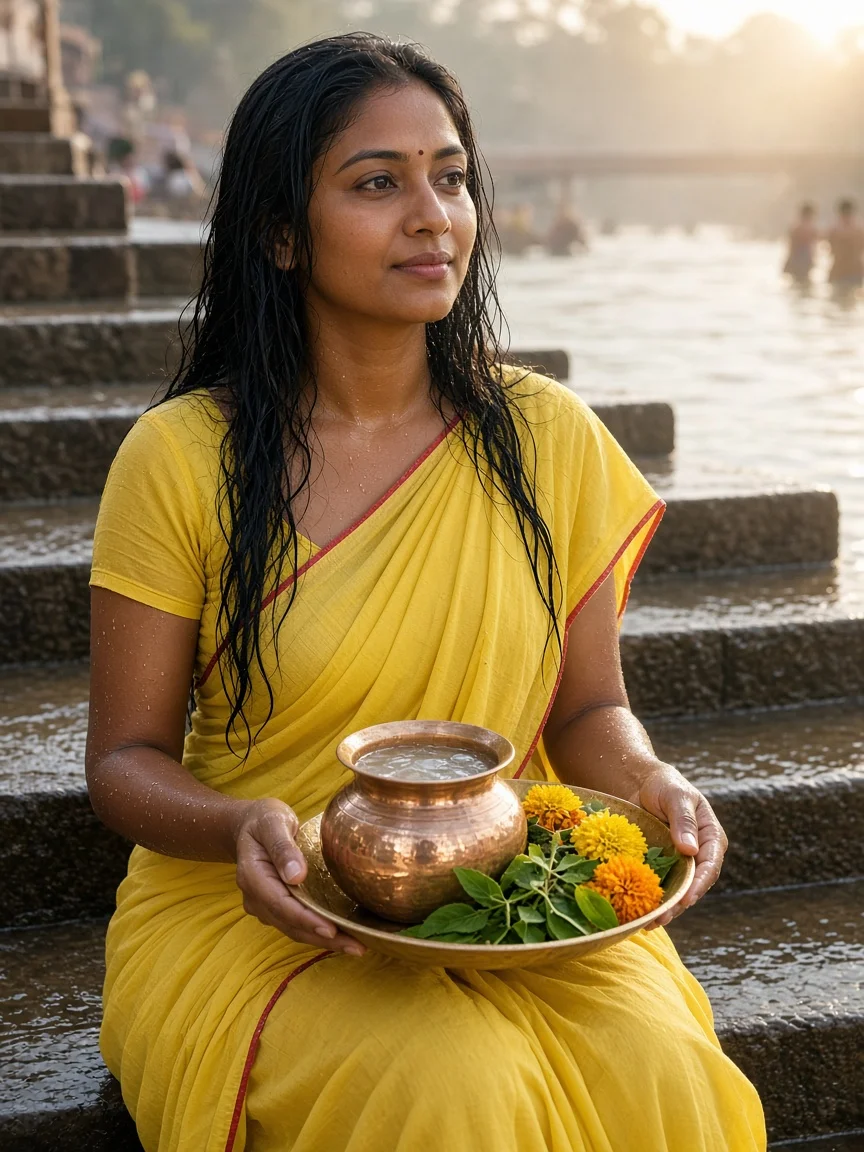
Photoreal 3:4 vertical portrait of an authorised adult Indian woman on river bathing-ghat steps on Chhath Nahay Khay morning after the ritual bath, spotless lemon-yellow cotton saree with a thin red border, long wet black hair over her shoulders, holding a brass thali with a copper lota of Ganga water, marigolds and tulsi leaves, tiny water droplets on skin, soft morning sun flare, calm pure expression, 50mm f/1.4 documentary portrait, natural skin pores, no text or watermark
8. Water-Level Soop with Floating Petals
For the most dramatic perspective, the camera sits just above the river surface. Rose and marigold petals drift through the golden foreground while the vrati raises her soop to the setting sun in a crimson-and-orange cotton saree. This low angle makes the offering feel monumental, and it is a favourite for Instagram.
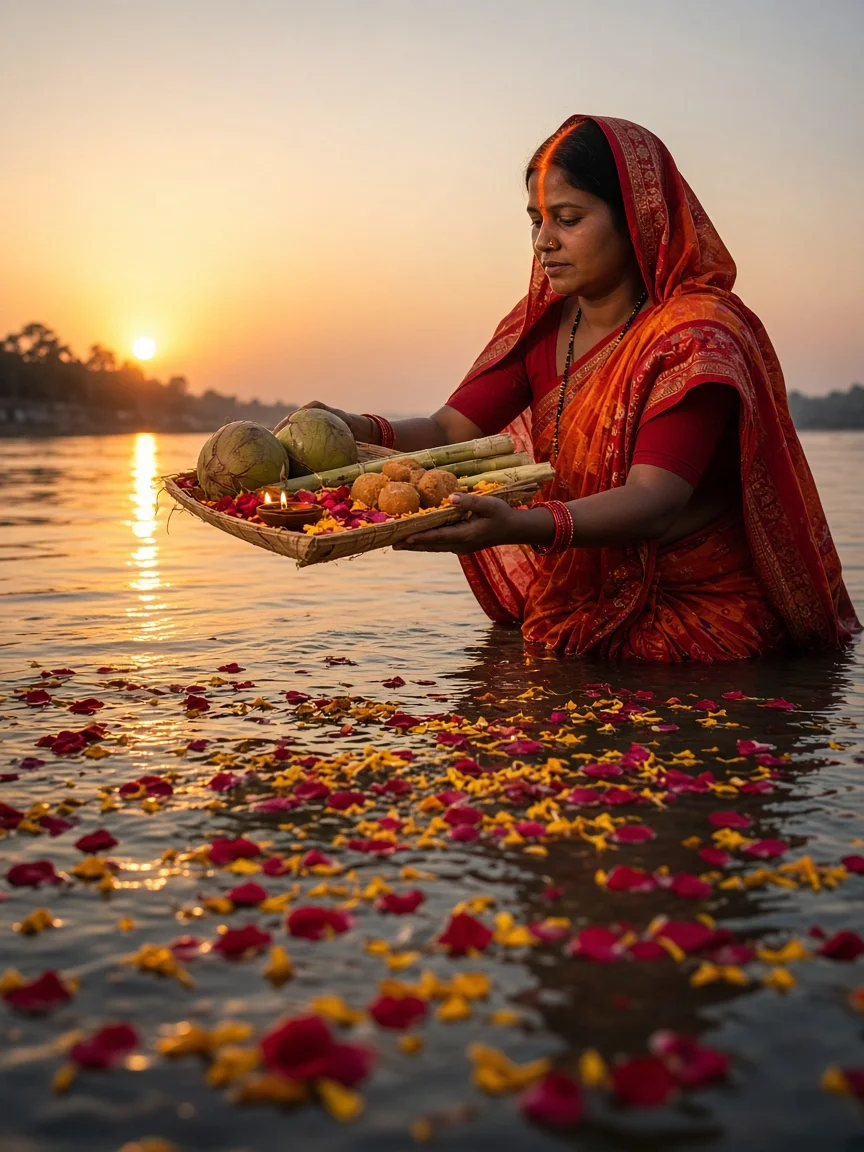
Photoreal 3:4 vertical low-angle photograph taken just above the river surface of an authorised adult married Indian woman offering a bamboo soop with coconuts, sugarcane, thekua and a flickering clay diya to the setting sun during Chhath, rose and marigold petals floating on golden ripples in the foreground, crimson-and-orange cotton saree, long orange sindoor catching the sun, documentary realism, 35mm f/1.8, natural skin pores, no text or watermark
9. Madhubani Tussar Saree with Mogra Bun
A tribute to Bihar's craft heritage. She stands beside the ghat in a beige-and-red Bhagalpuri tussar saree hand-painted with Madhubani peacocks and lotuses, hair in a mogra-flower bun, holding a brass thali with peeled sugarcane, a coconut and a small lota. Golden sidelight brings out the silk's natural slub and the painted border.
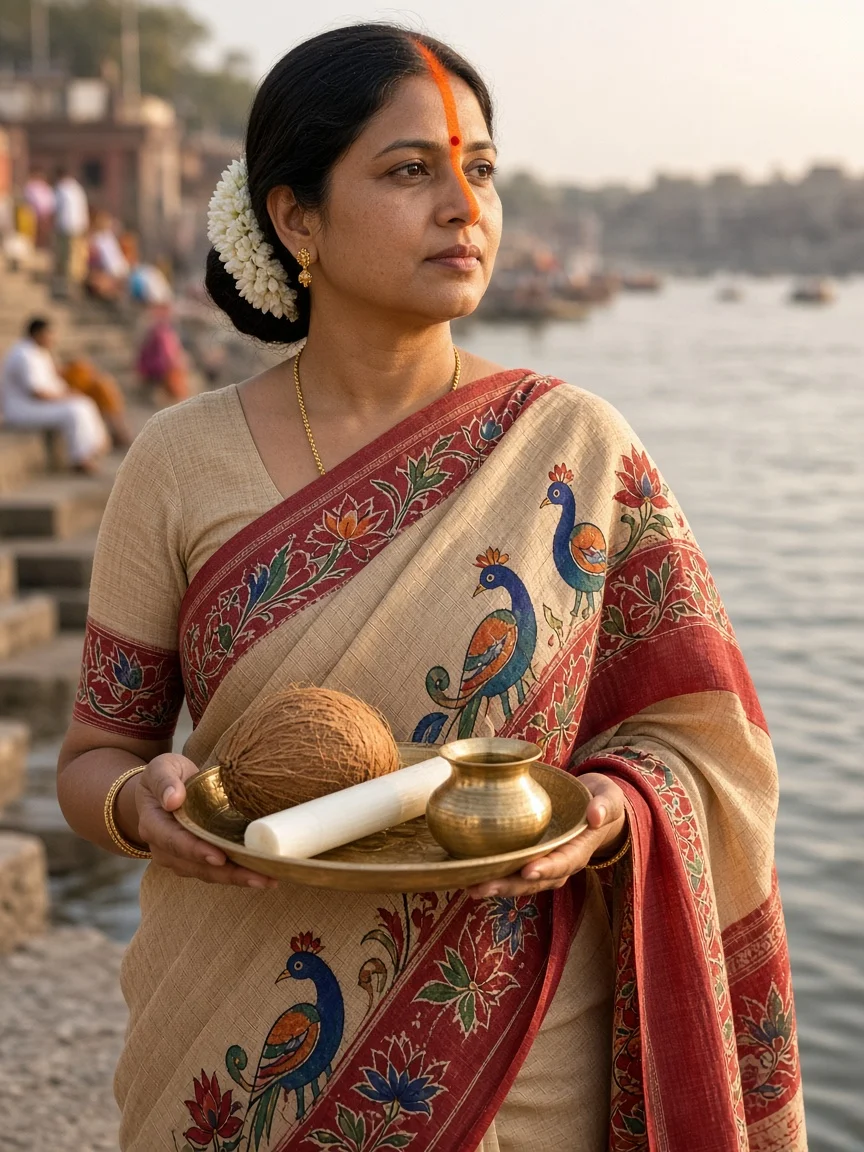
Photoreal 3:4 vertical portrait of an authorised adult married Indian woman beside a river ghat during Chhath in a beige-and-red handwoven Bhagalpuri tussar silk saree with hand-painted Madhubani peacock and lotus motifs on the border, hair in a neat bun with white mogra flowers, holding a brass thali with a peeled sugarcane piece, whole coconut and small brass lota, bold orange sindoor from nose to parting, golden afternoon sidelight, crisp silk weave, 85mm f/1.4, natural skin pores, no text or watermark
10. Final Morning Mist Prayer
The closing image of the vrat and the most emotional of the ten. Standing in calm, dark-blue water, hands folded in Anjali mudra, she faces the first sliver of sunrise breaking through cold November mist, her breath faintly visible. Soft rim light and fog turn the moment into something close to a painting.
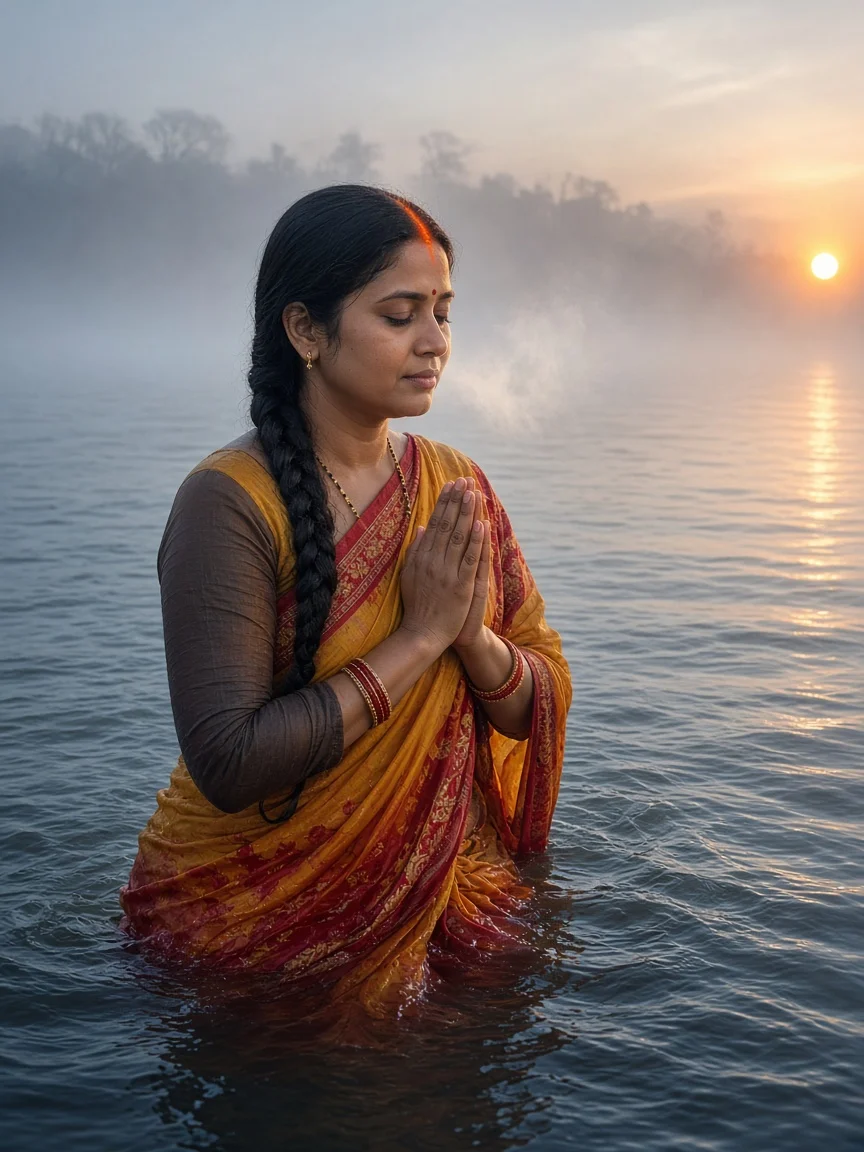
Photoreal 3:4 vertical emotional photograph of an authorised adult married Indian woman standing in calm dark-blue river water on the final Chhath morning, hands folded in Anjali mudra toward the first sliver of orange sunrise breaking through cold November mist, faint breath vapour in the chilly air, yellow-orange and red cotton saree wet below the waist, long orange sindoor glowing, quiet spiritual surrender, atmospheric fog and soft rim light, 85mm f/1.4, natural skin pores, no text or watermark
Using your own face, with care
To generate these portraits with your own likeness, upload a clear, well-lit, front-facing photo in Gemini or attach it in ChatGPT, paste the prompt and add a closing instruction such as: keep my face, skin tone, nose piercing and hairstyle exactly as in the uploaded photo, do not slim or lighten my face. Mentioning a nose piercing or a mole you want kept helps the model avoid quietly removing it.
Women's photos are especially easy to misuse, so upload only your own face or the face of someone who has clearly agreed, never a picture of a relative or friend taken from social media. If you want to make a picture for your mother, who is the vrati in your family, ask her first; most mothers will happily choose their favourite saree colour. For more family festival keepsakes, our Diwali AI prompt guide has portraits that suit the same week.
Health, safety and respect for real vratis
A vrati who has not eaten or drunk for over a day can feel dizzy or cold very quickly. If you are photographing a real Chhath, keep sessions short, never ask her to hold a pose in the water, and make sure a family member is always beside her. River edges in November are slippery and the water is colder than it looks; stay within marked areas and never deeper than the waist.
Many families in cities now hold arghya in a clean rooftop tank, a society pond or even a tub on the terrace, and the prompts here adapt easily: replace calm river with a terrace water tank decorated with sugarcane and diyas. Out of respect, every image in this guide shows the sun simply as the sun and avoids depicting Chhathi Maiya or Surya as human figures.
Fixing common problems in women's Chhath AI images
- Sindoor appears as a short red dot or a streak on the cheek. Use the full phrase from nose tip up the forehead into the hair parting, and specify orange, not red.
- The nath merges with the lip or floats. Ask for a small gold nath on the left nostril, or remove it for full-face portraits.
- The saree looks soaked or clingy. Say wet at the hem or wet below the waist with dignified traditional drape, and choose cotton rather than chiffon.
- Too many bangles or extra fingers. Limit jewellery to two or three items and give the hands one clear task.
- Madhubani border turns into noise. Name only two motifs, such as peacock and lotus, and ask for crisp silk weave.
- Greetings text appears in the sky. Keep the closing no text or watermark and add captions afterwards.
If you are planning festive pictures with your partner for other occasions, our Karwa Chauth couple prompts cover another festival where sindoor and fasting are central, and the gentle mood of prompt seven pairs well with the newborn ideas in our 1 month baby girl photoshoot prompts for families celebrating a first Chhath with a daughter.
Sharing your Chhath portrait
A 3:4 portrait drops straight into an Instagram post or WhatsApp status. For Reels, regenerate at 9:16 and keep the sun and the soop in the upper half of the frame. A line from a Chhath geet or a simple Jai Chhathi Maiya makes the best caption, and if the picture is a gift for the vrati in your family, tell her so; it will mean more than any filter.
Frequently asked questions
Can unmarried girls use these Chhath Puja prompts?
Yes. Replace married woman with young woman, remove the sindoor line and add a small bindi and simple jhumkas instead. Prompt seven, the Nahay Khay morning in a lemon-yellow saree, has no sindoor and works for any adult woman as written.
Why do women wear long orange sindoor on Chhath?
Married vratis draw sindoor from the tip of the nose to the hair parting. In popular belief the long line expresses prayers for the husband’s long life and family wellbeing, and the orange colour echoes the sun. Women often share sindoor with each other at the ghat after the morning arghya.
Which saree is best for a Chhath Puja photo?
A turmeric-yellow cotton saree with a red border is the most traditional vrati choice. Bhagalpuri tussar silk with Madhubani motifs adds regional character, and Banarasi silk in magenta, red or emerald suits evening and Kosi scenes. Wearing the pallu over the head signals a ritual setting.
How do I get the sindoor right in Gemini or ChatGPT?
Write long orange sindoor line from the tip of her nose up the forehead into the hair parting, keep the bindi small or omit it, and ask for sharp focus on the eyes and sindoor. Vague words like sindoor alone often produce a short red mark.
What are the four days of Chhath Puja?
Nahay Khay (ritual bath and kaddu-bhat), Kharna (evening kheer and roti, after which the 36-hour waterless fast begins), Sandhya Arghya (sunset offering at the ghat) and Usha Arghya with Paran (sunrise offering and breaking the fast).
Can I change the ghat to my terrace or a city pond?
Yes. Replace calm river with a decorated rooftop water tank, a society pond or a terrace tub with sugarcane and diyas. Lighting and outfit details in the prompt stay the same.
Which aspect ratio should I use?
Use 3:4 for Instagram posts and WhatsApp status, 9:16 for Reels and Stories, and 1:1 for profile pictures. The sindoor close-up crops best to a square or circle.
Related articles
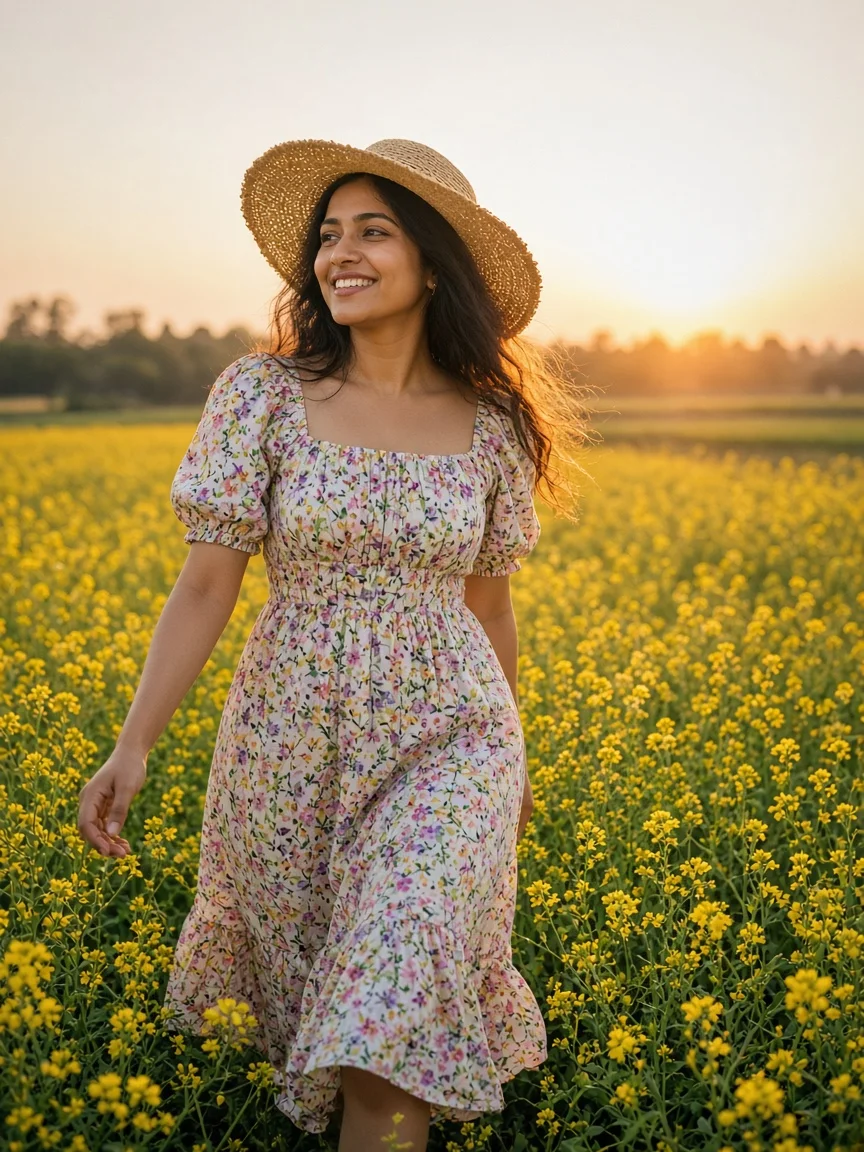
Short Dress Prompt for Gemini Girl: 10 Stylish Day-to-Party Looks
Ten short dress and midi dress prompts for Gemini girls with real results: mustard field sundress, Delhi brunch tea dress, Pondicherry shirt dress, Bengaluru blazer dress, Mumbai rooftop velvet, birthday sequins, Goa tiered dress, haveli fit-and-flare, satin studio look and sangeet anarkali dress, plus silhouette and styling tips.
Nancy · · 16 min read
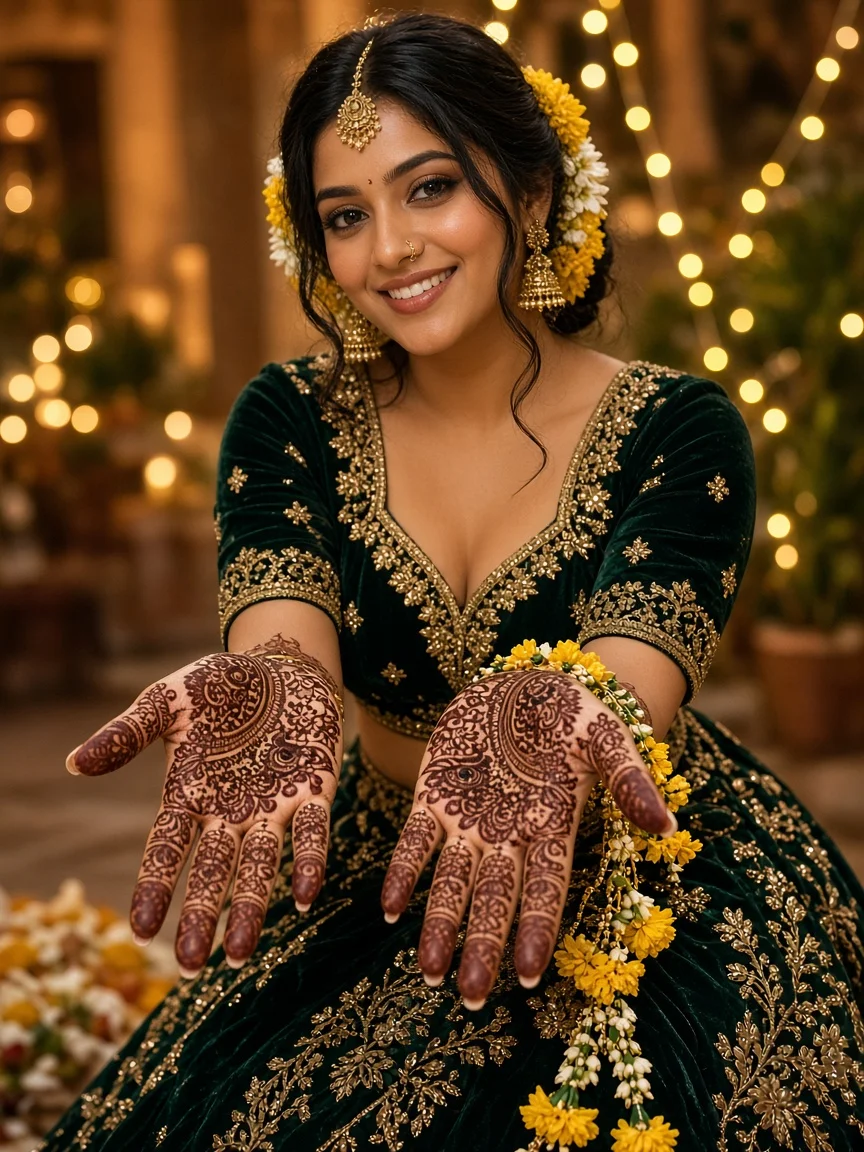
Mehndi Prompt for Gemini Girl: 10 Bridal & Festive Henna Photo Ideas
Ten mehndi prompts for Gemini girls with real results: green velvet bridal palms, marigold swing with wet henna, artist close-up, minimal mandala, friends circle, bridal feet, Rajasthani dulhan, Arabic rose henna, Teej leheriya swing and the morning-after stain, plus henna styles, hand fixes and safety tips.
Nancy · · 17 min read
Garba Prompt for Gemini Girl: 10 Chaniya Choli Portrait Ideas
Ten garba prompts for Gemini girls with images: Kutchi mirror-work dandiya hero, full-circle ghagra spin, Patola stepwell, black Rabari, Bandhani clap, Ajrakh courtyard, village brass pot, pastel organza, garbo diya aarti and velvet latkan back glance, plus a textile dictionary, face-lock steps and fixes.
Nancy · · 19 min read
Gemini Radha Rani Prompt: 10 Copy-Paste AI Photo Ideas for Instagram
Ten copy-paste Gemini Radha Rani prompts with images: Nilambari lotus pond, Barsana jharokha, Kadamba bansuri, Jhula Utsav, gopi chandan shringar, Mor Kuti peacock, Yamuna aarti, ghoonghat close-up, Phoolon Ki Holi and Sharad Purnima, plus shringar, Braj settings and own-face tips.
Nancy · · 16 min read
Comments
No comments yet. Be the first!