Rajputi Poshak Prompt for Girl: 10 Free Royal AI Ideas
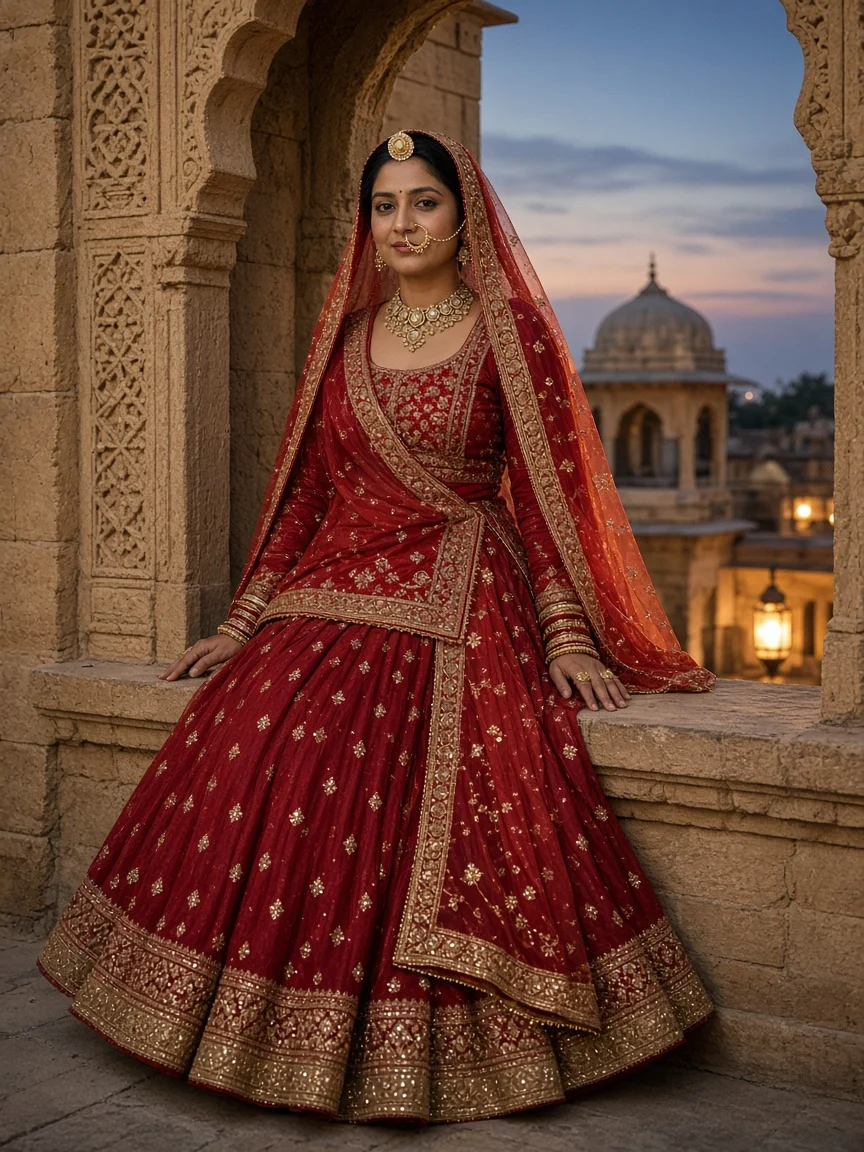
Table of contents
- Ten Rajputi Poshak prompts for an adult Indian woman’s portrait
- Start with the face you are allowed to use and the garment you want to show
- Crimson and Gold at an Amber Jharokha
- Rani Pink Aarti in a Palace Courtyard
- Build clothing and jewellery prompts in a controlled order
- Emerald Danka Above a Still Udaipur Lake
- Kesariya Bandhani Against Jodhpur Blue
- Peach Ghoonghat Framed by Sandstone
- Light ivory, bright yellow and stone without burning out details
- Sunshine-Gold Gota on a Heritage Swing
- Ivory and Antique Gold at Twilight Aarti
- Turquoise and Silver Across Jaisalmer Dunes
- Keep the bridal and dance interpretations technically honest
- Vermilion Bridal Detail with Borla and Nath
- Ghoomar Turns Inside a Marble Courtyard
- Adapt the same prompts for ChatGPT without copy-pasting Midjourney flags
Ten Rajputi Poshak prompts for an adult Indian woman’s portrait
This Rajputi poshak prompt for girl guide is written for adult women who want Rajasthani-inspired heritage portraiture from their own permitted photographs. The ten original prompts describe crimson at an Amber-style jharokha, rani-pink aarti, emerald above an Udaipur-inspired lake, kesariya Bandhani in Jodhpur, a peach ghoonghat, yellow on a haveli swing, ivory at a twilight terrace, turquoise over desert dunes, a vermilion bridal close-up and a maroon Ghoomar turn. Use them in Gemini, ChatGPT or a suitable image editor that accepts references. Each card concentrates on the garment, a real pose and readable items of adornment.
The underlying search phrases Rajputi poshak prompt for Gemini in English, Rajasthani poshak prompt for Gemini girl and Rajasthani look prompt free are reflected here as free, copyable English text. No wording guarantees exact construction, face identity, historical perfection, clarity or virality. A “raw” or “8K” instruction cannot certify genuine handwork or a physical eighty-panel skirt. Generated motifs and jewellery are visual approximations, not an appraisal of authentic heritage crafts. Ask someone familiar with your family’s clothing choice to confirm the look if a culturally specific event matters.
Common contemporary Rajputi poshak styling distinguishes a flared ghagra from a fitted kanchali, an additional kurti worn above it and an odhani as veil. Lengths, corner arrangements, wedding conventions and colours vary across communities, households and eras. Naming four pieces helps a model preserve that separate structure instead of substituting any generic lehenga, but a rendered kurti hem or sheer crossover still needs inspection. If your own tradition has a different arrangement, adapt the prompt to it rather than treating an AI diagram as the definition.
Start with the face you are allowed to use and the garment you want to show
Use a clear single-person permitted source with an unobscured hairline, jawline, eyes and hands. Adornment-heavy scenes amplify occlusions and reference ambiguities, so a beauty-filtered late-night selfie can be a poor match. A low-resolution close face might be adequate for a peach veil crop, while a full-length twirl needs a clear body silhouette or pose reference. Keep the original at maximum sensible resolution and do not rely on an AI tool’s upgrader to restore identity; extreme portrait claims are just prompts.
Choose who is meant to wear the outfit. For an adult bride, only use her reference where she has agreed or you are editing your own image. A festival model in a cream poshak need not suddenly become a bride because the Odhani has covered her hair. The royal bridal version is intentionally separate, and you should explicitly say adult bride or adult non-bridal model. Age references should stay realistic; convert none of these to a child or suggest a minor bride just because the search phrase says girl.
State location as inspiration if no place-specific photographic reference exists. A mass-produced view labelled Amber Fort or City Palace cannot establish an accurate architectural reproduction; it is an editorial setting. Do not confuse a generated journey with a genuine visit in captions. If you own reference photos of a known haveli or jharokha you may use them where the tool allows, confirm how it handles them, and keep recognisable other visitors out of the portrait unless they have consented.
Crimson and Gold at an Amber Jharokha
Twilight gives crimson and sandstone a promising contrast, but heavy decorative sources should not erase the eyes. Ask for an actual broad neutral illuminant, because a real illumination argument matters more than another “royal masterpiece” phrase. The person’s hands should rest on the window sill without a newborn duplicate finger or warped jewellery. A central Borla and round nath are distinctive searches, but generated output must be compared to trusted garment photos rather than enumerated in the article as proof of authenticity.
Frame the body widely enough to show the relationship between ghagra and outer kurti while keeping the architecture quiet. The odhani’s border should end in a stable place on a shoulder rather than disappearing across the chest like random lace. If the kanchali and kurti incorrectly merge into a plain blouse, return to the original and repeat the four garment labels in the same order with only necessary pose notes. Simplicity in camera framing can help more than piling on keywords.
Using my permitted adult Indian woman’s clear daylight reference, create a photorealistic Rajasthani heritage portrait in a carved sandstone jharokha reminiscent of Amber Fort at twilight. Preserve my recognisable face, natural age and warm brown skin. Dress me in a traditional four-part Rajputi poshak: crimson flared ghagra, fitted embroidered kanchali, sleeveless hip-length kurti layered above it, and a sheer translucent odhani with a gold gota-patti border pinned over my hair and falling across one shoulder. Add a round golden Borla at the centre of the hair parting, a refined circular Rajasthani nath with linked pearl chain, a Kundan-inspired aad choker, one bajuband and a simple hathphool. The jewellery must sit separately from facial skin and cloth. Warm lantern light stays behind me while soft neutral fill protects facial detail and crimson fabric texture. The sill supports naturally resting hands without stone intersecting them. Elegant non-bridal heritage portrait, vertical 3:4, readable textile and architecture, no text or watermark.
Rani Pink Aarti in a Palace Courtyard
A thali is a horizontal supporting object, not a square painting balanced by one finger. Ask for two hands at its sides and keep a physical distance from the transparent odhani and kanchali. One sensible contained diya creates a readable focal point; scores of near-camera lights often produce overly stylised, orange-flat skin. Some reference photos or real scenes will differ in priestly or domestic ritual practices; match the family’s aarti instructions rather than treating the picture as a universal celebration plan.
The pink fabric should remain rani pink under warm fill, not change into unrecognisable scarlet unless you intentionally choose that result. Small mirror-work reflections belong to the embroidery area and should not multiply onto a golden Borla or into a person’s teeth. Carry out a visual check of hands, supported lamp and jewellery chain, and make sure the selected output has not implied flame stays safely on the thali just because it was requested. In real staging, keep combustible fabric away and use an adult handler.
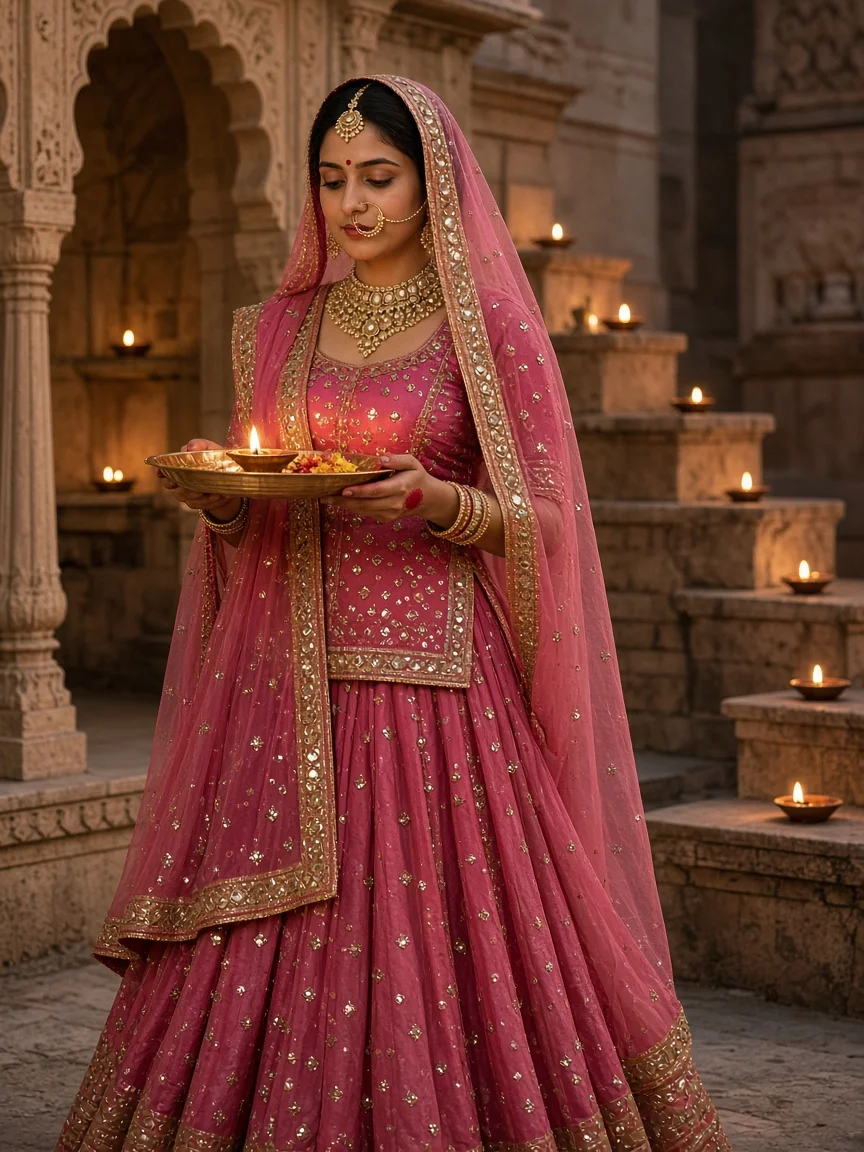
Create a realistic palace courtyard aarti portrait from a permitted photo of an adult Indian woman, retaining face, age and natural complexion. Her rani-pink Rajputi poshak comprises a flared ghagra, fitted kanchali, hip-length kurti and fading sheer odhani with intricate gold gota-patti borders and small real mirror-work reflections. Include a faithful small circular Borla, fine aad choker and modest nath that does not hide the mouth. She supports a broad metal aarti thali in two anatomically correct hands at waist height with a small diya safely inside the rim and a few marigold petals on the metal; odhani and fingers stay clear of flame. Warm environmental dusk and soft neutral face fill keep pink fabric distinct from skin and brass. Place a few stable oil lamps on distant courtyard ledges rather than floating hundreds of fire dots. Formal non-bridal evening visual, 50mm photographic feel, vertical 3:4, no text or watermark; do not claim the lights prove fire-safe staging.
Build clothing and jewellery prompts in a controlled order
Begin with the four garment components in order from lower to upper: flared ghagra, fitted kanchali, hip-length kurti and sheer odhani. Then choose cloth and finish: satin for soft luminous fall, velvet for depth and thickness, georgette for a more fluid skirt, cotton-like or tie-dyed Bandhani where appropriate. A border called magji in your styling vocabulary may be important to show at the hem. AI cannot confirm real zari or handwoven textile: you are instructing appearance not declaring a material certification.
Gota-patti, zardozi and danka or dabka are distinct craft vocabulary with differing common meanings and treatments. Avoid combining every technique as thick shiny blobs along every seam. For one garment, specify the place: gold gota-patti border on odhani, silver zardozi front motifs on turquoise kurti, golden danka-style detail on emerald velvet kurti. Trusted references and artisan or wearer knowledge are needed if you want to teach what an authentic piece actually is. The editorial instructions here intentionally say “inspired” where exact materials are impossible to know.
Borla, aad, nath, sheeshpatti, bajuband and hathphool occupy different regions of the face, neck, upper arm and hand. Place each relative to anatomy rather than stacking vague majestic accessories. A Borla is not a necklace and a nath’s chain must not wrap around both ears. Many terms can produce clutter, so a non-bridal scene often needs only headpiece, choker and a modest nath. Family preferences and comfort matter more than a generated arrangement.
Emerald Danka Above a Still Udaipur Lake
For this full-length scene, velvet and satin need different lighting responses. The kurti can absorb richer directional highlights while a satin ghagra shows broad clean folds and gold border. Keeping both emerald allows the white marble setting to maintain contrast. A lone aad and small round headpiece leave more room to assess the façade and actual face. A person cannot hold one hand in the marble while appearing to stand beside it, so check feet clearly and keep reflections physically consistent.
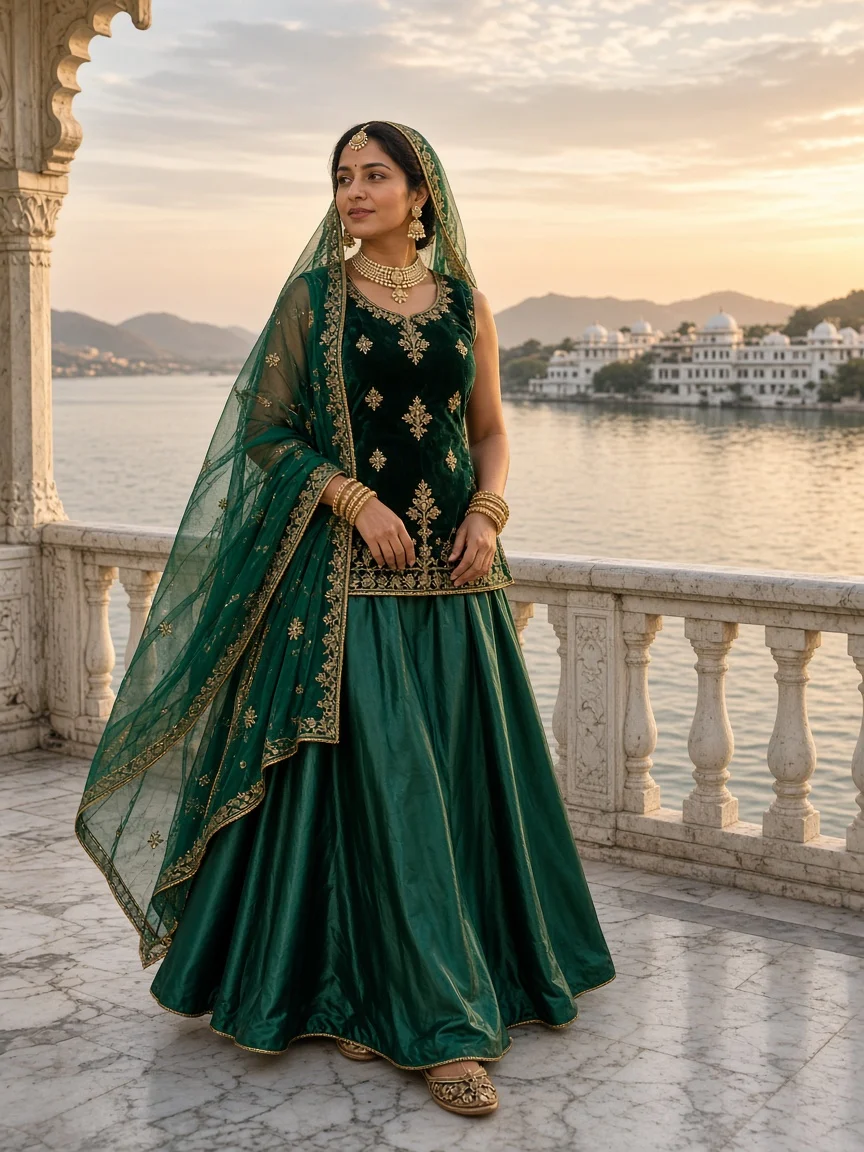
Generate a full-length adult Indian Rajasthani woman’s portrait from my authorised reference on a white-marble lakeside terrace with a calm Udaipur-inspired panorama at golden hour. Her identity and medium-brown skin must remain recognisable. Style a rich emerald Rajputi poshak: flared satin ghagra with a broad golden magji border, fitted kanchali, a sleeveless waist-to-hip velvet kurti carrying gold danka-style embroidery and zari edging, plus a sheer green odhani pinned to hair and lightly draped over one shoulder. Add a small pearl Borla and balanced aad-like choker visible against the kurti neckline; omit redundant large bridal necklaces. Her feet and clothing rest naturally on the terrace rather than appearing to float. Soft golden rim illumination meets broad neutral face fill, calm water and carved archways remain restrained in the background, actual velvet pile and satin folds, full-body perspective, vertical 3:4 heritage editorial, no readable signs, brand names or watermark.
Kesariya Bandhani Against Jodhpur Blue
Bandhani’s fine point-like pattern can become random oversized floral circles unless the prompt specifies small resist-dyed dots and their controlled distribution. A silver-border treatment fits this brief without calling all silver accessories spuriously traditional. A brass mirror should have one handle and only one appropriately positioned reflection if its front is visible. Holding it at hip height avoids an accidental reflected duplicate face and keeps identity anchored in the rooftop portrait. Strong blue and orange colours can coexist without becoming overprocessed if skin stays neutral.
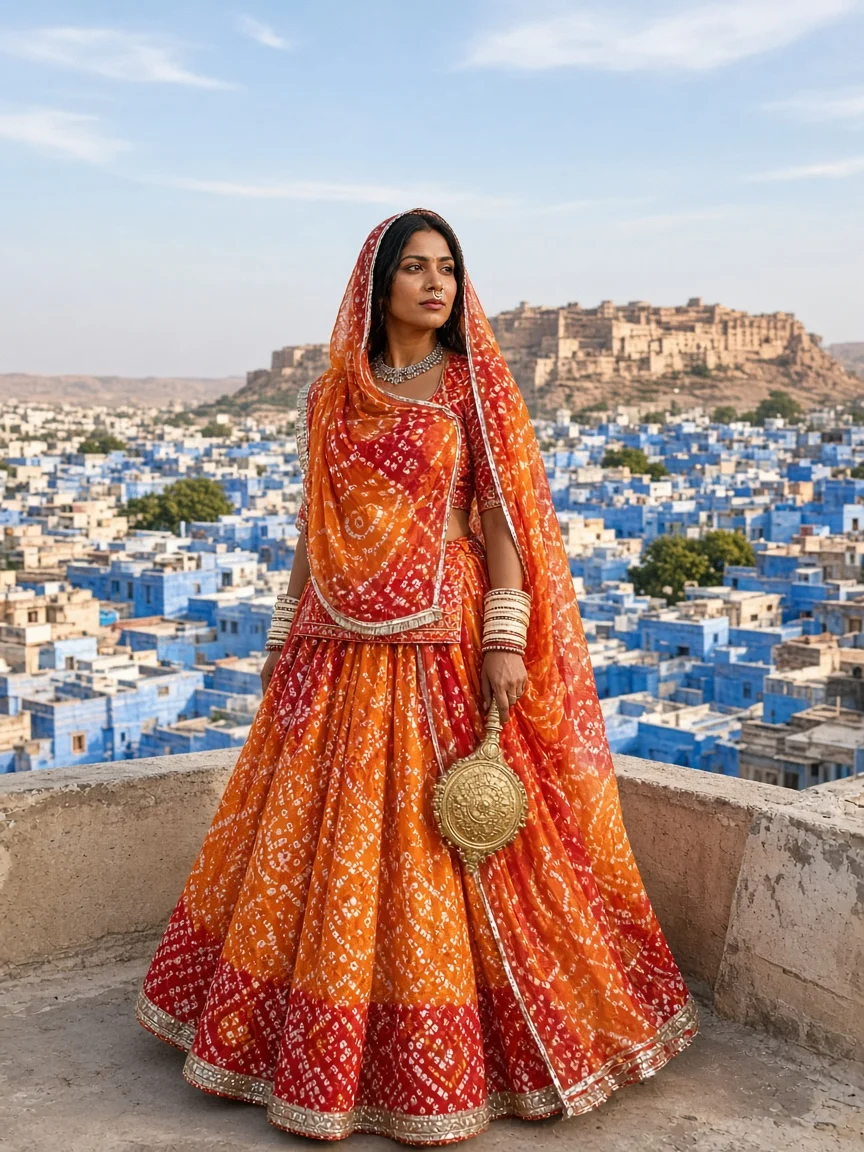
Using my permitted adult Indian woman’s face reference, create a crisp rooftop portrait with a softly detailed panoramic blue-city backdrop inspired by Jodhpur beneath clear desert daylight. Dress her in kesariya saffron and red Bandhani tie-dyed ghagra mixed with small tasteful white resist-dye points and a silver gota-kinari border. Layer a fitted kanchali beneath a hip-length patterned kurti and a fine matched sheer odhani with flowing edge; retain the distinct Rajputi poshak construction instead of converting it into an ordinary modern lehenga. Style a timaniya-inspired choker, a neat circular nath and ivory-coloured traditional bangles, checking each item against my supplied clothing preferences. She holds a simple carved brass hand mirror naturally by its handle at hip height with accurate fingers. Soft directional sun on textile and neutral face illumination preserve warm skin tone; legs, feet and rooftop parapet positions are physically plausible, vertical 3:4 travel-fashion photograph, no logo, writing or watermark.
Peach Ghoonghat Framed by Sandstone
The odhani should behave as translucent fabric, not an opaque screen over the entire face. If you want expression to remain recognisable, request a lifted corner framing the cheeks instead of full coverage. One high-contrast ring near an eye can produce strange duplicated eyes or merged pearl-shaped highlights, so crop the nath faithfully to one side and allow the face a clean area. Warm transmitted light through peach cloth should be supported by a soft natural frontal source. Look at the eye and chain edges closely at final size.
This is one of the easiest concepts for a low-resolution reference because the crop is limited, but it can put the entire face behind materials that hide the original. If the result resembles generic stylised royalty more than you, give priority to preserving your eyes instead of more text about fine jewellery. The related Onam saree prompt guide shows how transparent textile and a distinct border can be discussed within another specific cultural occasion. Do not mix that garment vocabulary with Rajasthani dress just because both use gold borders.
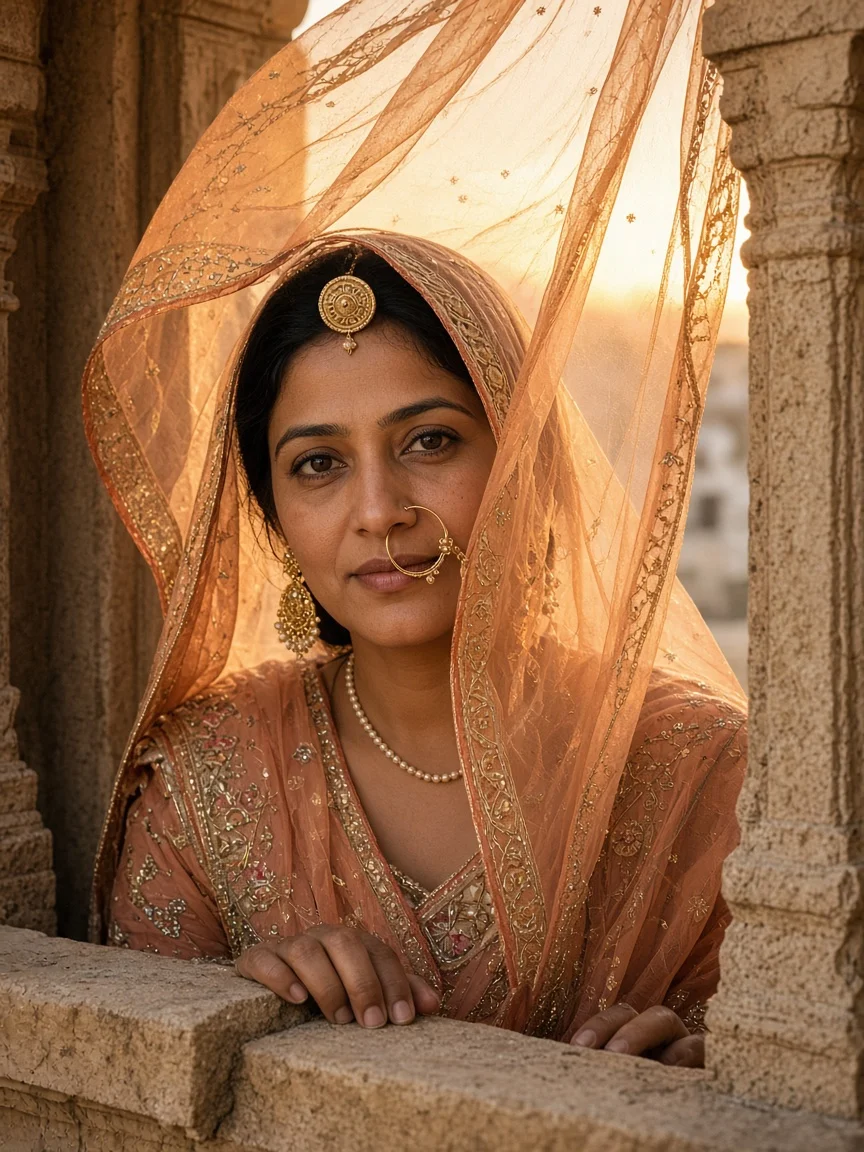
Create an intimate heritage close-up using my authorised adult Indian woman’s reference face, making her peach-and-gold ghoonghat reveal rather than erase recognisable features. She stands inside a carved sandstone jharokha at golden sunset. A translucent peach silk odhani gently frames her face, with some fabric caught by a soft breeze while eyes, nose, cheeks and actual identity remain clearly visible. Add a spherical golden Borla positioned at the middle hair parting, a traditional circular nath to one side with a thin pearl chain toward the hair and elegant Kundan-inspired earrings; jewellery must not merge into skin. Peach and gold embroidery appears on the visible fitted kanchali and kurti neckline and on the odhani border, with a full Rajputi ghagra continuing below the crop. Natural brown skin and expressive kohl-rimmed eyes, small real skin pores, relaxed fingers resting on the stone sill. Warm backlight on veil combined with gentle frontal fill, vertical 3:4 photographic portrait, no additional face veil, duplicated nath, lettering or watermark.
Light ivory, bright yellow and stone without burning out details
A yellow swing image benefits from morning light that reveals the border without turning the entire garment into a luminous slab. Shadows beneath a supported jhoola indicate weight. Keep its chains taut, the seated body in the seat and garlands comfortably outside the hand area. Cotton versus silk should be reflected in fabric rather than incorrectly pasted onto wood or skin. If yellow clothing loses a border against sunlight, choose shade fill or a change of source rather than heavier artificial sharpening.
Ivory carries a narrower exposure range before visible weave disappears. Cream background, skin and a gold thali need separation at the neck and forearm lines. Blue or purple twilight may gently appear in the far sky, but strong colour gradients across the person will alter the intended ivory. Soft neutral lighting is preferable to adding many glow tokens. Aarti flame and its reflection should remain local and modest, with the veil clearly away from the fire and behind no false promise of safety.
The broader Diwali AI photo guide is useful for twilight-lamp composition but has many family and celebration scenes outside the scope of this Rajasthani clothing collection. For deep crimson heritage material plus romance, wedding anniversary prompts for couples can inform a wholly different two-person shoot. The line to keep clear is who the portrait represents, what occasion is being styled and whether the model has permission to reproduce the involved faces.
Sunshine-Gold Gota on a Heritage Swing
A still swing seated pose is simpler than an airborne veil and a walking turn, so it is a good full-length test before Ghoomar. The skirt naturally pools over the lap, its long border ends in visible folds and the kanchali sleeve continues under the arms rather than ending at the shoulders. Two hand grips should each correspond to one chain with human wrist joints. If the floral garlands attach to sleeves, reduce their number and ask for specific cleared hand rests. No motion guess needs to be introduced.
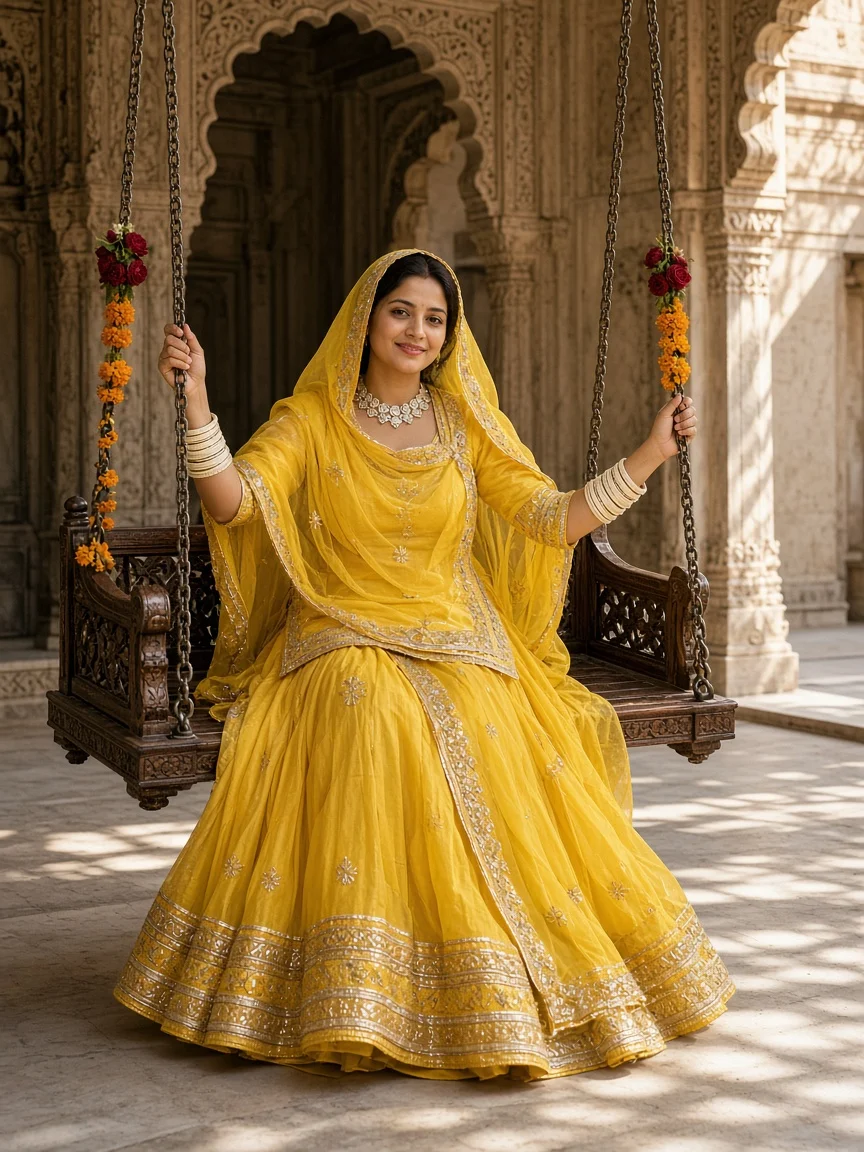
From a permitted adult Indian woman’s photo, generate a bright morning heritage portrait of her seated securely on a carved wooden jhoola inside a quiet haveli courtyard. Her sunshine-yellow Rajputi poshak has a full flared ghagra, fitted kanchali, hip-length kurti and matching sheer odhani, all properly supported by the sealed seat and gravity, highlighted with fine gold gota-patti artwork. Style a modest Kundan-inspired aad necklace, ivory-tone chuda bangles and one unobtrusive hathphool while retaining natural proportions and skin colour. One or two orange marigold garlands with a few red roses rest around the upper chains safe from hair and fingers. She holds the chains with anatomically clear hands and smiles gently, joyous rather than bridal or toylike. Soft direct morning sun and open shade retain nuanced yellow fabric and human complexion, architectural background and scene perspective correct, vertical 3:4 family-festival editorial, no printed script or watermark.
Ivory and Antique Gold at Twilight Aarti
Try a full-length frame with a safe high back balustrade rather than near-edge dramatic posing. The thali sits at waist height so its reflection warms part of the front but not the whole head. Golden motives can retain a worn antique character when brightness is controlled; “heavily royal royal” tends to make them polished blobs. Feathery gauze needs to stay thin, while the kanchali and kurti should look as though they occupy real layers rather than interpenetrating on the torso. Inspect stable feet and supported props in the final rendered result.
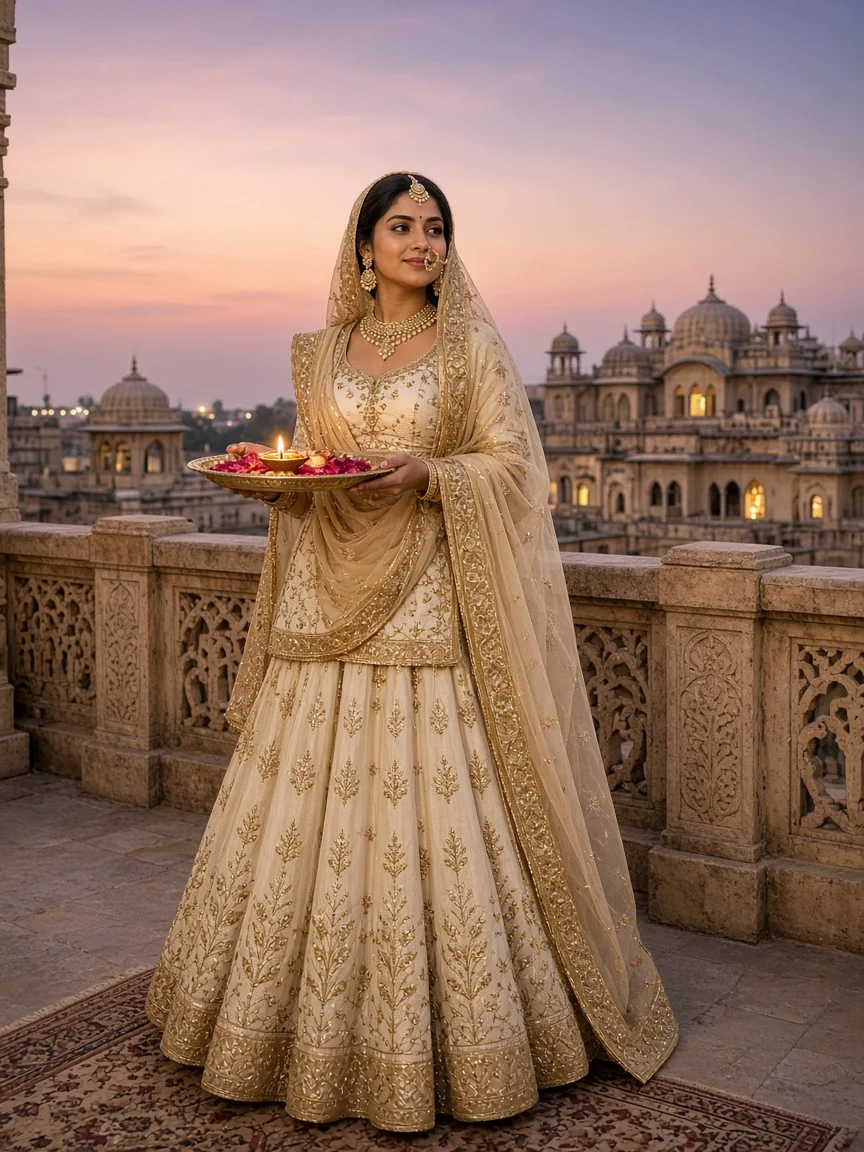
Edit my permitted adult Indian woman’s reference into an elegant aarti portrait on a sandstone palace terrace under a soft peach, pink and lavender twilight sky. Preserve her recognisable face and natural warm undertones. Dress her in an ivory cream-and-antique-gold Rajputi poshak with flared ghagra, fitted kanchali and hip-length kurti decorated with proportionate gold embroidery, plus a sheer odhani whose coloured border remains translucent cream instead of turning metallic. Add a rounded pearl Borla, fine traditional aad choker and modest nath. She holds a wide stable brass thali with both hands at waist distance from the veil, containing rose petals resting on its base and one small lit diya that never reaches hand or clothing. Neutral ambient lighting keeps face and cream fabric distinct from the warm diya; sculpted balustrade and palace domes beneath a restrained twilight sky. Full-length vertical 3:4 photorealistic cultural editorial, no typography or watermark. Do not equate styled image with safe live-fire handling.
Turquoise and Silver Across Jaisalmer Dunes
A desert portrait needs readable environment and clear stance rather than dangerous sweeping fabric across the eyes. Let the wind flow along one direction in odhani folds while its head anchor remains fixed. Golden dunes should reflect a little ambient warmth without turning natural skin yellow or crisping the pastel turquoise into a gradient abstraction. Camel and human silhouettes in the far distance establish scale. Individual feet can be hidden by dunes only if the stance remains possible; normally one small sand contact cue is enough.
Desert layering is often not ideal outdoor weather attire, so an illustrative interpretation should not be mistaken for a real trekking recommendation. Actual desert shoots require sun protection, local permission, suitable heat and hydration planning, and careful environmental respect, none of which an image generator can provide. If the real exposure is physically unsafe, skip the shoot and create a disclosed composite instead. For ethical creative practice, do not dress an unfamiliar real person in culture-specific clothes from public photos without their consent or a clear lawful purpose.
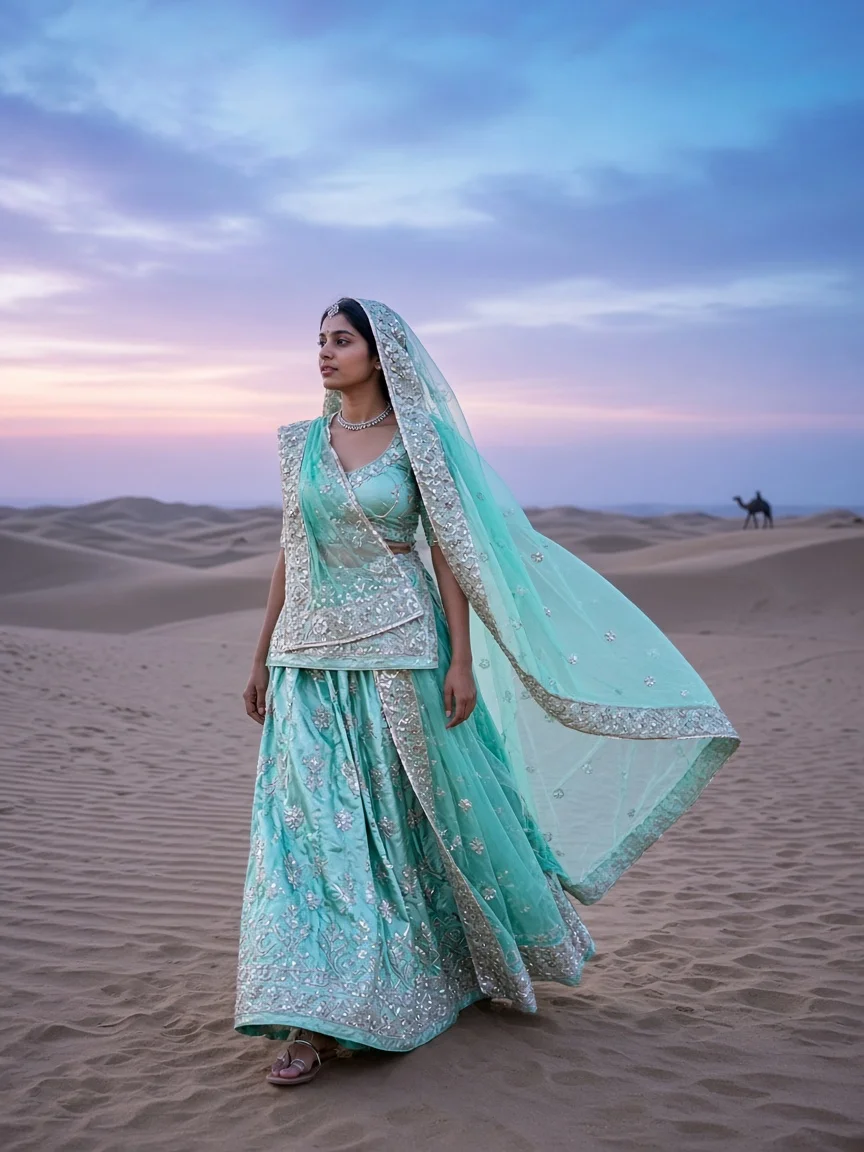
Create a quiet cinematic desert portrait from an authorised image of an adult Indian Rajasthani woman standing on smooth compact sand at the edge of flowing Thar-style dunes near Jaisalmer at twilight. Preserve individual facial likeness and natural adulthood. She wears a pastel-turquoise Rajputi poshak with three visible main components: flared silk ghagra, fitted kanchali beneath a sleeveless hip-length kurti, and translucent odhani lifted modestly by an evening breeze. Intricate restrained silver zardozi motifs trace the front and a substantial silver magji hangs naturally near the border. Include a restrained traditional aad and small Borla; let soft lavender and dim golden horizon light meet neutral face fill without making skin blue. Textile weight, feet sinking only slightly into sand and odhani fixed at hairline appear physically realistic. One faraway camel and handler silhouette establishes scale without competing with the person, vertical 3:4 fine-art fashion photograph, no text or watermark.
Keep the bridal and dance interpretations technically honest
Solah shringar usually refers to a traditional collection of bridal adornments; the exact jewellery and practices depend on region, community and household. This guide cannot authenticate a “complete” royal arrangement just by naming ornaments inside a prompt. Borla, aad and Nath placement has render-quality guidance, but a real bride’s preference and expert help should lead actual wedding dressing. Asking a model for gold, Polki, Kundan or antique heirlooms describes an intended surface appearance and never establishes a jewel’s composition or value.
The Ghoomar scene needs a natural veering skirt, not literally a woman rotating unnaturally through every body axis. “Turn” and “spinning” describe motion; an “80-kali” mathematical construction or an exact 360-degree body rotation in a still picture may yield duplicated legs or skirt slabs. A sane approach is one turning step with broad cloth, recognisable torso and two appropriately posed arms. A respectful cultural interpretation does not involve making physical claims about dancer expertise from a borrowed face photograph.
For traditional portrait transfer, use neutral direct wording such as “preserve the authorised adult reference woman’s eyes, jaw and natural age,” then the four garment parts. Compare skin against the unedited original and choose only a result with realistic jewellery anchoring. This source’s bridal phraseology is not an invitation to invent a marriage, claim tradition certification or reassign identity. Captions should clearly distinguish wedding editorial or AI styling from a document of a wedding that occurred. A new, earlier Bhai Dooj sibling prompt guide instead keeps home ceremonies and adult sibling identity at its centre.
Vermilion Bridal Detail with Borla and Nath
The bridal close-up is intentionally jewellery-rich. The chain should approach the ear along a natural path, the Borla stay at the hairline rather than stand on the tip of the nose, and the necklace lie separate from the kurti’s embroidered neckline. A responsibly described generated export is “Rajput bridal-inspired AI portrait” if that accurately reflects the scene—not certified Rajput bridal documentation. Avoid material claims about “pure” stone or thread in the caption, since they are not verified by pixels.
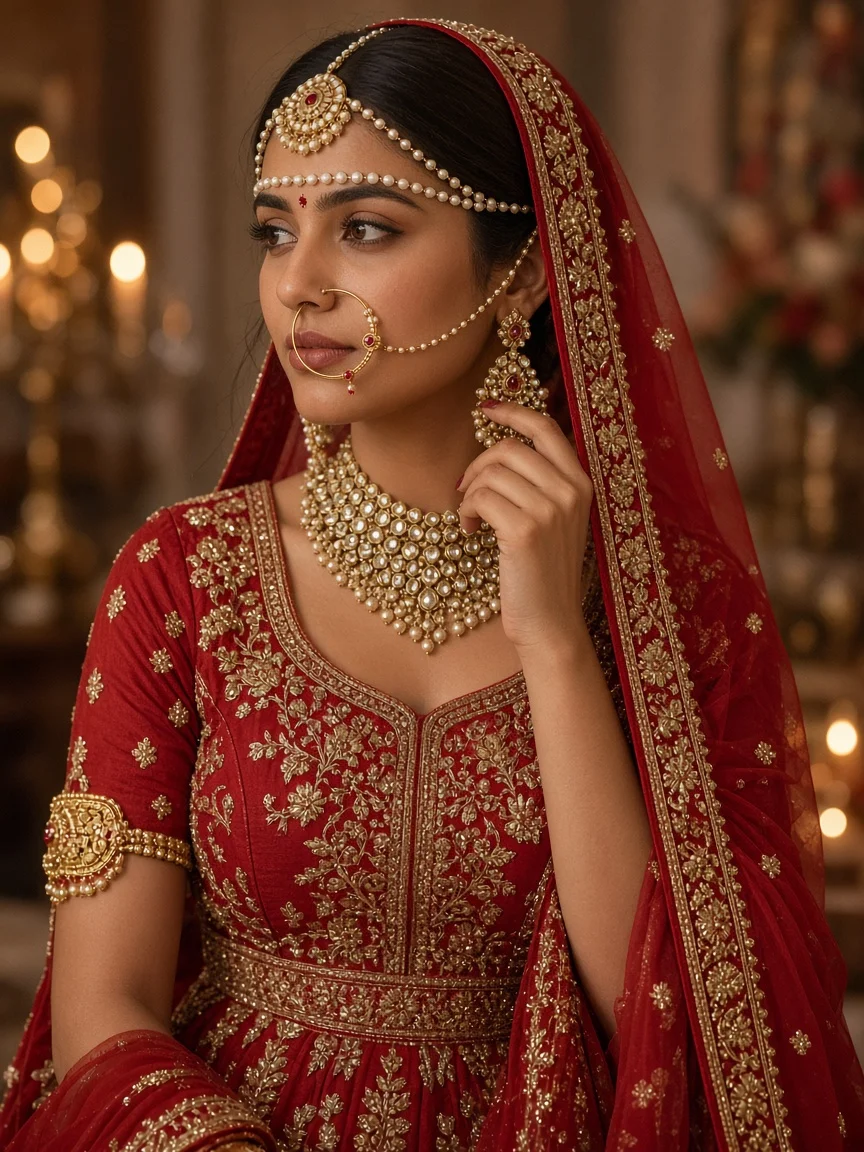
Using the authorised reference of the adult Indian woman I am the real bride or have permission to portray, create a detailed Rajput bridal editorial in a traditional deep-vermilion Rajputi poshak. The flared ghagra below the frame supports a fitted kanchali with sleeves and a richly embroidered kurti; dark golden danka, fine zardozi and gota-patti work are visible along the odhani border without metallic-textured skin. Arrange bridal adornments deliberately: centre-hairline round Borla, pearl sheeshpatti following its proper hairline, traditional aad necklace sitting near the collarbone, large circular nath with pearl chain toward ear, one gold bajuband above the right forearm, and natural earrings connected at plausible anchor points. Retain recognisable face and real bridal age, expressive kohl-lined eyes and individual brown complexion, warm intimate soft light with discrete distant diya-style bokeh rather than lit fire near face. Accurate hand anatomy touching an earring, vertical 3:4 close-up, no claim about authentic precious materials, no text or watermark.
Ghoomar Turns Inside a Marble Courtyard
Use “natural fabric arc at a single turn” rather than stacking camera-flash, freeze-frame and cinematic verbs. A broad border can be shown across the spinning skirt while the fitted torso stays recognisable. Check the two wrist paths, ankles and attachment of payal; jewellery should not scatter from the exposed foot into floor patterns. The panel count is irrelevant unless actual knowledge and garment construction require otherwise, so no unsupported count in this prompt. If multiple skirt layers look physically impossible, reduce flare and accept a smaller but truthful shape.
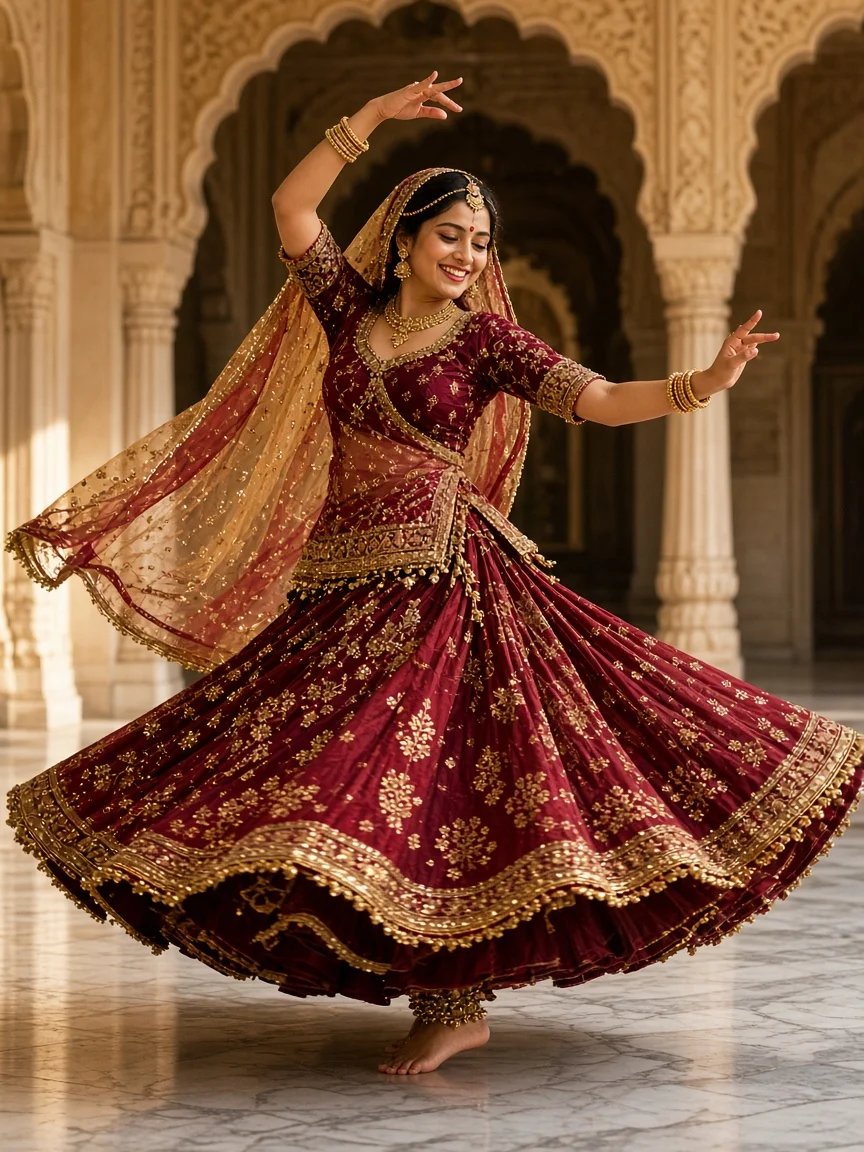
Create a dynamic full-length photograph using a permitted adult Indian woman reference performing a traditional Ghoomar-style turn in an airy palace marble courtyard. She wears a maroon-crimson Rajputi poshak including a deeply flared ghagra, fitted kanchali and hip-length kurti, with a sheer pale-gold dotted odhani moving in a modest arc above one shoulder while remaining attached to head and not masking her face. The ghagra opens into a broad natural spiral revealing its golden gota-kinari magji, rich hems and physically plausible fabric folds, rather than growing duplicate skirts or masking her feet. Provide a small Borla, aad choker, one bajuband and glimpsed traditional payal that does not distract from movement. Separate realistic arms and hands form an easy turned dance pose; face and natural brown skin remain recognisable as the reference person. Warm side daylight plus gentle neutral fill, freeze fabric without freezing every expressive movement, realistic floor reflections and stone arches, vertical 3:4, no literal 360-degree body distortion, no text or watermark.
Adapt the same prompts for ChatGPT without copy-pasting Midjourney flags
Gemini and ChatGPT interfaces evolve and available image-upload, editing and reference behaviours depend on the current product. Read these as natural English prompt bodies rather than a promise that “--ar 3:4” or “--style raw” works everywhere. Use the host tool’s actual portrait-ratio control, provide the source through its official upload workflow and describe the desired output explicitly. General non-copyable flags should not be included in caption text; they can go through an rendered result as an unreadable error.
The step workflow is simple: choose an authorised reference and scene, paste the entire prompt into the supported editor, and set the real available portrait ratio. Ask for one controlled result. Check it at normal and enlarged views against the reference, adjust only the single major facial or garment defect and regenerate from the original. If every new version gets further away, restore the original and simplify the environment before increasing jewellery or cinematic instructions. Never assume a published tool’s generic model title fixes old dataset errors.
Save the original alongside accepted output, source reference, exact prompt and any disclosure. One vertical master of every scene can supply a differently cropped mobile portrait and a print-like four-by-five if needed, but a tall phone wallpaper might require dedicated composing. Record the scene as Rajasthani-inspired if you cannot verify actual place markers. Keep personal photos within storage and sharing settings you understand, and consider that public posting by both you and the depicted person needs comfortable mutual understanding.
For more women-led cultural textile context, see Kerala Kasavu and Onam prompts and Diwali festive photo prompts. A one month baby girl photoshoot guide offers early-family portrait advice, not adult Rajasthani clothing direction. Good Rajputi poshak prompts build one visually coherent person through garment layering, art-informed adornment and restrained light. That is more useful than the superficial excess of royal adjectives and unearned authenticity guarantees.
Frequently asked questions
What garments should a Rajputi poshak prompt include?
Name a flared ghagra, fitted kanchali, hip-length or intended-length kurti, and a sheer odhani with its border and drape. Exact dressing, garment lengths, occasion and accessories vary by community and wearer. Add the number of pieces in a consistent order so the editor is less likely to reduce everything to a generic lehenga.
Can a prompt guarantee an authentic royal Rajputi look?
No. Visual terms can guide silhouette and adornment, but cannot authenticate handwork, jewellery, dress practice or a historic site. Use trusted textile and family references when accuracy matters and describe an output as inspired styling rather than traditional documentation.
How do I use Rajputi poshak prompts in ChatGPT or Gemini?
Upload a permitted clear reference only through a supported editor, paste the natural-English body and choose its current available aspect-ratio option. Do not assume Midjourney flags apply in another tool. Inspect identity, hands, garment layers and accessories on the generated result.
What is a Borla and where should it appear?
In this Rajasthani styling context, Borla describes the rounded forehead ornament placed at the central hair parting. It differs from a necklace and should not sit between the eyes. Familiar jewellery references and wearer guidance are best for confirming the particular variation and material.
Can I turn these prompts into a couple or a man’s portrait?
These ten are adult-women-focused. A separate couple or man prompt should define each person, differing garments and respectful interaction rather than simply changing “girl” to “boy.” Avoid inventing a real relationship or duplicating a bride’s face onto another adult without consent.
Which aspect ratio suits a Rajasthani poshak portrait?
The supplied pictures and briefs use vertical 3:4. It suits most half- and full-length outfit compositions, though a narrow phone wallpaper may benefit from a separately generated or cropped 9:16 composition. Use the editor’s available dedicated output-ratio setting where possible.
How can I stop the odhani and jewellery from hiding my face?
Use an unobstructed reference, ask for transparent framing rather than an opaque full-face veil, and anchor every jewellery item to its anatomical place. Strong broad face light helps. Compare eyes, nose, hairline and jewellery chain at enlarged view and remove unnecessary ornament instructions when identity drifts.
Is the bridal prompt suitable for a minor?
No. All portrayed subjects here are adults, and the bridal concept depicts only an explicit adult bride. “Girl” in the search-derived title is not an instruction to portray a child bride. Use only authorised references and never convert the bridal styling to a minor.
Related articles
Aesthetic Girl Photo Collage AI Prompt: 10 Layouts for Instagram
Ten aesthetic girl photo collage AI prompts with real results: streetwear with a B&W strip, haveli Polaroids, pastel photo booth, Y2K film strip, ivory-gold saree multi-frame, neon rain, book café, clean-girl grid, Pondicherry day-out and monsoon chai story, plus same-face and layout tips.
Nancy · · 18 min read
Eyes Prompt for Girl: 10 Aesthetic Close-Up AI Photo Ideas
Ten aesthetic eyes prompts for girls with real results: winged liner macro, golden hour half-face, kohl eyes over a dupatta, bindi calm gaze, over-shoulder glance, rain glass, smudged kohl flash selfie, lace shadow, single tear and classical dancer eyes, plus framing, catchlight, styling and face-lock tips.
Nancy · · 17 min read
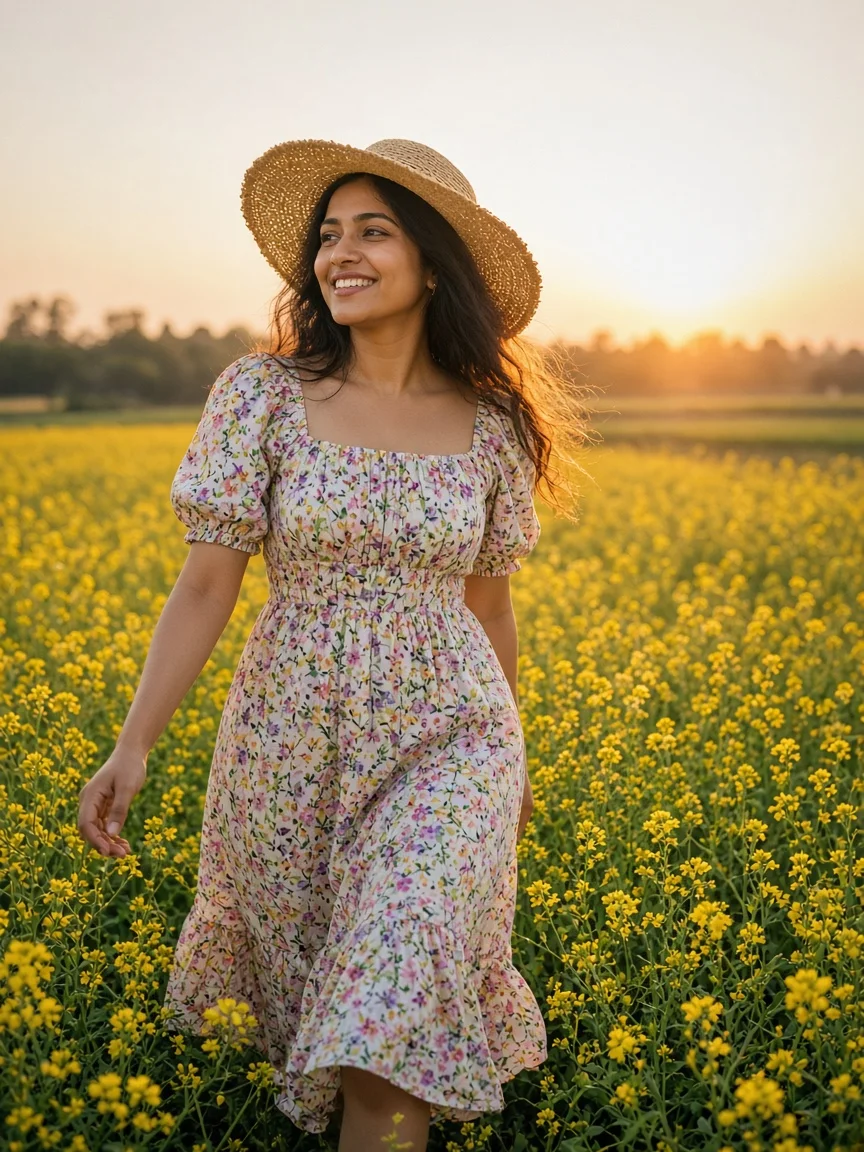
Short Dress Prompt for Gemini Girl: 10 Stylish Day-to-Party Looks
Ten short dress and midi dress prompts for Gemini girls with real results: mustard field sundress, Delhi brunch tea dress, Pondicherry shirt dress, Bengaluru blazer dress, Mumbai rooftop velvet, birthday sequins, Goa tiered dress, haveli fit-and-flare, satin studio look and sangeet anarkali dress, plus silhouette and styling tips.
Nancy · · 16 min read
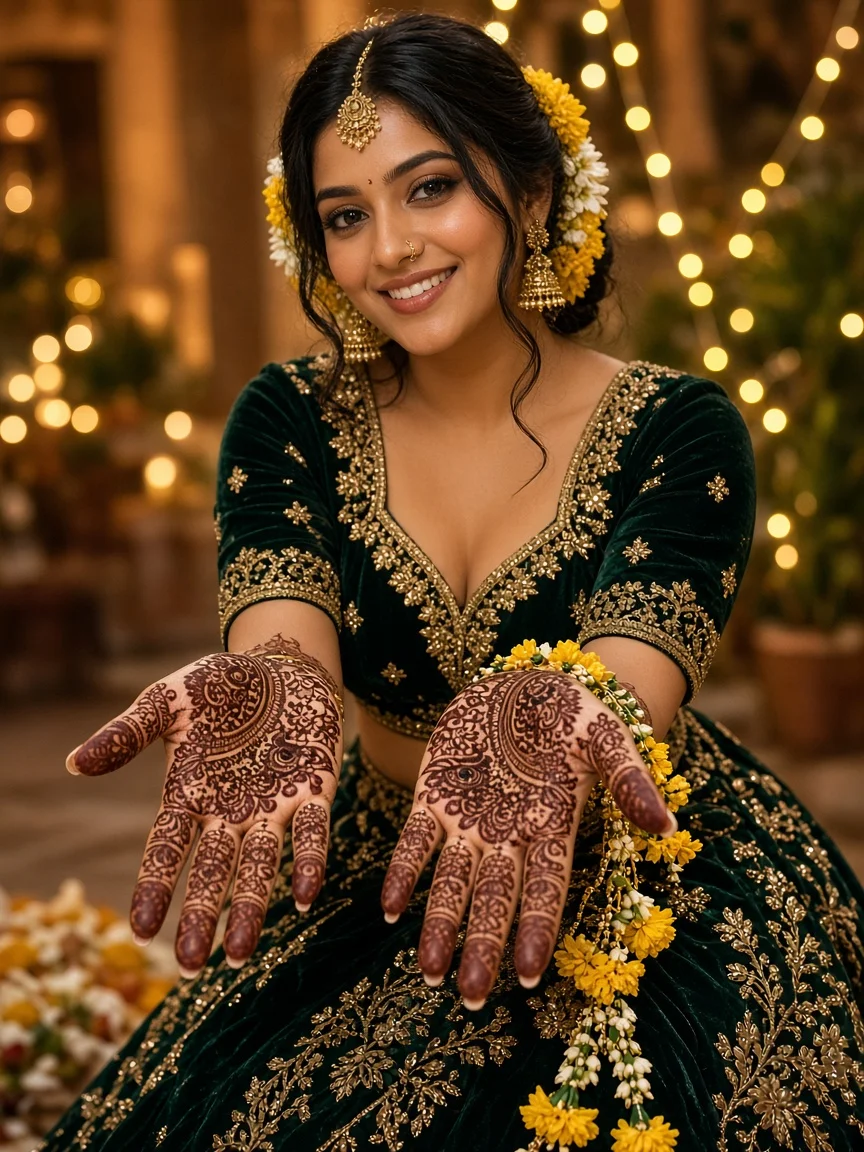
Mehndi Prompt for Gemini Girl: 10 Bridal & Festive Henna Photo Ideas
Ten mehndi prompts for Gemini girls with real results: green velvet bridal palms, marigold swing with wet henna, artist close-up, minimal mandala, friends circle, bridal feet, Rajasthani dulhan, Arabic rose henna, Teej leheriya swing and the morning-after stain, plus henna styles, hand fixes and safety tips.
Nancy · · 17 min read
Comments
No comments yet. Be the first!