Bhai Dooj Prompt Gemini: 10 Free Sibling Photo Prompts
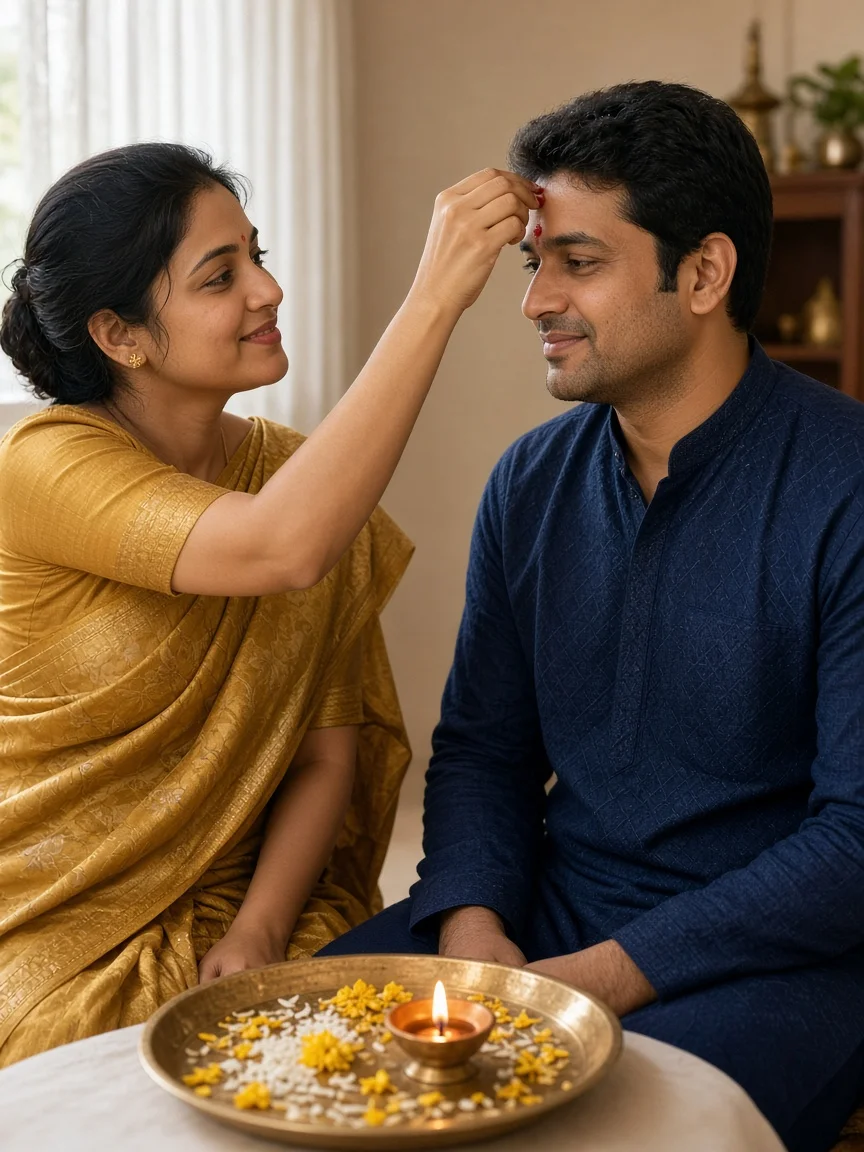
Table of contents
- A practical Bhai Dooj prompt Gemini guide for sibling portraits
- Give both references a role, a place and a reason to interact
- Vermilion Tilak and a Window-Lit Brass Thali
- A Candid Bite of Kaju Katli
- A Gift Box Shared Between Adult Siblings
- Direct and edit light without sacrificing natural skin
- Banarasi Blue in a Heritage Courtyard
- Bengali Bhai Phota with Chandan and Durba
- Prepare children’s images with permission and care
- Little Siblings and a Petal-Filled Flower Thali
- Choose a story tone: candid, contemporary or formal
- A Front-Camera Laugh After the Tilak
- Sage Organza and Tea at Twilight
- Crimson Banarasi and a Charcoal Bandhgala
- Diyas and Petal Rangoli on the Verandah
- Export, compare and caption your Bhai Dooj edit accurately
A practical Bhai Dooj prompt Gemini guide for sibling portraits
These ten original bhai dooj prompt gemini ideas focus on a relationship and a specific action rather than generic festive glamour. You can recreate a red-kumkum tilak with a brass thali, playful kaju-katli feeding, a wrapped gift and shagun envelope, blue Banarasi clothing in a haveli, Bengali Bhai Phota, two young children, a front-camera laugh, sage-coloured balcony styling, crimson silk with a bandhgala and an evening verandah of diyas and petal rangoli. Each complete prompt is accompanied by an independently created Indian-themed reference image and practical guidance on what to inspect.
The wording is free to copy or adapt in Gemini, ChatGPT or another image editor that can handle references, but generation access and limits belong to your own tool and account. We do not claim free unlimited generation, guaranteed virality, a particular model version, eight-kilopixel output or automatic face preservation. A resolution tag such as “8K” is not a face lock. Exact lens labels largely guide aesthetics; real control still comes from a sharp permitted photograph, separate role labels and a careful comparison of the result. The images are illustrative edits, not documentary proof of a celebration.
Bhai Dooj is also known through regional names and traditions including Bhai Phota, Bhai Tika and Yama Dwitiya. The occasion is celebrated with different home practices, foods, family roles and timing, so none of these scripts replaces instructions from an elder or the person leading your own ceremony. Treat the Bengali scene as a visual brief to check with your family, not as a promise that a single sequence of props guarantees cultural accuracy. If you are planning a portrait rather than restoring an existing memory, avoid implying that an edited palace or courtyard is an event you attended.
Give both references a role, a place and a reason to interact
Two-person editing needs more than “keep their faces.” Start with one usable image per person at similar distances and comparable daylight. Label reference A as the sister and B as the brother, then name place and action: sister on the left supports the thali; brother opposite reaches toward her. Distinct seating, shoulder positions and hairlines help the editor keep faces from mixing.
Avoid heavily shadowed or profile sources that require the model to invent unseen details. Do not upload ambiguous group photographs. Keep supplied images small in number and clearly labelled. Identify both people, then specify different hairstyles or jewellery instead of repeating identical accessories for each.
Prompt specificity works best when you prioritise the few things that create the desired picture. “Brass diya at the edge of the thali with flowers” is more actionable than a long run of luxury adjectives. Positive directions for window light, cotton weave or two distinct faces should precede a short rejection list. The ten examples here are intentionally complete enough to be copied, while the customisation notes explain what to change. If you are using only one joint reference, crop no one out and ask for the general layout rather than forcing separate-turn pose changes.
Vermilion Tilak and a Window-Lit Brass Thali
This first scene relies on the friendly asymmetry of mustard and navy. A diagonal gesture connects the sister’s hand to the brother’s forehead, while the low brass thali occupies the foreground. Keep the diya entirely supported within the rim of its plate, with rice and flower petals sitting on the metal rather than artificially suspended. Window daylight should remain more important than the tiny flame in the lit room. Overly red religious tilak that extends into eyebrows or across the nose weakens identity and the gesture, so use one small accessible mark.
Silk should retain weight at shoulders and laps, with a simple border rather than whole-body shimmer. Do not imply a second person resembles an authorised sibling when you supplied only one reference. Inspect fingertip-to-forehead contact closely; describe a single fingertip if that is your intended gesture.
Using two clear, permitted adult Indian references, create a natural Bhai Dooj photo at home. The sister, shown on the left in a mustard silk saree with a restrained golden border and small jhumkas, gently applies a small red kumkum tilak to her brother’s forehead. He sits opposite her in a navy silk kurta, face and age recognisable, with a warm sibling smile. Keep their individual facial geometry and skin colours unchanged and all fingertips anatomically separate. A low antique brass puja thali contains a diya firmly inside its rim, yellow marigold petals, a little akshat rice and a traditional mithai bowl. Soft window daylight balanced with subtle diya warmth, truthful woven fabrics, professional 50mm portrait look, vertical 3:4, no printed words or watermark.
A Candid Bite of Kaju Katli
Food introduces a simple moment of humour that should still look physically possible. One diamond-shaped bite is enough; multiple identical pieces in the fingers and mouth look manufactured. The sweet should lie outside the lips until the feeding action is captured, with the hand neither penetrating the face nor disappearing through a dupatta. Preserve the shape of both eyes during laughter and keep teeth anatomically plausible. You may adjust “kaju katli” to a sweet your siblings actually eat, with its shape and texture changed in the prompt as well.
An 85mm-style prompt is not a literal aperture setting. A closed tin and marigold doorway provide enough context without sacrificing faces. If the mood was recreated rather than photographed, do not imply a candid memory. Real feeding should be consensual and use a manageable bite.
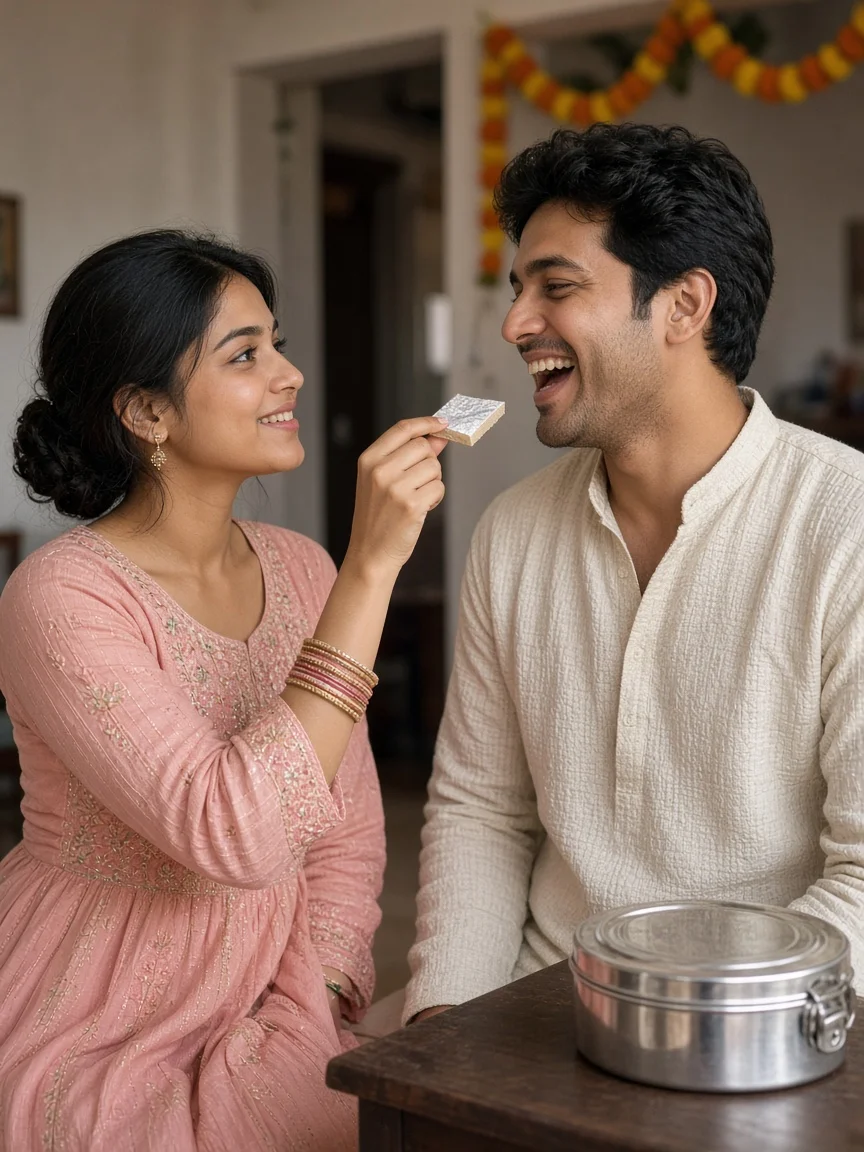
Transform my permitted photo references of an adult Indian sister and brother into a candid Bhai Dooj sweets moment. The sister wears a peach-pink thread-embroidered Anarkali and glass bangles, offering one small bite of diamond-shaped kaju katli with safe, believable fingers near her laughing brother’s mouth. He wears a textured cream kurta with minimal woven detail, holding one hand up in amused delight. Preserve both original identities and do not duplicate either face or feed sweet through his cheek. A marigold toran sits softly behind a familiar living room and a closed silver mithai tin rests on a side table. Bright diffused daylight, candid expression rather than studio posing, realistic mouths and hands, 85mm style with moderate background detail, vertical 3:4, no signage, watermark or forced text.
A Gift Box Shared Between Adult Siblings
Gift exchange works when the object is a shared weight between two sets of hands. Let the giver support the lower-left corner while the recipient holds one side and settles it into both hands. A shagun envelope can rest on a table in clear view rather than becoming an extra flat rectangle inserted through a thumb. If your tool supports a separate object reference, use it only for a real gift design you intend; proprietary logos, elaborate tiny calligraphy or printed serial numbers usually look wrong and add no emotional value.
Warmth should come from sincere slight smiles. Small mirror-work panels catch daylight without excessive shine. If the frame looks like a couple celebration, restore “adult siblings” and remove bridal elements or romantic head positioning. Both faces must remain visible as attention shifts to the gift.
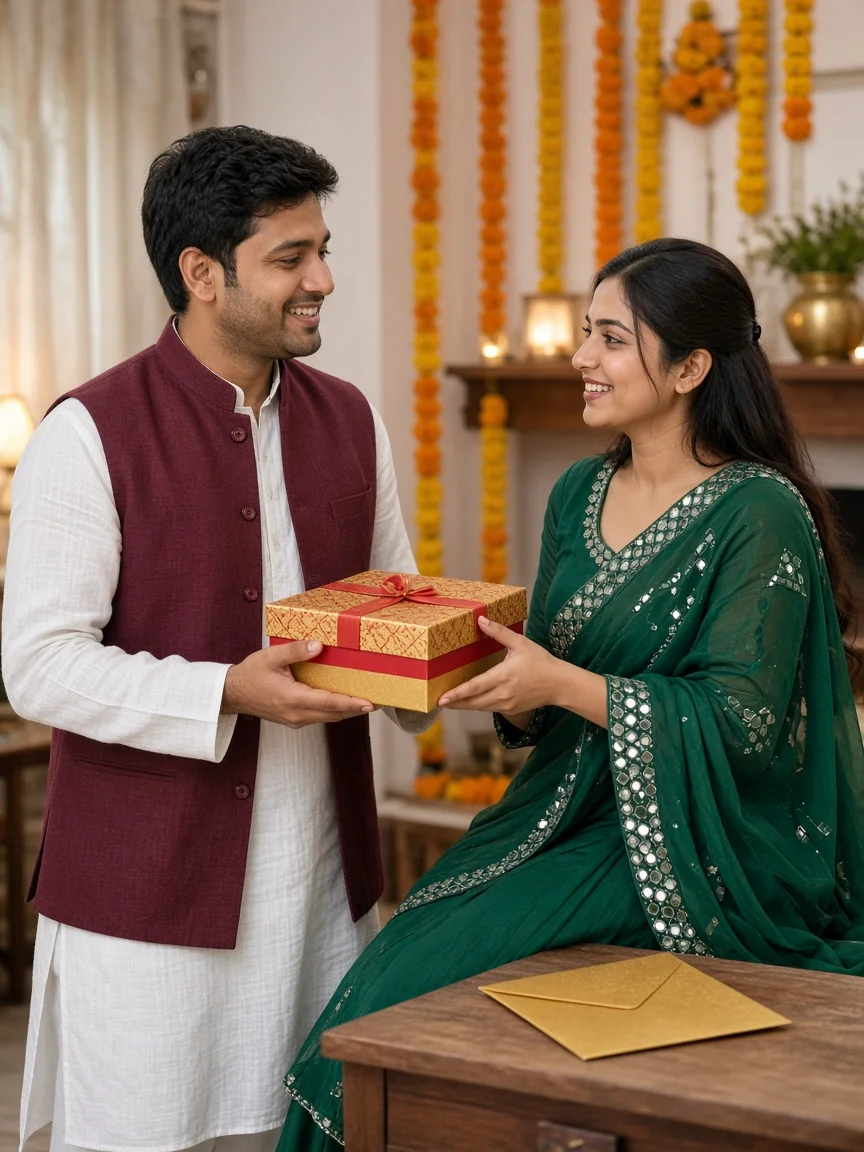
Create a sincere Bhai Dooj gift exchange using authorised references of two distinct adult Indian siblings. The brother in a maroon Nehru jacket over a white linen kurta supports a modest unbranded gold gift box tied with red ribbon, while the sister in an emerald mirror-work georgette salwar suit receives its opposite side with both of her hands. Show genuine surprise and warmth through eyes and smiles rather than exaggerated expressions. A plain decorative shagun envelope rests visibly on the adjacent wooden table, not floating or multiplying. Conserve individual reference faces, ages, natural brown complexion and sensible neckline details. Soft broad room light with a small amount of warm festive illumination, marigold strands in background, realistic fabric and ribbon tension, natural hand anatomy, 50mm indoor lifestyle photograph, vertical 3:4, no logos or watermark.
Direct and edit light without sacrificing natural skin
Choose one primary source when combining daylight with warm decorative lights. The tilak, sweet and Bhai Phota pictures use broad daylight and modest additional glow. If a face turns orange, start again with the original and request neutral fill, not heavier grading; repeated editing can magnify smoothing and jewellery artefacts.
The haveli uses late sunlight plus open-shade fill; the blue-hour balcony still needs readable foreground faces. Diya scenes also need neutral face illumination. If every source is equally bright, depth disappears. A soft subject key with dimmer background lamps preserves eyes and jawlines.
Wearable texture also helps keep the scene visually grounded. Tant cotton and organza should not reflect light like satin, Banarasi zari belongs primarily to its weave and border rather than random sparkles on the face, and linen carries a fine yarn texture. Broad descriptive terms such as “heavily royal” invite visual overfilling. Reduce them in favour of the actual space and cloth you want. Preserve a stable source original with the unedited skin colour to compare all candidates fairly.
Banarasi Blue in a Heritage Courtyard
A haveli frame needs space around the subjects, so choose a slightly wider vertical composition than the close thali ritual. A carved bench permits both people to sit at the same level and their conversation serves the sibling story. Avoid posing a hand around a waist, prolonged romantic eye contact or heavy bridal sets, because those pull the viewer into a different event. The nuanced gold border of blue woven fabric provides the occasion detail even if the thali is largely a supporting prop.
Stone arches are strong because they establish architectural depth, but be prepared to inspect rail, column and bench convergence at the edges. Synthetic aligned columns that stop through the person’s body, carved motifs blending into a kurta or a stool floating above the ground are reasons to regenerate. If golden hour oversaturates sandstone and faces together, describe soft open shade on skin with backlight restricted to the architecture. Keep the requested courtyard generic unless you have actual permission and proper geographical references for a named place.
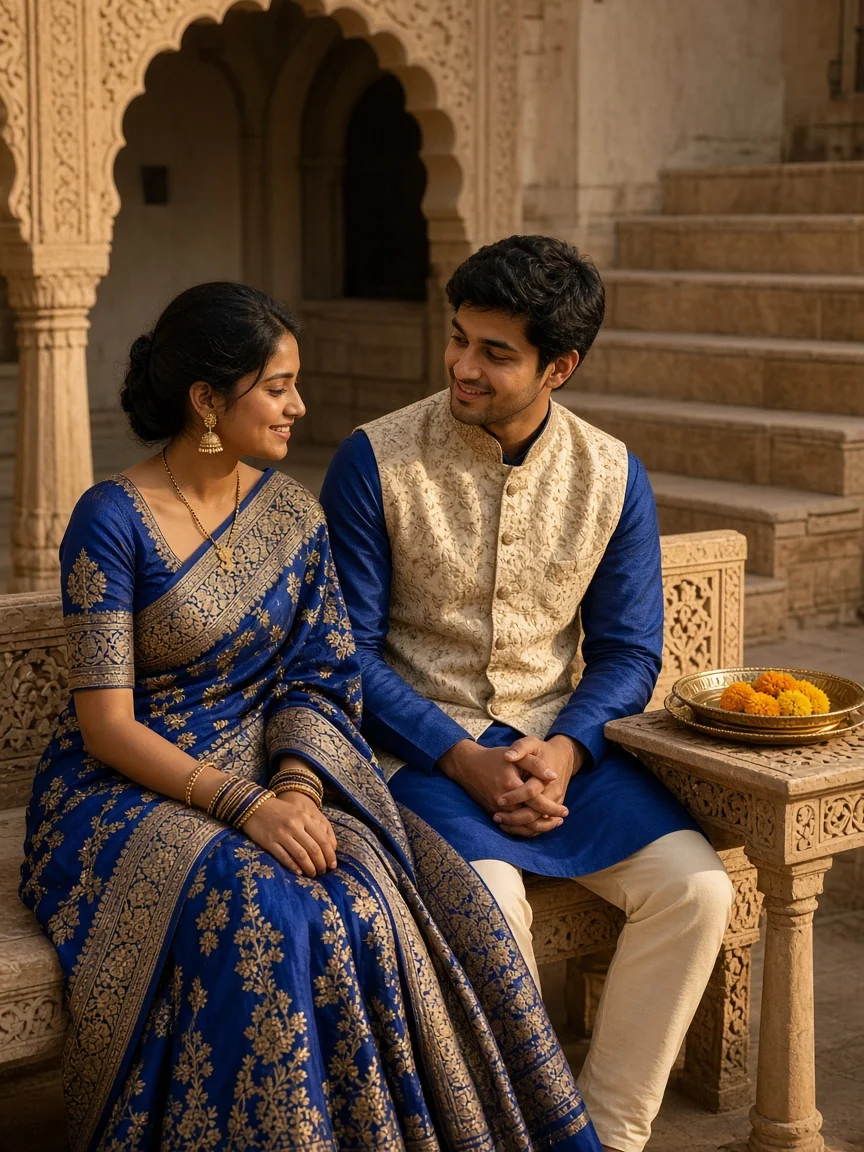
Generate a golden-hour sibling portrait from two approved adult Indian reference images, retaining each person’s exact familiar face and age. They sit side by side on an ornately carved stone bench in an ancestral haveli courtyard, clearly relaxed as brother and sister. She wears a royal-blue Banarasi silk outfit with a restrained antique-gold woven border and understated gold earrings. He wears a coordinating blue silk kurta with a cream floral-embroidered bundi. On a separate carved side table is a stable brass thali filled with orange marigold flowers and no theatrical smoke. Long late-afternoon sunlight brushes sandstone arches while gentle open shade retains facial detail and natural medium-brown skin. Correct seated legs, hands and textile drape, architectural perspective, 50mm heritage travel editorial, vertical 3:4, no signboards or watermark.
Bengali Bhai Phota with Chandan and Durba
Bhai Phota deserves its own visual grammar, not a generic red tilak with a Bengali label added. In this scene, the white-and-red Tant saree, Shakha Pola bangles and pale chandan phota are clearly described, with durba grass, paddy grains and sandesh on the brass plate. Cotton fabric has a plainer tactile character than showy Banarasi zari. The adult sister should perform a gentle formal gesture while the brother accepts it in a seated home pose. The reference face of each person remains more important than elaborate ornamentation.
Check the exact celebration within the family you are photographing. Some households use specific ritual materials, a particular hand, elder-led blessings or food choices that differ from this artistic reference. Rather than asserting that the procedure is universal, invite the caretaker of the occasion to approve the visual choices. Render a multi-wick pradip safely to the side or choose an unlit prop for a posed frame if fabric or children are nearby. Mention authentic regional detail only to the extent your sources and family knowledge support it.
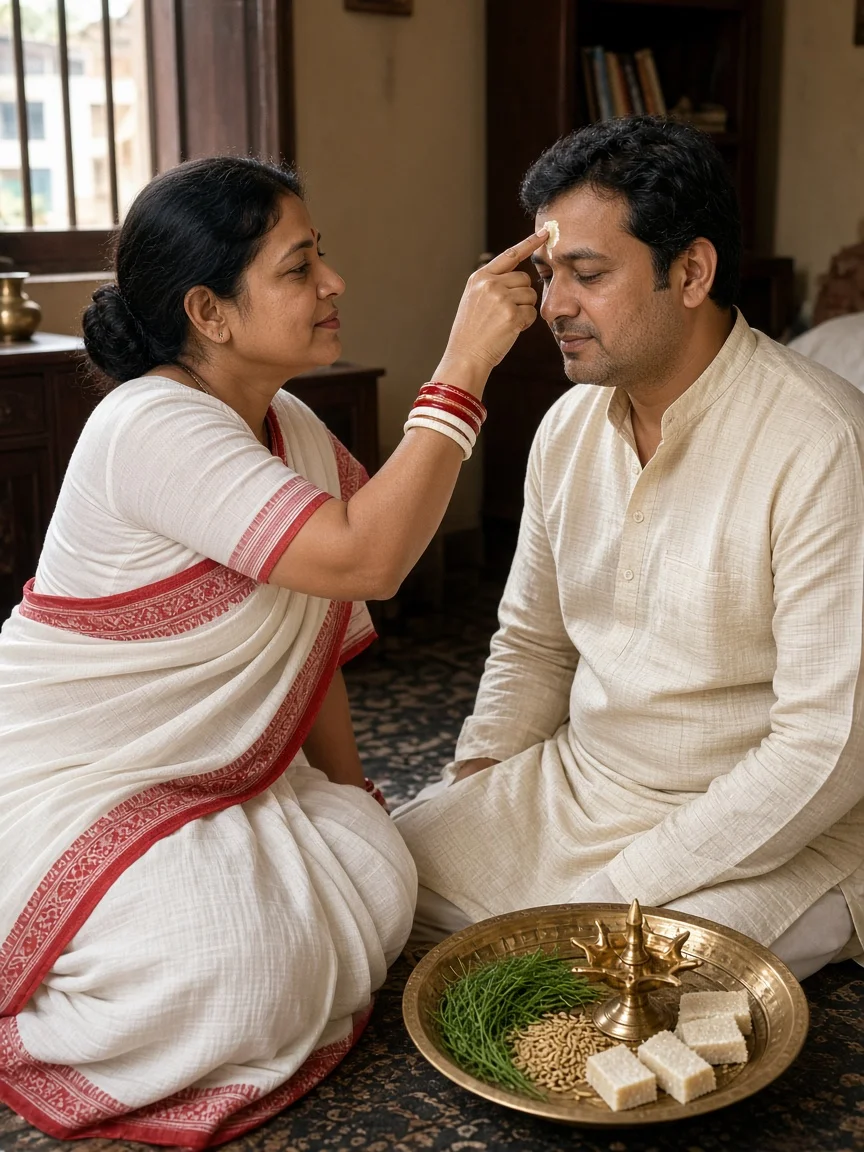
From two permitted adult Indian sibling photographs, create a culturally respectful Bengali Bhai Phota portrait based on my own family’s ritual practice. The sister wears a white Tant cotton saree with a red border, traditional Shakha Pola bangles and a neat low bun, gently applying a small pale sandalwood chandan phota to her seated brother’s forehead. He wears a cream tussar-silk Punjabi-style kurta and looks calm and affectionate. Keep their reference faces, age and individual skin tones recognisable and fingers anatomically correct. A floor-level brass plate displays green durba grass, modest raw paddy grains, sandesh and a stable multi-wick brass pradip. Keep lamps safely away from fabric or leave unlit for the staged photograph. Broad window light in a Bengali home, real cotton folds and specific regional details, vertical 3:4 natural editorial, no script text or watermark.
Prepare children’s images with permission and care
A child’s picture requires much stricter handling than two consenting adult siblings. Use images supplied or authorised by a caregiver, include only children whose caregiver has clearly agreed to the edit, and avoid using public social media downloads as assumed permission. No friendly home background justifies extending access to private photographs more widely than intended. If the outcome will be shared publicly, that decision belongs with the caregivers too; a private festival album is a valid choice, not a reason to weaken the standard.
Real-world safety works differently from image composition. A candle should not be placed on a child’s rug, close to a lehenga or within reach of toddlers who might grab it. In the sample, the thali is flame-free, while an adult manages any ceremonial lamp outside this close frame. Real celebrations also need appropriate bite-size sweets, direct caregiver supervision, no food-forced poses and no children on unstable balconies or steps. Natural small faces and child-appropriate clothing should not be enhanced with mature makeup or unrealistic polished features.
For additional family-portrait ideas, see one month baby boy photoshoot prompts and one month baby girl photoshoot prompts. Those infant-focused pages are about controlled home reference photography and must not be treated as advice for independent ritual participation by very young children. The same consent-first attitude applies to family sharing in our Diwali AI photo guide, which provides wider festive lighting and group composition inspiration.
Little Siblings and a Petal-Filled Flower Thali
The young-child scene intentionally removes problems caused by standing on tiptoes or reaching across a table. Both sit on a rug so the girl can reach her brother’s forehead at a comfortable height, and he holds one manageable laddoo rather than a handful of rolling sweets. Keep the jasmine small and restrained in her hair instead of dangling across the face. A yellow cotton kurta is breathable-looking and practical; white pyjama fabric should show ordinary folds and not melt into a rug pattern.
Compare jaw, eyes and hair with the approved source instead of accepting an idealised different child. Reject extra fingers or sweets intersecting hands. Avoid makeup or styling that changes apparent age. Caregivers might prefer a rear-view composition, but it does not solve every concern around sharing.
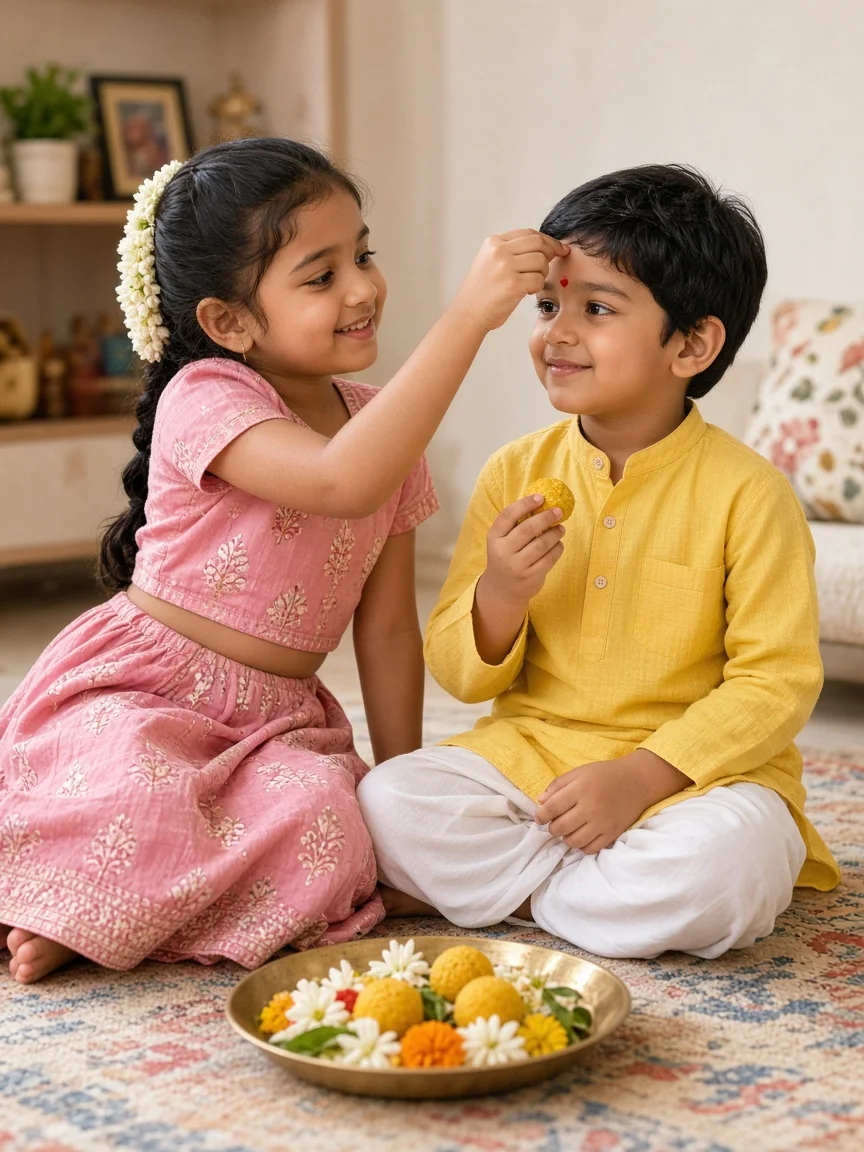
Use only caregiver-approved references of the two Indian children, a seven-year-old sister and her five-year-old brother, to create a warm home Bhai Dooj family photograph. The girl in a modest pink cotton festive lehenga with a little jasmine in her hair gently applies a tiny red tilak to her younger brother. He sits comfortably on a patterned rug in a yellow cotton kurta and white pyjama, smiling while holding one small piece of laddoo. Retain their individual child proportions and genuinely young features without adult makeup or toylike CGI. A low brass flower-and-sweet thali stays flame-free on the rug; include clear daylight and an uncluttered home background. Correct small hands and seated bodies, friendly safe atmosphere, vertical 3:4 family photography, no text or watermark; caregivers decide whether sharing the image is appropriate.
Choose a story tone: candid, contemporary or formal
The selfie succeeds with informal expressions, plausible arm extension and a simple doorway. Front-camera views mildly stretch face geometry near the edge; avoid extreme wide-angle directions. Leave the phone unbranded and its screen simple. Ask explicitly for laughter rather than relying on an assumed candid style.
For a quieter contemporary mood, sage and olive create coordination without making identical costumes. Pearl accessories are balanced by a balanced garden balcony and tea rather than lots of ceremonial props. On the rise of twilight, use reflective surfaces lightly; mug and jewellery should not unduly brighten faces. Do not confuse a two-person seated composition with romance. Specify sibling conversation, separate chairs, a little space and the eyes directed at one another’s familiar faces instead of an anniversary embrace.
Mature formal clothing like a crimson Banarasi saree and chartered bandhgala changes the geometry. Both can stand but need balanced shoulder positions and breathing room. Treat Polki-like jewellery as an aesthetic reference rather than asserting that an image shows verified precious stones or an actual inherited item. If you need a separate celebration direction, our wedding anniversary couple prompts cover romantic settings while Karwa Chauth couple prompts focus on their own ritual. They are relevant style resources, not Bhai Dooj sibling scripts.
A Front-Camera Laugh After the Tilak
A hand holding a phone toward the editor’s camera is conceptually the front-facing camera’s own origin, so ask for arm extension and perspective rather than a third-person telephoto look. The screen need not contain a nested duplicate image. It can be turned away or appear as a plain dark surface. Screenshot-like frames, duplicate faces inside the handset and dangling thumb attachments are artefacts to reject. Otherwise, a sincerely amused face with irregular lifelike detail better conveys a memory than extremely smooth skin.
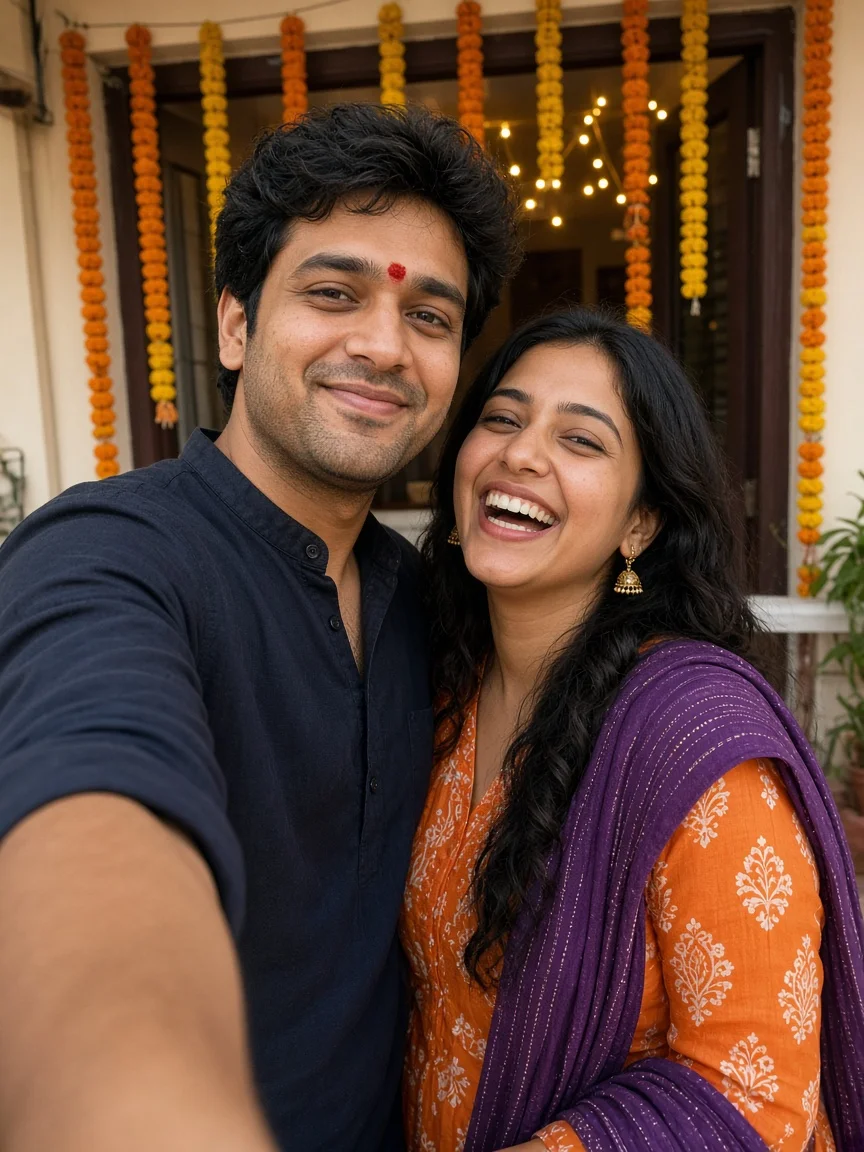
Make a lively but believable front-camera Bhai Dooj selfie from authorised photographs of adult Indian siblings. The brother extends a plain smartphone toward the actual camera, his hand and forearm joined naturally, a small red kumkum tilak on his forehead and a playful grin. His sister wears an orange cotton kurta with a purple dupatta and leans near his shoulder, genuinely laughing rather than posing romantically. Maintain each person’s face, skin colour and approximate age from references, avoiding the identical-face effect. Simulate a slightly wider front-camera field of view with restrained perspective, enough headroom for both and a marigold-decorated familiar doorway behind. Warm interior string lights mix with soft front daylight, detailed eyes and teeth without distortions, no phone branding or mirrored wording. Vertical 3:4 candid phone photography, no watermark or unreadable captions.
Sage Organza and Tea at Twilight
Balcony styling depends on controlled amounts of light, glass and foliage. Keep any glass jars on a flat ledge away from heat sources, fairy lights low-voltage and appropriate for their location, and balcony furniture secure. The photography prompt should not be treated as a household safety plan. Separate mugs held by separate siblings are easier to inspect than intertwined hands at the middle. If a glass jar reflection doubles a face, reduce the prominence of background reflections instead of more recent attempts to blur skin.
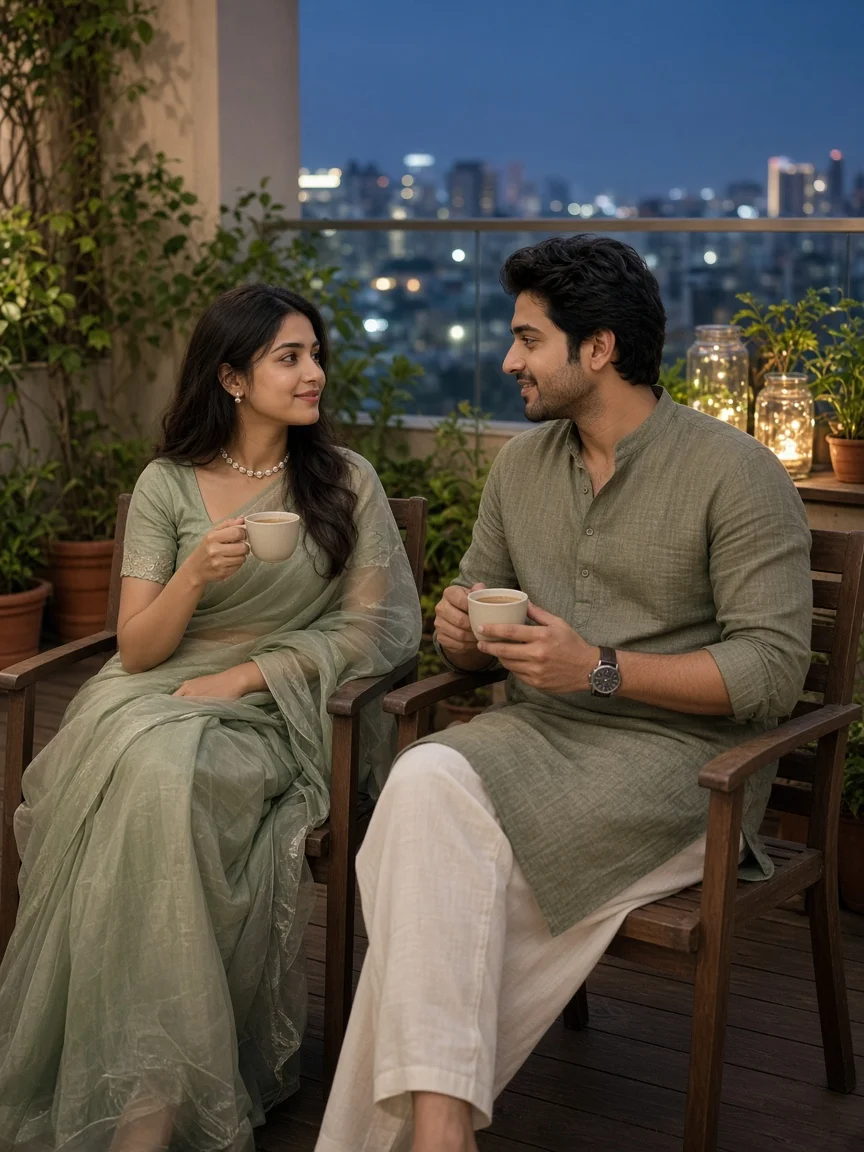
Create a contemporary Bhai Dooj portrait of two authorised adult Indian siblings seated on separate teak chairs on a tidy apartment balcony at blue hour. The sister wears a pastel sage organza saree with fine narrow borders, delicate pearl earrings and a single-strand pearl choker, her hair in gentle waves. Her brother wears a muted olive-sage textured linen kurta with neatly rolled sleeves, off-white trousers and a simple dark leather-watch strap. They hold tea mugs while chatting warmly, with recognisable individual faces and natural skin undertones. Two small glass jars of fairy lights and potted plants sit around them and a softly blurred city appears beyond safe balcony railings. Calm soft neutral face illumination, restrained twilight palette, realistic organza translucency and fingers, 50mm editorial, vertical 3:4, no luxury logos or text.
Crimson Banarasi and a Charcoal Bandhgala
Formalwear is convincing when it carries weight: the pallu falls naturally and bandhgala buttons follow a straight closure. Carved jali frames rather than overlays skin. Keep balanced exposure on both faces. Similar caution matters when adapting a textile from our Onam saree prompt guide: border detail and occasion determine its proper visual role.
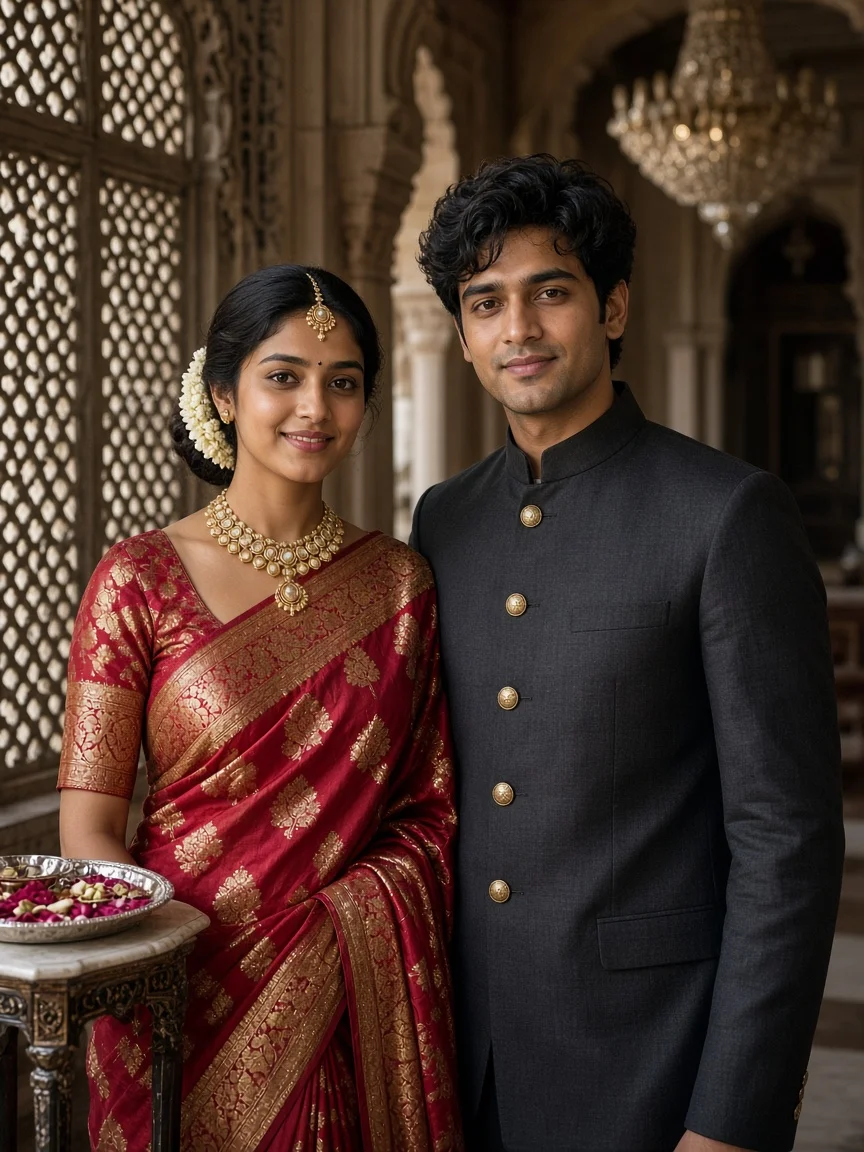
Use two approved adult Indian reference portraits for a refined festive sibling editorial in a heritage hall. The sister stands comfortably in a crimson Banarasi silk saree with intricate gold zari, a modest heirloom-inspired polki necklace, small maang tikka and low bun circled by a jasmine gajra. The brother stands beside her in a charcoal raw-silk bandhgala with antique-gold buttons, shoulders and hands naturally positioned. Keep their faces, identities and ages recognisably different, with gently affectionate sibling expressions rather than bridal or romantic cues. A carved jali screen and distant chandelier convey architecture without overwhelming the faces. A silver tray on a stable side table holds loose rose petals and dry fruits and no flame. Soft directional daylight with controlled warm room fill, authentic heavy zari folds, balanced skin, vertical 3:4, no text or watermark.
Diyas and Petal Rangoli on the Verandah
Two sources can help here: neutral blue-hour ambient light reading faces and warm diya highlights touching a hand or step. Keep a sensible physical distance between flames, petals, clothes, hair and bare feet in the real staging. A candle-focused prompt cannot make an unsafe arrangement safe. If an arrangement is unsafe for a real portrait, use unlit props rather than asking the edit to make danger look attractive. Faces should not become orange-black silhouettes just because a lamp is visible.
Describe one circular petal design or a few large colour zones rather than intricate unreadable ornamentation. Inspect wrists and kneeling legs for extra limbs before choosing the output. A generated setting is never documentation that the depicted fire arrangement was physically safe.
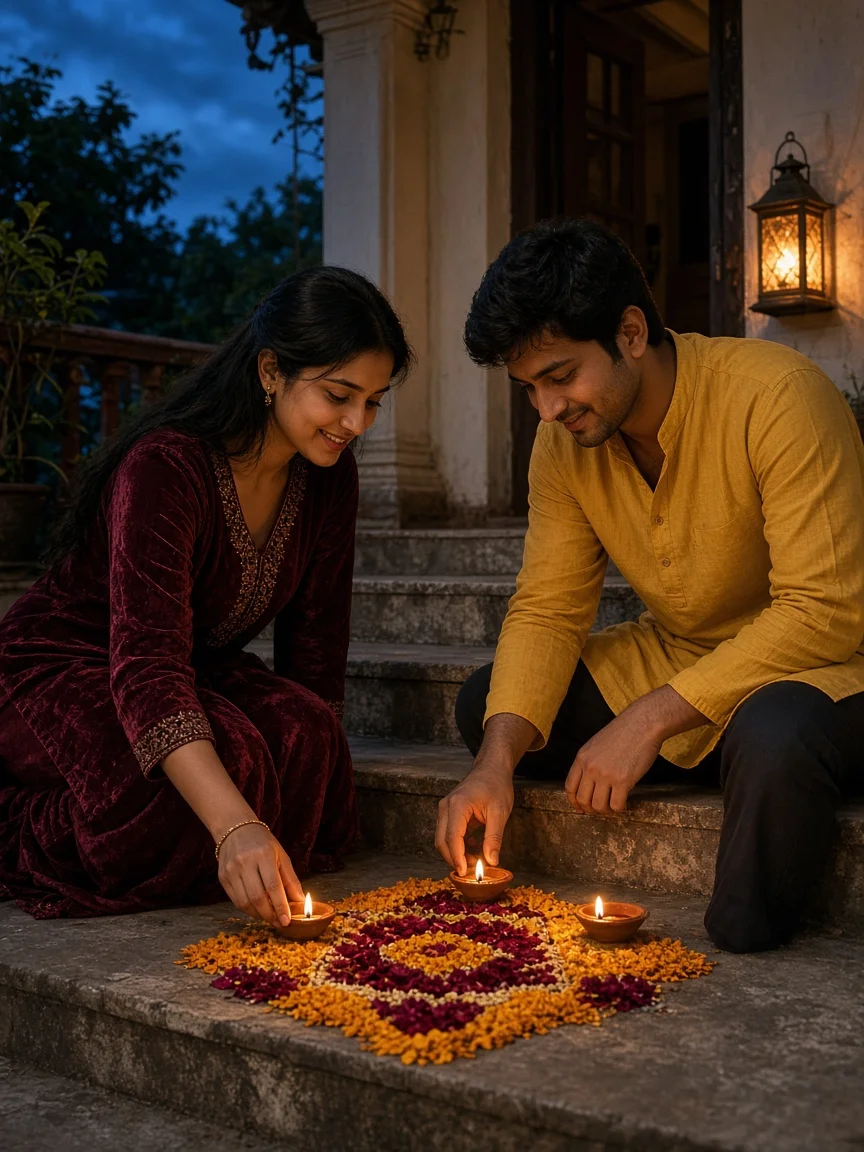
Edit authorised adult Indian sibling references into a cinematic but realistic Bhai Dooj verandah photograph at blue hour. The sister wears a deep-maroon velvet kurti and her brother a mustard-yellow cotton kurta. Both sit comfortably on broad stone steps, each carefully setting an earthen clay diya on a flat stable part of the steps away from fabric and bare feet. Between them is petal rangoli arranged in a neat circular pattern from orange marigold and dark-red rose petals, without loose burning lamps inside the flower pile. Warm restrained diya highlights combine with soft neutral ambient face fill, preserving natural brown skin and true individual reference features. Deep-blue dusk sky, calm doorway, real hands and textile folds, vertical 3:4 storytelling editorial, no typography, sparks, watermark or decorative smoke.
Export, compare and caption your Bhai Dooj edit accurately
Begin with the full uncropped output and compare each face against the matching permitted source at the same viewing scale. Check the older brother does not become a teenage face, a sister’s jaw or hairstyle survives, and both arms attach correctly to the correct person. Then review the ritual props: tilak on the right forehead and not eye, actual plate support, sweet touching fingers rather than teeth, grass separate from brass, and lamps standing flat. Save cleanly chosen candidates rather than filming a montage of failed identities.
Use one composition master and make separate versions for a four-by-five feed crop, portrait print or narrow story. A story crop needs enough room above faces for stickers you add intentionally, but do not require generated greetings or elaborate unreadable names. Private WhatsApp originals, image-archive filenames and edited derivatives should be clearly separated. From these ten begins one useful export tree: original references, source prompt, accepted full-resolution result, and social crop. The most polished output is still an illustrative AI image when it was composited.
Captions should say “Bhai Dooj sibling portrait styled with AI” or another truthful description where context matters. Avoid invented dates, claims about a venue you did not visit or assertions that two synthetic references are a documentary artifact. Combine this guide with the broader festive Diwali prompt guide for lighting and home compositions or Radha Krishna prompt ideas when devotional art rather than a family resemblance is your actual goal. Good AI portraits leave room for your family’s individual traditions while keeping references, identities and occasions honestly distinguishable.
Frequently asked questions
Are these Bhai Dooj Gemini prompts free to use?
The text can be copied and adapted freely. Your own image tool may still require an account, paid usage or have daily limits. There is no promised unlimited generation, resolution or viral performance. Check the editor’s current reference-image and output options before starting.
Can I use a photo of my brother and sister to preserve both faces?
Use clear references only with their permission and label each sibling explicitly. Similar source lighting and angles help, but no lens tag, 8K wording or one-line instruction can guarantee exact identity. Compare the final eyes, hairlines, ages and distinctive features before choosing it.
What is the best Bhai Dooj prompt format?
Specify the sister and brother separately, who performs the action, their clothing, one clear ritual prop grouping, lighting and vertical crop. For example: sister left applies a small kumkum tilak; brother right sits opposite; supported brass thali in foreground; soft neutral daylight. Avoid competing aesthetic instructions.
How is the Bengali Bhai Phota prompt different?
This visual brief uses a white-and-red Tant saree, Shakha Pola, pale chandan, durba grass, paddy and sandesh. Ritual practice varies by Bengali family and instructions, so ask a knowledgeable family elder to approve the procedure and props rather than treating the prompt as a universal script.
Can I generate a children’s Bhai Dooj portrait from online photos?
Do not assume online availability is permission. Use caregiver-authorised references, keep supervision and privacy decisions with caregivers and use a flame-free setup for young children’s posed close-ups. Consider keeping the edited family memory private rather than sharing default publicly.
Will these prompts work in ChatGPT as well as Gemini?
They are natural-language briefs suitable for capable photo editors, including current versions of ChatGPT and Gemini where references are supported. Adapt controls to the actual product you use. Multiple-reference handling, face preservation and maximum image sizes vary, so test the exact scene before batch generation.
How can I stop AI from making siblings look like a romantic couple?
State adult siblings and their distinct family relationship, use genuine friendly interaction rather than embracing or bridal cues, and keep separate comfortable body positions. Avoid maang-related bridal jewellery unless it is intended for the particular person. Review the result and remove unintended wedding imagery.
What safety checks matter for diyas in the verandah scene?
Any actual flame belongs on a stable non-combustible surface with a responsible adult, clear of hair, flowing clothes, flowers, children and feet. Do not let a prompt override real household precautions. For generated images, inspect whether the lamp is supported, its flame size plausible and no cloth intersects it.
Related articles
Gemini AI Photo Prompt Copy Paste Trending Halloween: 10 Spooky-Chic Indian Looks
Ten copy-paste Gemini Halloween prompts with real results for Indian boys, girls and couples: jack-o'-lantern balcony, gothic noir, UV skull face paint, Pierrot at the mela, flash house party, velvet sorceress, masquerade, pumpkin farm, lantern walk and Bhoot Chaturdashi diyas, plus face-lock, lighting and costume tips.
Nancy · · 20 min read
Ravan Dahan Gemini Prompt: 10 Dussehra Effigy Night Photo Ideas
Ten Ravan Dahan Gemini prompts with real results: three-effigy blaze, rooftop view, pre-burn couple selfie, siblings at the mela, motorcycle overlook, effigy maker, awe at the fire, newlywed leaf exchange, friends cheering and morning-after embers, plus firelight, safety, face-lock and caption tips.
Nancy · · 17 min read
Navratri 9 Avatar AI Photo Prompt for Girl: 10 Devi Roop Day-by-Day Ideas
Ten Navratri 9 avatar AI photo prompts for girls with real results: day-by-day Devi roop portraits inspired by Shailaputri, Brahmacharini, Chandraghanta, Kushmanda, Skandamata, Katyayani, Kalaratri, Mahagauri and Siddhidatri, plus a sindoor khela finale, symbol chart, day colours, face lock and Reel tips.
Nancy · · 17 min read
Diwali Wishes Prompt for ChatGPT: 10 Personal Greeting Photo Ideas + Wishes
Ten Diwali wishes image prompts for ChatGPT, one for each recipient: elders, colleagues, friends, partner, siblings, family far away, neighbours, handmade diyas, a blank card flat-lay and a family aarti, plus ChatGPT text formulas, ready-to-copy wishes in English, Hindi and Hinglish, and a copy-space workflow.
Nancy · · 17 min read
Comments
No comments yet. Be the first!