Gemini AI Snow Photo Editing Prompts Free: 10 Ideas
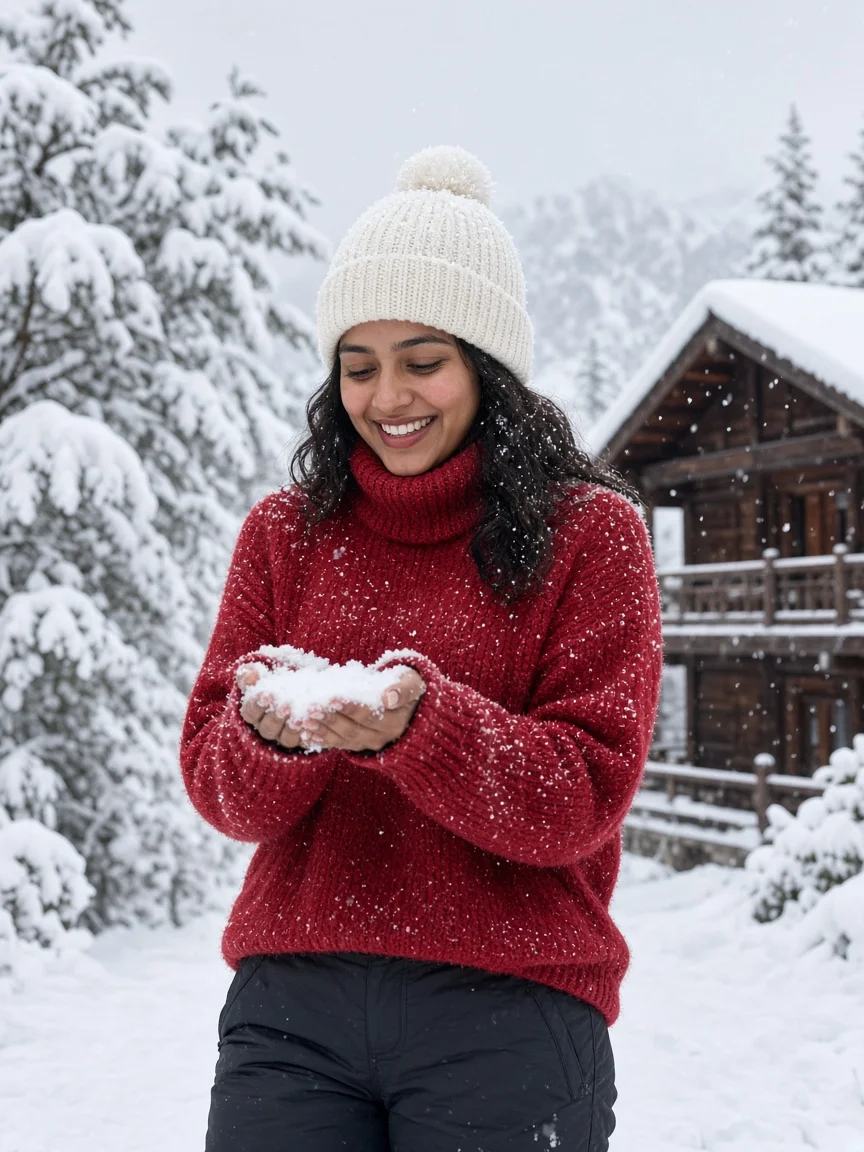
Table of contents
- What makes a Gemini AI snow photo editing prompt actually useful
- Choose by lighting story before choosing by colour
- Prepare the original photo so your winter edit keeps important details
- Crimson Knit and Catching Snow in Gulmarg
- Charcoal Wool and Coffee on a Manali Snow Street
- Shimla Blue Hour Beneath a Shared Pashmina
- Run snow edits iteratively, without replacing the original repeatedly
- Pastel Pink Puffer Against Alpine White
- Cognac Suede and a Snow-Dusted Park Bench
- A Mustard Snowsuit and a Handmade Snowball
- Use cultural detail carefully and avoid flattening winter India into one scene
- Navy Velvet Pheran with Golden Tilla Detail
- A Transparent Umbrella in Neon-Lit Snowfall
- Cable-Knit Cocoa on a Chalet Sunrise Balcony
- Adult Siblings Playing in a Himalayan Pine Clearing
- Diagnose flat, over-filtered or identity-changing snow photos
- Save the right crop and keep a useful record of the edit
What makes a Gemini AI snow photo editing prompt actually useful
A winter edit should show the physical interaction between snow, clothing, skin and light rather than replacing the background with white circles. This free guide offers ten original gemini ai snow photo editing prompts for adult Indian men, women and couples, plus one caregiver-approved child scene. You will find crimson knit in Gulmarg, a tailored Manali coffee portrait, a shared Shimla shawl, pastel resort gear, cognac shearling, mustard snow play, a Kashmiri Pheran, an umbrella at night, a cocoa balcony and adult sibling action. Each is designed to give you a specific photographic choice instead of “make it snowy.”
These prompts suit Gemini, ChatGPT and other capable image editors that accept a reference photo. The current platform, quota and features determine available generations: no image generator is unlimited for every account, and lens statements are aesthetic cues rather than face locks. Do not promise yourself that adding “85mm” guarantees one hundred percent identity. Use permitted images with clear facial detail, ask for a controlled scene change and inspect the selected result. If you want a professional composite, retain your real original rather than claiming a destination trip that did not happen.
This collection also differs from our general menswear guide by concentrating on snow itself: particle scale across distance, snow on knit versus technical fabric, retained white detail in overcast light, warm illumination at blue hour, backlighting after dark and the bodily logic of play. Repeating one identical storm over every person produces fake-looking effects. Let the atmospheric differences guide which prompt and crop best match your actual reference and intended use.
Choose by lighting story before choosing by colour
Daylight snow has three distinct expressions here. In overcast Gulmarg, a crimson sweater retains a saturated warm anchor with heavy-knit texture against softly exposed white. In Manali snow, charcoal wool over ivory canvas contrasts café-lit windows and distant grey mountains. At a resort, pastel puffer and white trousers require particularly careful exposure: the clothing, face and snow all have bright values, so jacket seams and silver zips need structure to avoid washing into one pale block. Cognac suede introduces a richer complementary colour beneath pines.
Twilight asks for a different grammar. In Shimla, a maroon pashmina and a single coloured warmth from a vintage lamp oppose blue mountains, which should not turn the faces blue as well. Night snow with a clear umbrella needs a lamp behind one shoulder to catch flakes plus subdued neutral face illumination in front, while neon reflections belong on wet surfaces on the road. The chalet balcony has gentler alpenglow and cream knit; its steam should remain a fine curl, not a theatrical plume.
For an emotional narrative, shared shawl or adult sibling interaction is stronger than a face close-up with falling flakes—but more demanding for identity integrity. Use two known references and distinguish them clearly. Young child portraits require caregiver consent, age-appropriate warm clothing and close actual supervision of cold-weather play; decorative generated effects are not a reason to disregard warmth, surface stability or a child’s desire to stop. The child scene here involves the child alone making a snowball rather than projectiles aimed at others.
Prepare the original photo so your winter edit keeps important details
Use one properly exposed source where the subject’s hairline, jaw, eyes and hands are easy to see. Even neutral daylight shows both cheek colour and eyebrow shape better than restaurant neon or a beauty-filtered social-download selfie. Choose a file taken at approximately the distance you want: a standing portrait lends itself to an alpine bench or a marketplace walk, while a close selfie is more appropriate for shoulder-level snow contact. Do not expect a source taken with distorted wide-angle close-up to produce a perfect eighty-five-millimetre portrait response.
Include mouth, neck and shoulders so a sweater collar or pashmina has a physical place to sit. A second semi-wide photo provides better body reference when the tool supports additional images. If you want earmuffs or beanies, remember that the original hairline may stay concealed. Print bed can lose important subtle textures, so use a full-resolution original where available. Two people in different source files should have compatible head orientations, distances and daylight exposure; do not hide either face behind a profile or mask and then expect a consistently matched couple.
For action or play, an original with a natural gesture helps. Looking down at cupped hands gives the editor a believable target for powder snow; a free shoulder offers an accessible snowball pose. If a reference hand is cut by the edge of the photograph, keep the crop or adjust the scene so both hands need not appear. Guardian permissions are necessary for a child’s reference; sharing the original and final image should be decisions caregivers make deliberately rather than an automatic consequence of being included in an effect tutorial.
Crimson Knit and Catching Snow in Gulmarg
This is the leading snow example because every layer has a separate role. Red wool is the saturated foreground element, mitts carry snow physically and distant chalet and far pines provide scale. Ask for a small loose handful rather than a precise spherical ball hidden near the chin. Fine grains on the beanie and sweater can be textured; giant geometric crystals on eyelashes tend to look sticky rather than like weather. A pale grey overcast sky keeps facial detail legible. Check how fingers join mitten fabric and whether headwear cuts into the natural scalp line.
Using my permitted adult Indian female reference, create a natural Gulmarg snowfall portrait that preserves my recognisable eyes, cheeks, hairstyle and natural complexion. Dress me in a thick crimson chunky-knit turtleneck with individually detailed stitches, white ribbed beanie with a small pom, dark insulated trousers and simple knitted mittens. I smile softly while holding a small amount of loose powder snow in both cupped hands away from my face. Crisp but restrained snowflakes cling to hair and shoulder folds, with finer distant flakes amongst tall pines and a softly blurred wooden chalet in the background. Overcast winter daylight protects brown skin colours and shows gentle cheek warmth, smooth shallow depth yet truthful mitten anatomy, vertical 3:4 professional outdoor editorial, no text or watermark.
Charcoal Wool and Coffee on a Manali Snow Street
The coffee scene demonstrates moderate-depth rather than extreme-blur photography. Brick or wooden roads can retain some midground information to tell the Manali café story, and the tall peaks should continue behind rather than simply becoming an unrelated flat white wall. A coffee cup must be genuinely held between gloved fingers and thumb, with steam moving gently upward as cold air would imply. It is not necessary to sign a location on every cup; abstract brand-free packaging avoids extra garbled signs. The winter clothing makes sense against the snow because long wool is visibly a heavy, substantial layer.
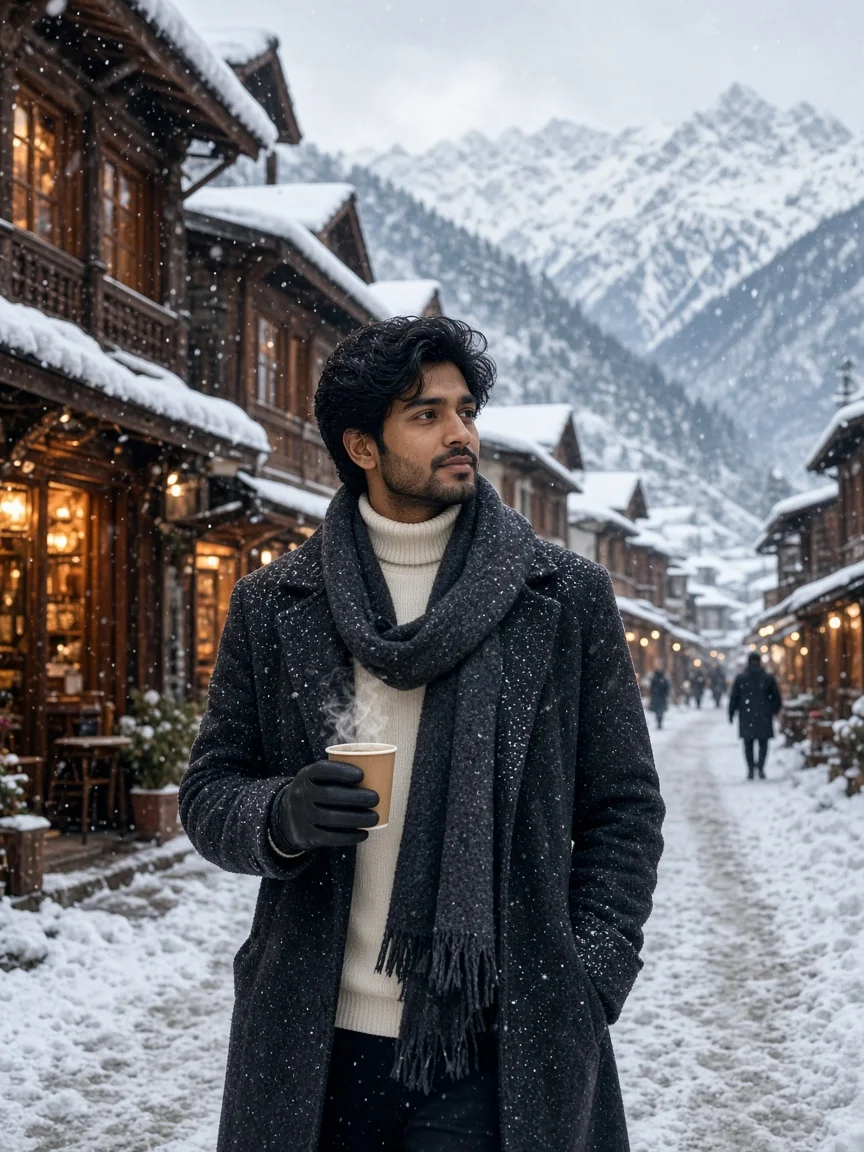
Create a stylish Indian male Manali snow street portrait from my permitted reference photo, preserving distinctive facial geometry, beard and adult age. A tailored charcoal wool long coat sits over an ivory turtleneck and a loose dark-grey woven muffler, with black leather gloves holding a plain takeaway coffee cup. Add two delicate steam curls rising from the hot drink and scattered small flakes on hair and shoulders. A quiet street lined by rustic wooden cafes with warmly lit windows extends behind me, with distant snow-capped peaks. Show a few out-of-focus closer flakes and finer dusty snow farther away rather than identical white circles across the picture. 50mm travel editorial daylight and balanced complexion, walking naturally, no branding, vertical 3:4, no watermark.
Shimla Blue Hour Beneath a Shared Pashmina
With two faces, keep the embrace physically honest. A wide shared pashmina can cover shoulder areas while hands still grip the wrap from the outside; do not hide all the body in it, because it becomes a shapeless blanket with two heads. If separate photographs are accepted, label man and woman separately, keeping similar age and eye levels. Sparse snow in the lamp’s halo is the atmospheric cue. The streetlamp should not appear behind someone’s face as a glowing halo destruction, so place it slightly to one side with a soft neutral frontal fill.
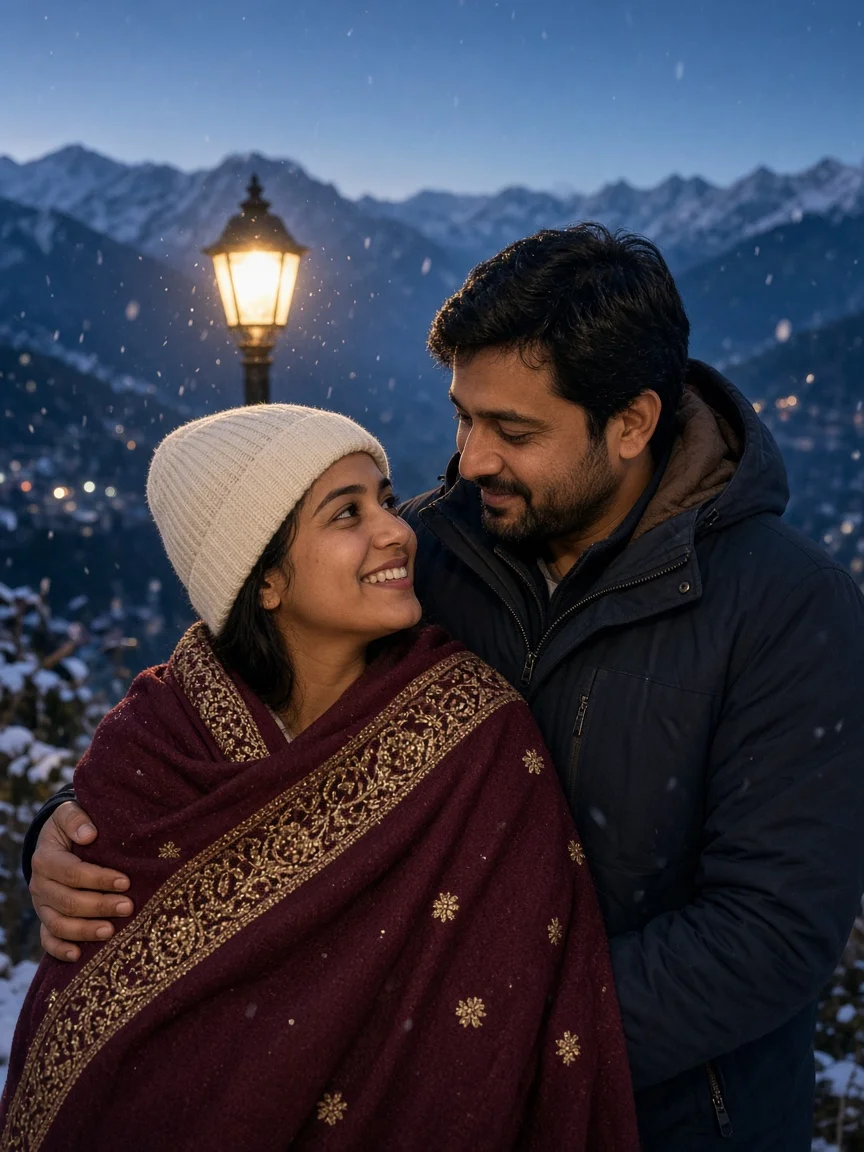
Use two authorised adult Indian couple references to create a warm Shimla twilight photograph. Keep both partners’ individual faces, skin tones, age and expressions recognisable. They stand close and comfortably wrapped together in a generous deep-maroon and antique-gold embroidered pashmina, woman in an ivory knit beanie and man in dark winter parka, hands outside fabric with natural anatomy. Their mutual affectionate gaze feels calm not staged. A tasteful vintage lamp behind one side gives warm highlights on sparse transparent snowflakes in the air; distant blue Himalayan silhouettes and village lights sit beneath blue-hour sky. Fabric drapes across shoulders without hiding facial features, comfortable proportions, soft neutral face fill, premium portrait look, vertical 3:4, no neon text or watermark.
Run snow edits iteratively, without replacing the original repeatedly
Start with the source and one complete picture brief, not a chain of duplicated effects. Ask to retain facial identity while you change garment and environment. Once the model returns a result, describe the defect minimally: “Reduce snow particle size behind the shoulder and retain natural warmth in cheeks,” or “Keep the reference face while replacing only the jacket with crimson knit.” If the result progressively transforms a face, return to the original and start a new attempt; repeated edit-of-edit sequences may reinforce those distortions.
Lens and depth tokens guide style but do not enforce lens physics. Employ “moderate foreground bokeh, finer distant particles” for snow texture and describe what should remain readable: the beard, hands, knit edges or chalet. A requested f/1.4 look can soften part of the nearer face if the model interprets it too aggressively, so prioritise actual inspection. Midjourney’s aspect and reference features differ by current version. No single prompt works unmodified as a universal identity-guarantee setting across all tools, accounts or output requirements.
Look for snow-to-surface consistency. Snow collects on horizontal shoulders, lintels, bench tops and trees, much less on vertical coat button fronts. Different heavier fabrics appear different when carrying powder: fine fluffy dust on cord and wool; small melting droplets on technical waterproof cloth; a thin textured layer on bench planks. Water contacts the ground as slush or meltwater where traffic and reflected warmth exist. Treat blue-tinted shadow and gold-lit snow as a limited palette, not a completely white environment with giant unrelated orange lights floating in it.
Pastel Pink Puffer Against Alpine White
Pastel and bright technical clothing are a good exposure test. If white leggings merge with the ground, request more visible seam architecture and natural shadow variation at knee level rather than pink outlines around the entire body. Ski goggles should rest above the brows instead of producing transparent duplicates of eyes beneath them. Reflective metallic hardware may catch direct sunlight on one edge, but it should not reflect a fake second face. Avoid whitening skin or putting blue snow bounce on one half of the face with the other appearing as a separate warm exposure.
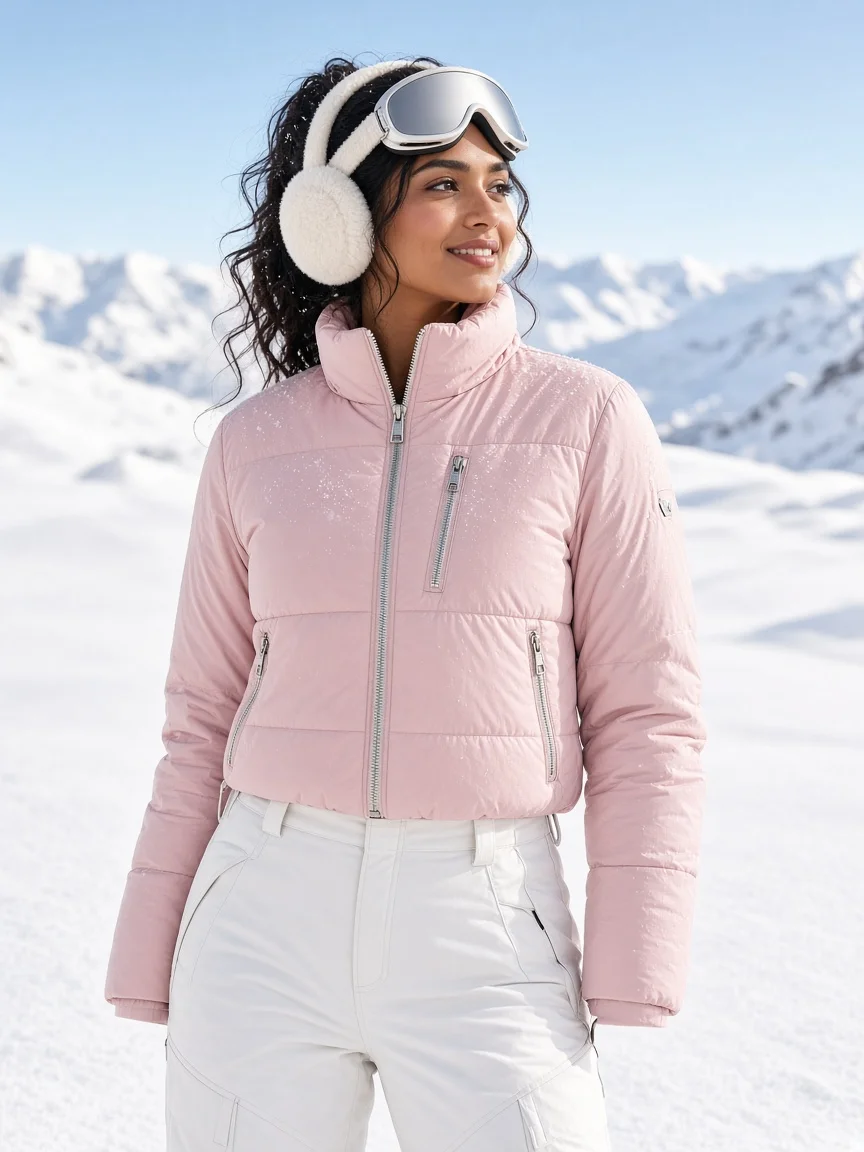
Generate a bright refined snow resort portrait of the adult Indian woman from my permitted reference. Preserve natural face and warm undertones. Style a well-fitted pastel-pink technical puffer jacket with silver matte zipper details, white insulated ski trousers with clean seam construction, ivory faux-fur earmuffs and ski goggles resting above the forehead so eyes remain visible. Measured rosy skin and a subtle confident smile, not bright artificial makeup or blue tint. Fresh powder and pale mountain ridges sparkle behind in crisp high-altitude daylight, but clipped snow highlights must be avoided and the jacket’s quilted fabric retains structure. A few tiny flakes catch hair and jacket without jelly-like clumps on eyelashes. Anatomically correct relaxed posture, premium winter travel photography, no apparel logos, vertical 3:4.
Cognac Suede and a Snow-Dusted Park Bench
The suede bench portrait demonstrates how environmental texture relates to pose. Pressed snow on the bench suggests weight; snow should not stand vertically in thick stacks beside a seated person’s coat. Suede nap and cream shearling have contrasting smooth and plush surfaces, not a uniform polished leather appearance. Correct seat height and leg bend matter to a believable posture. If the output places knees at an impossible level, fall back to a waist-up portrait leaning against the bench rather than retaining attractive scenery with incorrect anatomy.
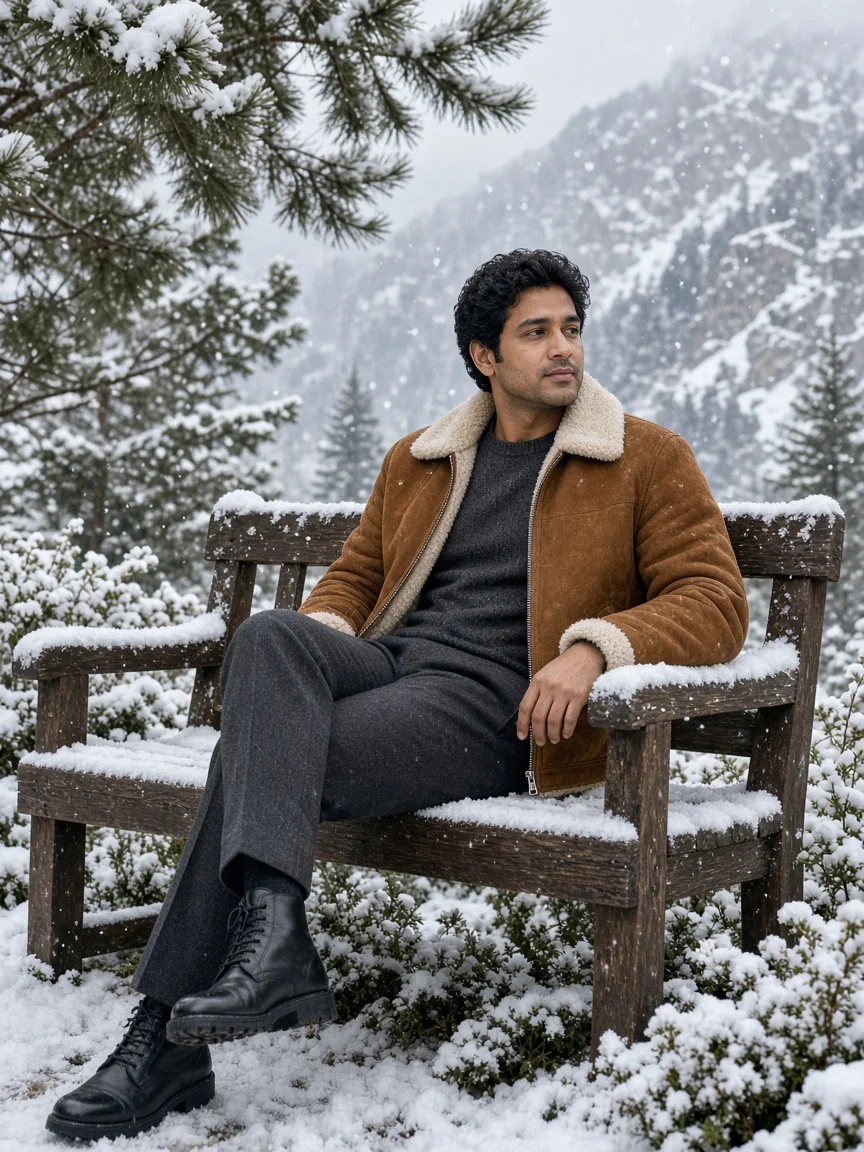
Produce a quiet-luxury outdoor portrait of my approved Indian adult male reference seated on a dark timber mountain garden bench dusted with fresh snow. Keep accurate male face, natural hair and slight beard. Dress the man in a cognac-brown suede shearling aviator jacket with plush cream collar and cuffs, dark charcoal wool trousers, fine dark knit and polished winter boots. He rests one arm on the bench and looks off-camera relaxed, hands and seated legs anatomically plausible, wool drape not melted into snow. Light snow is visible on bench corners and drifting through calm pine boughs, with different focus by distance. Suede nap and wool carry soft diffuse daylight, skin brown compared to background white, vertical 3:4 unbranded candid editorial.
A Mustard Snowsuit and a Handmade Snowball
Mustard yellow creates clear separation between child and snow, while red mittens give a modest secondary colour spot. The young child should wear practical boots, warm hood and outer suit with no long decorative scarf hidden around the neck. For actual play, use soft clean powder on safe compacted ground with an attentive adult controlling location, gloves and warmth; no snow toward an eye or face and no unattended deep snow play. Add a synthetic snow frame only after keeping a proper unedited family image. Privacy options include private albums or faceless momentary hands, not mandatory public posting.
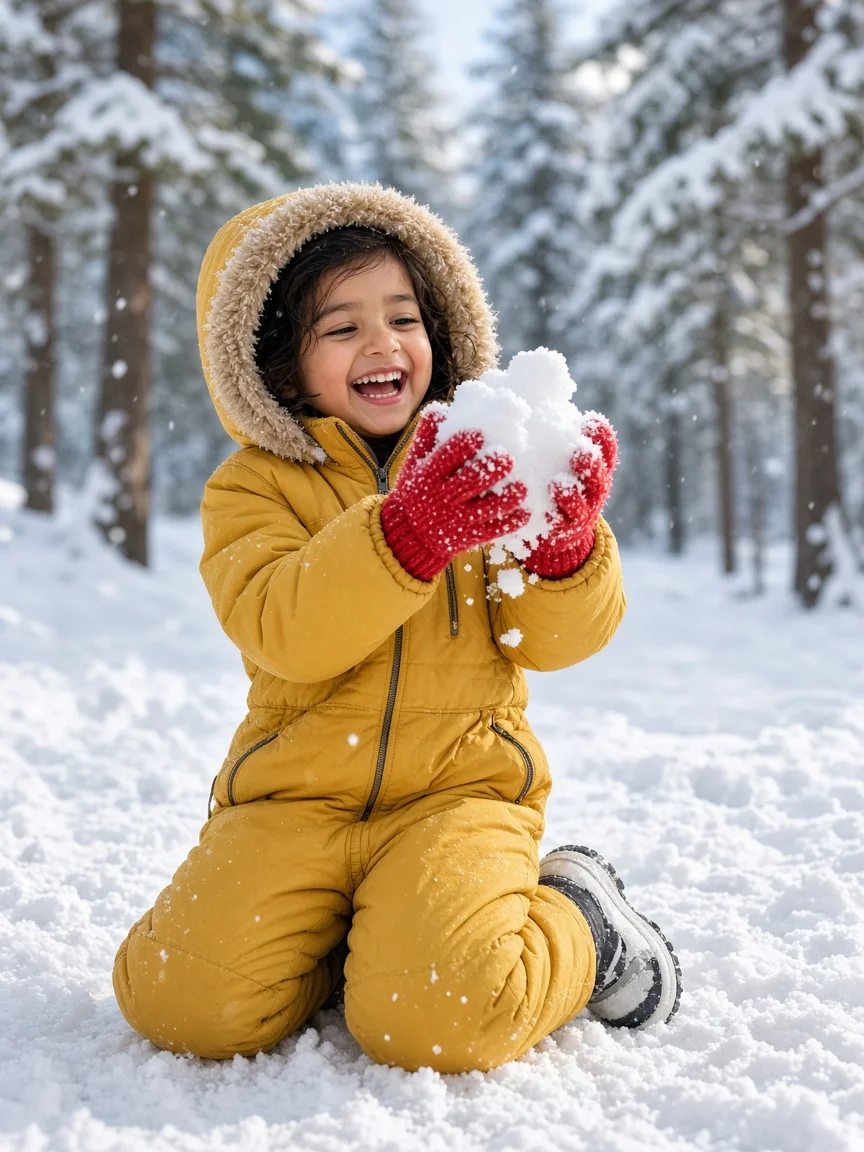
From an approved child reference used with the caregiver’s consent, create a simple winter-play picture of a joyful four-year-old Indian child in a mustard-yellow insulated waterproof snowsuit, ivory faux fur hood trim, red knitted mittens and sturdy snow boots. The child kneels on compacted snow in an open visibly safe snowy clearing, constructing a small loose snowball with snow held away from eyes. Preserve genuine age, facial features and mitten scale. Soft child-friendly daylight and shallow pines in background, moderate small flakes around not any flying debris toward face. Retain natural skin, candid delight and body proportions for a young child. Aim for family photography aesthetic not toylike CGI, child clearly bordered in colour against white, vertical 3:4, no text, no watermark.
Use cultural detail carefully and avoid flattening winter India into one scene
The navy velvet Pheran and gold Tilla work are meaningful cultural inputs rather than generic royal Indian decoration. Describe a comfortable loose garment with volumetric sleeve folds, embroidered yoke and cuffs, and a light pashmina that keeps the jaw open. Ask whether silver ornaments make sense for the person you are referencing and follow local photo traditions rather than inserting every ceremonial element. Since there can still be exposed Chinar leaves, envision a snow-touch garden rather than an aggressively retouched blizzard. Restraint makes the fabric distinct on both screen and print.
Romantic couple lighting also works for a non-snow anniversary style. The wedding anniversary couple prompt guide contains courtyard, shawl and traditional textile choices once the draft is published. Winter prompts for boys explains fleece, herringbone and campus tailoring in more detail. If you want less documentary snow and more devotional colour, use Radha Krishna couple prompts as its own distinct artistic direction rather than adding costume jewellery into every winter portrait.
The Onam saree prompt guide offers a different textile and bright light example—useful for understanding border contrast and preservation of cream as opposed to bright white. It is not a winter pose reference. Keeping each cultural prompt defined to its occasion helps generated output look respectful and keeps your guide copy informative and original. Similarly, broader Diwali AI photo prompts should guide festival-based warm ambient lights, not be used to indiscriminately place diyas inside snow.
Navy Velvet Pheran with Golden Tilla Detail
A heritage garment gains credibility through matter-of-fact daylight rather than dramatic glowing jewellery. Navy cloth absorbs more light than a pale coat, so light only along embroidery will still be enough to differentiate Tilla details without leaving the face underlit. Preserve the reference person’s age. A heavy shawl should fold under gravity rather than sit like a firm bungalow roof on top of the head. Include Chinar leaves alongside frost so the place reads as one seasonal transition and the pattern itself stays easy to assess rather than being hidden by snow graphics.
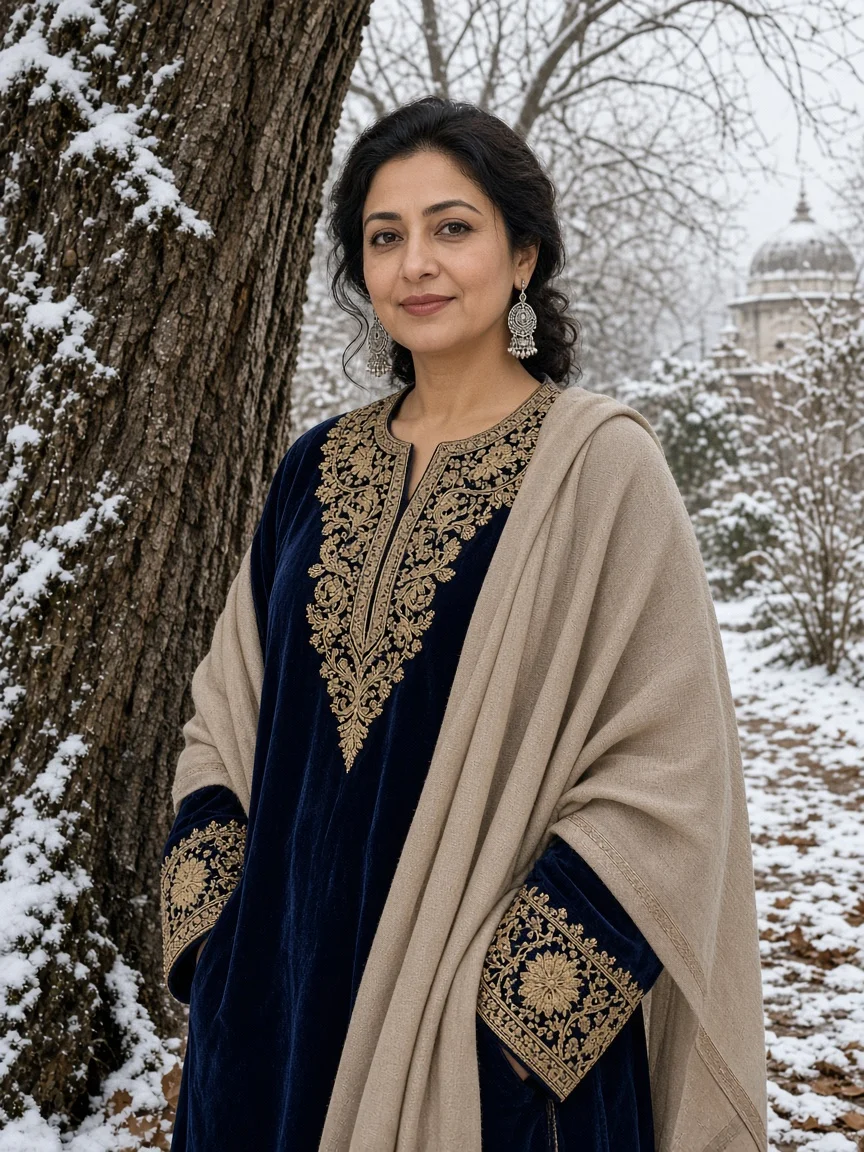
Create a respectful cultural winter portrait from an authorised reference of an adult Kashmiri Indian woman, preserving her natural facial identity and age without excessive de-ageing. She wears a deep navy velvet traditional Pheran with wide relaxed sleeves and intricate golden Tilla embroidery on the neck yoke and cuffs, plus an airy muted-beige pashmina wrap draped loosely around hair without obscuring jaw or eyes and tasteful traditional silver ear ornaments. She stands beside a large snow-dusted Chinar tree on a garden path with some remaining fallen leaves. Diffused soft overcast winter daylight shows every real fold of velvet and the raised embroidery’s texture while retaining natural brown skin and realistic garment geometry. Dignified friendly expression, vertical 3:4 heritage editorial portrait, no signage or watermark.
A Transparent Umbrella in Neon-Lit Snowfall
Night street edit realism comes from subdued neutral fill on the subject. The lamp can illuminate translucent flakes near a shoulder behind, but visible front light is still required so skin has warm variation rather than orange silhouette. Transparent umbrella ribs converge at a central shaft, and leather fingers should hold it in a believable place. Side-road water reflects street windows, as not all snow is clean powder by this hour. Keep town signs indistinct to avoid arbitrary made-up scripts; a geometric neon graphic is a sufficiently mood-setting prop.
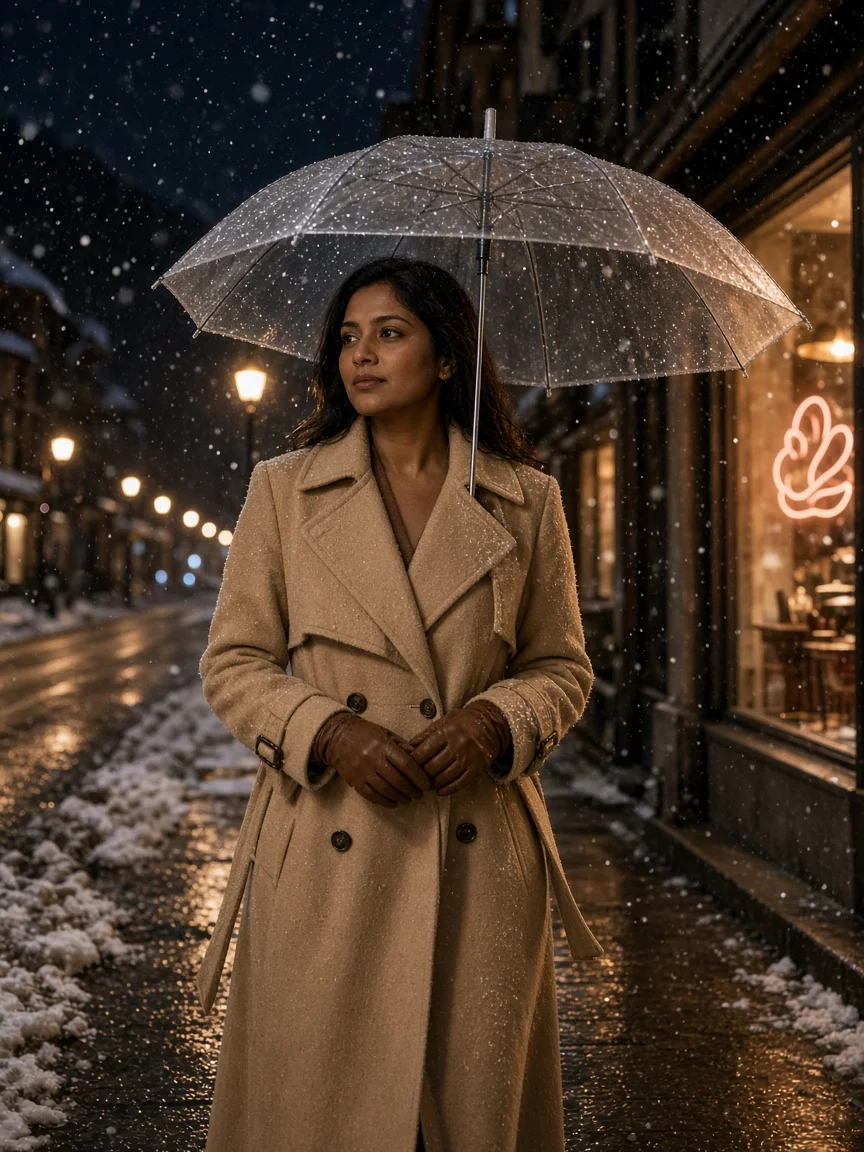
Edit the authorised adult Indian female reference into a believable winter mountain-town portrait at night. She walks beneath a physically correct transparent umbrella in a camel-beige wool trench coat and brown leather gloves, face facing three-quarter camera and eyes readable. A warm lamp behind one shoulder backlights slender falling snowflakes into a few bright points, keeping density moderate and hair visible. Distant modification cafe-window neon and golden street lighting reflect softly on wet slushy roadside edges, not a completely glass mirror city. One more subdued neutral front fill retains the reference skin colour under mixed illumination. Practical coat collar and accurate glove-held umbrella shaft, natural walking posture, vertical 3:4 cinematic editorial but authentic snow physics, no shop signs or watermark.
Cable-Knit Cocoa on a Chalet Sunrise Balcony
Morning cocoa works because the physical action supports the weather and environment. Two hands can wrap a broad rustic mug while steam escapes freely above the rim; the mug should be comfortably held and never intersect the sleeve. Long icicles belong overhead at the building edge and extend vertically—not in the body line from shoulders. Cream knit catches a soft rose or amber light from mountain sunrise but remains cream rather than pink, and snow-white clothing detail must be protected from blown highlights. A frame that fits balcony rail establishes subject scale much more effectively than an isolated face floating in mountain white.
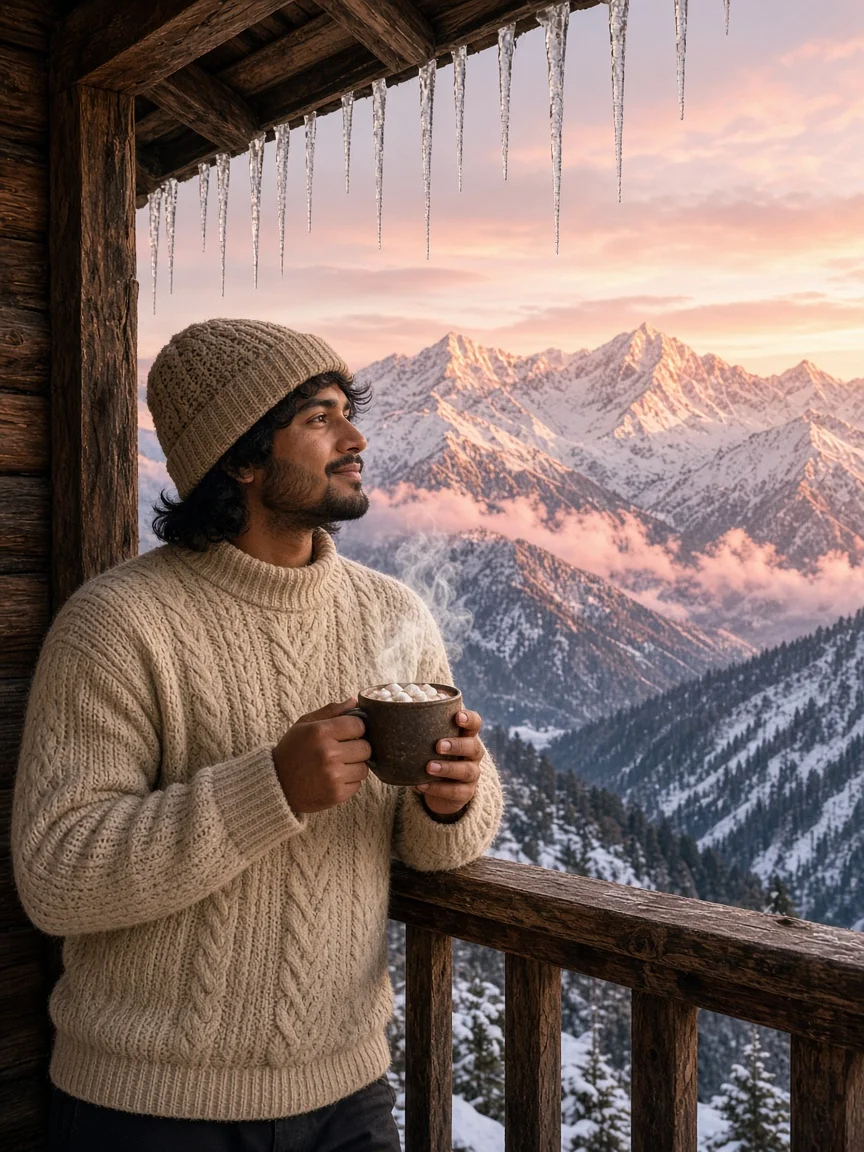
Create a cozy sunrise chalet balcony portrait from my permitted Indian adult male reference. Keep my face, hairstyle and natural winter beard identifiable with correct skin tone. I wear a chunky cream cable-knit fisherman sweater and warm neutral knit beanie, holding one rustic dark ceramic mug of hot chocolate with small marshmallows in both natural gloved or bare hands. A delicate line of steam rises from the cocoa and moves gently in morning cold air. Icicles hang safely above the balcony’s overhanging roof with no strange spikes through face, wooden railing and log wall in foreground leading to golden-pink alpenglow on detailed snow mountains. Warm facial daylight and textual cable-knit stitches, 50mm storytelling editorial, vertical 3:4 no brand labels or watermark.
Adult Siblings Playing in a Himalayan Pine Clearing
Adult sibling action benefits from separate defined poses. The near face and mittens should resolve crisply enough to show colour and expression, with interaction aimed at outer winter clothing, not head or neck. Snow scattered from a ball’s grip can produce a few larger chunky particles in the foreground while tiny atmospheric pieces sit in farther layers. One tree can naturally partially occlude one person, but duplicated limbs, boots eight inches apart simulating dislocated knees and one head emerging from the wrong sibling are clear rejection reasons. For real play, use soft snow, space to step safely and enthusiastic consent.
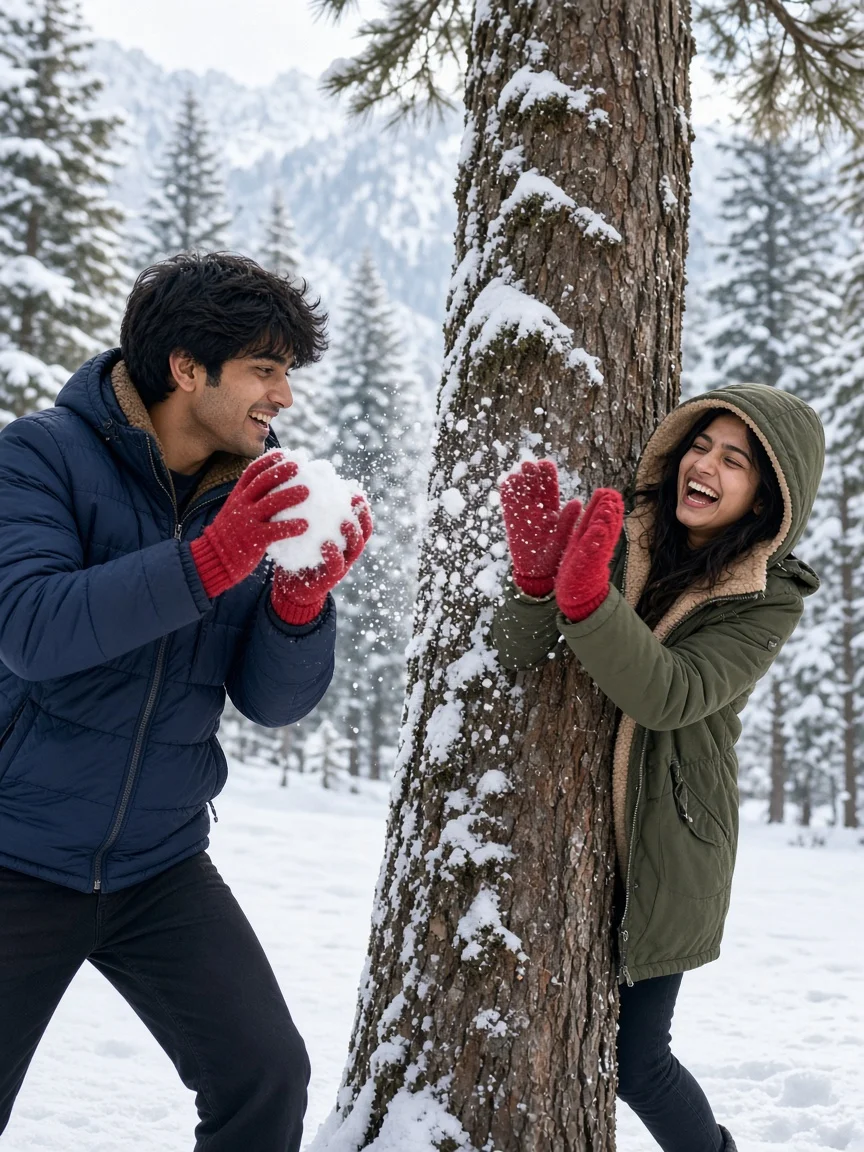
Using authorised references of an adult Indian brother and sister, create a fun but safe winter play portrait in a crisp Himalayan pine forest. Both adults remain clearly age-appropriate with individual familiar facial features, the sister in olive-green parka with warm sherpa hood in her late teens and brother in navy quilted puffer in early twenties. She laughs and steps beside a broad tree trunk, both of her red mittens protecting face in a natural defensive gesture. He holds a small loosely packed snowball near shoulder angled toward her outer parka at safe separation, no projectile aimed at either face. Sculpt natural high-shutter airborne powder with larger only at active hands and fine flakes farther away, clear daylight faces and genuine sibling expressions, 3:4 vertical movement portrait without studio stiffness, no watermark.
Diagnose flat, over-filtered or identity-changing snow photos
Flat snow often has three typical problems: every flake has the same size and brightness, the white overlay sits uniformly across the entire face, or snow is refracted into blurry circles with no atmospheric hierarchy. Remove large bright particles from eyes, lips and central eyebrows, with only rare foreground bokeh near edges in a given composition. Give nearer particles less definition when they are out of focus while far flake size and density should naturally reduce. When you request weather interaction, specify mitten, wool, beanie, bark and bench contact separately.
Identity and colour must be assessed against the original file at same magnification. A desired winter-kissed effect can produce artificial red cheeks and unusually blue lips, so reduce them rather than claiming this preserves true skin. Reject repeated portrait-smoothing if eyebrows and natural fine beard detail disappear. The same criteria as a fashion portrait apply here: eyes gaze orientation, actual hairline under beanie and the neck-to-scarf attachment should look plausible. If the crop loses all of these areas, the fact that background snow is technically attractive becomes irrelevant.
For children and family photos, permission and privacy are the main publication checks—not merely pretty snow effects. Limit publicly shared photos to ones caregivers want outside their own album. Do not misuse a photograph from a public upload as if permission were automatically granted to make derivative pictures. Existing family-milestone guides such as one month baby boy photoshoot prompts and one month baby girl photoshoot prompts discuss safe controlled home reference capture, though their infant-specific constraints should not be confused with supervised outdoor snow play for an older child.
Save the right crop and keep a useful record of the edit
Decide first whether you need an overall narrative, social avatar or memory print. A table frame is best with moderate surrounding architecture to show a bench or chalet context, whereas a cropped avatar concentrates on the eyes, red knit or gold Tilla. A taller 9:16 story can hold ski scenery above a clear face, but it is not a one-button export across all ten scenes unless headroom was planned. Crop again from a full three-by-four master and keep the original safe source rather than overwriting it with a digital art result.
For a phone background, evaluate where clock or icon text will sit relative to crimson ears, snowy ridges and window light. Our iPhone lock screen wallpaper prompts provide placement tips suitable for a separate export. Extremely bright ground can affect legibility on a phone, while the many black-blue areas of a neon snow night may appear cluttered behind notification icons. Retain both a clean master and a social-purpose crop instead of baking watermark-like corner messages into every output.
Name the output files after the source date, theme and revision, and preserve the final prompt with them. A responsible description can say “Snow getaway styled with AI from our old photo” when peers might mistake the image for research-grade weather conditions or an actual travel date. Snow prompts will be most valuable when the chosen winter scene expresses individual taste, honours culture and preserves a recognisable person, while weak extra effects have been intentionally left out.
Frequently asked questions
Are Gemini snow prompts free to use?
You may copy and adapt these prompts freely. Your tool’s own generation access, resolution, speed and quotas vary by account and version; no external guide can guarantee free unlimited generation. Check current tool availability before planning a large set.
How do I get snow that looks real rather than like a dot filter?
Describe different depth layers, smaller farther flakes, limited snow on outward shoulders and seats, and believable interactions with hair, gloves and fabric. Avoid equal-sized opaque dots on every part of the face, and inspect each source and result closely.
Does an 85mm f/1.8 instruction guarantee my real face?
No. It is an intimate portrait-style cue. Source clarity and your editor’s available reference controls matter more. Inspect identity versus original, especially under beanie, scarf, headwear or high-contrast neon snow lighting.
Which clothes stand out best in a snowy Indian portrait?
Crimson, charcoal, cognac, navy and red patterned pashmina all hold shape against snow. Pastel pink looks fresh in clear resort light if structural seams and face exposure remain distinct; choose the colour according to setting rather than using red in every scene.
Can I make a couple portrait from separate uploaded references?
Often yes where multiple references are supported. Label individuals explicitly and keep close eye level and similar illumination. Because interactions share fabric and hands, reject awkward blending, duplicated arms or changed couples instead of keeping any scenic success.
How should I create a child’s snow-play edit safely?
Use only an authorised child image and appropriate warm snow suit. Real play requires attentive adults, a safe compacted clearing, suitable gear and stopping for cold or discomfort. No throwing snow at a child’s face; privacy-safe family sharing may be more appropriate than public posting.
Can these prompts work in ChatGPT or Midjourney?
Adapt them into the exact reference, size and style controls of your current tool rather than assuming a universal syntax. Each gives a usable subject, outfit, weather, lighting and composition brief; identity preservation depends on source and model.
How can I prevent winter skin from becoming blue or orange?
Start with accurate daylight and ask for balanced white-bounce or neutral fill. Reduce output when a scene gives cheeks extreme red-blue patches, remove harsh neon glow and compare your selected image against the unedited skin at the same display brightness.
Related articles
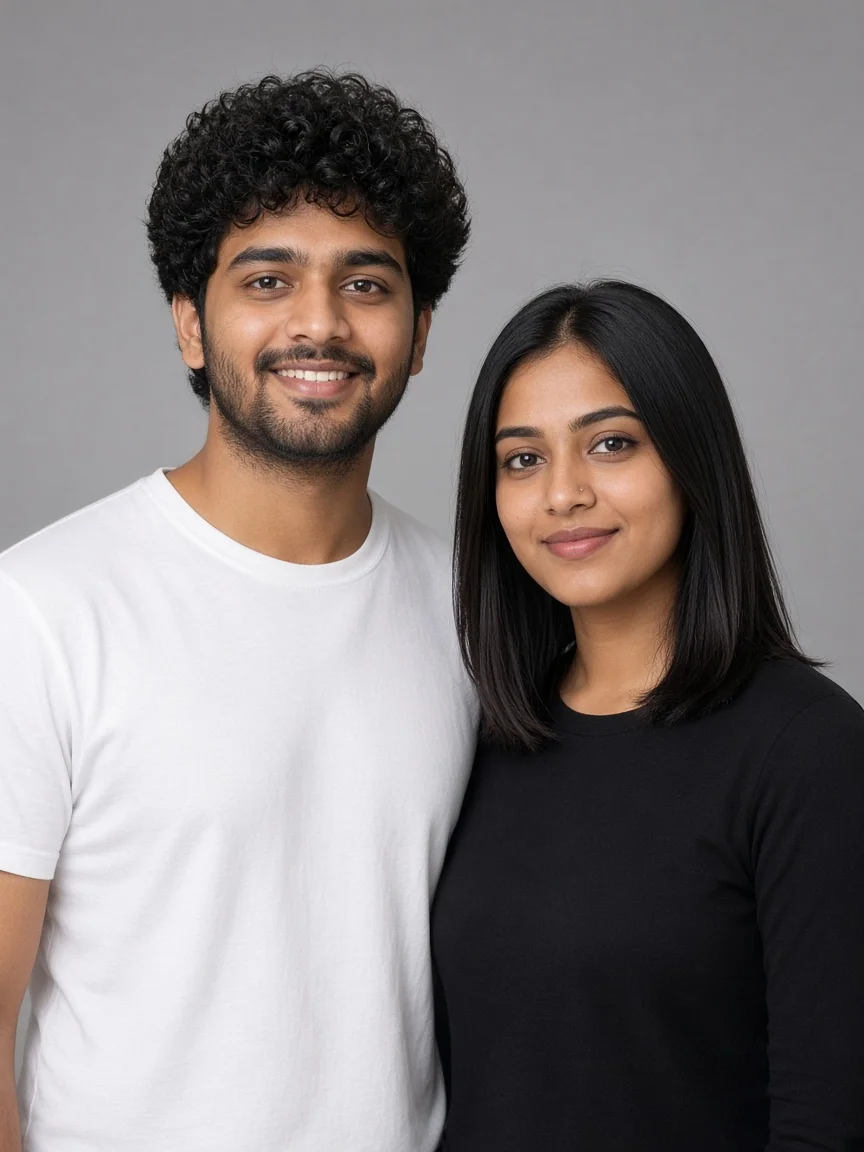
Gemini AI Photo Prompt Copy Paste Trending Boy and Girl: 10 Themes + Face-Lock
Ten copy-paste Gemini AI photo prompts for boy and girl with real results: studio face-lock test, 90s Connaught Place coffee, Jaipur courtyard, Kolkata neon rain, Himachal bonfire, Diwali doorstep, college library, Mumbai terrace picnic, Varkala cliff and Darjeeling toy train, plus a labelled two-reference method that stops face merging.
Nancy · · 17 min read
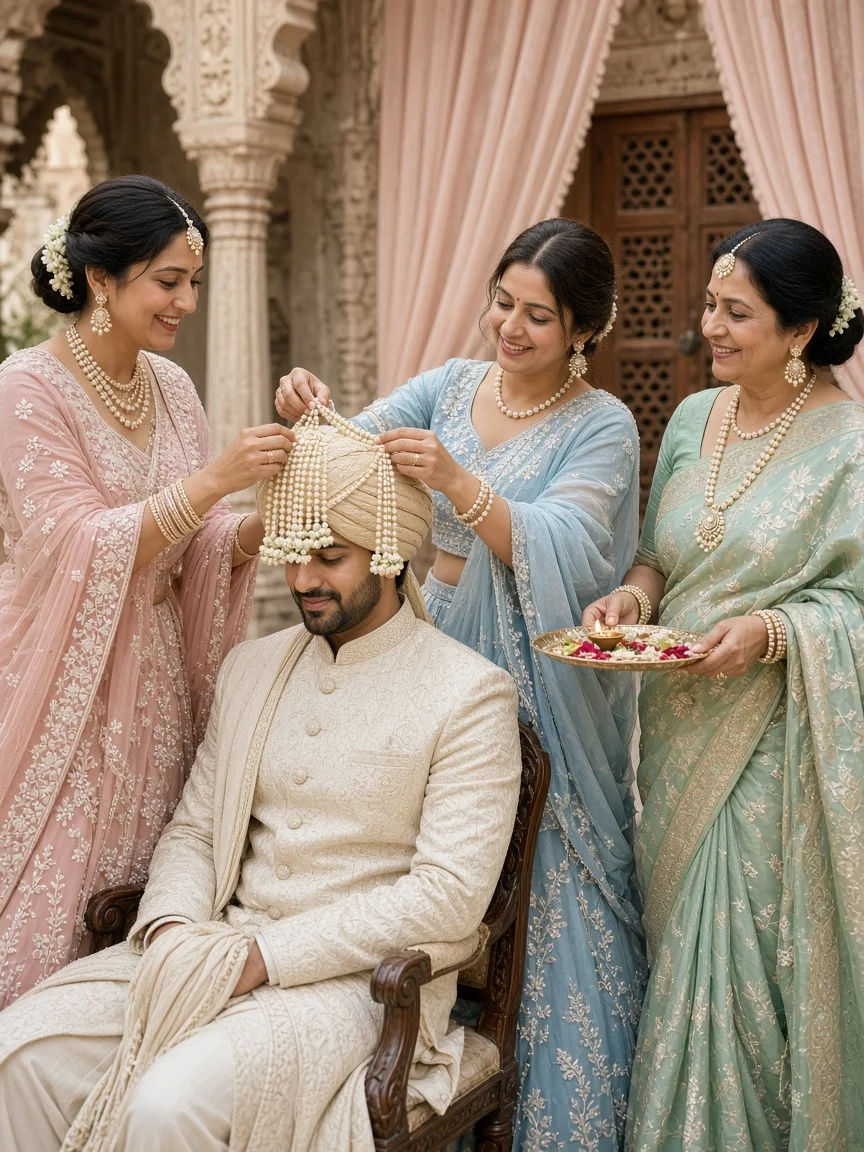
Indian Traditional Wedding Prompt for Gemini: 10 Pastel Ritual & Family Photo Ideas
Ten pastel Indian traditional wedding prompts for Gemini focused on family rituals, with real results: sehra bandi, milni, phoolon ki chaddar, kanyadaan, petal-shower blessing, vidaai, Punjabi chooda, Marathi antarpat, griha pravesh and joota chupai, plus family colour coordination and a multi-face workflow.
Nancy · · 18 min read
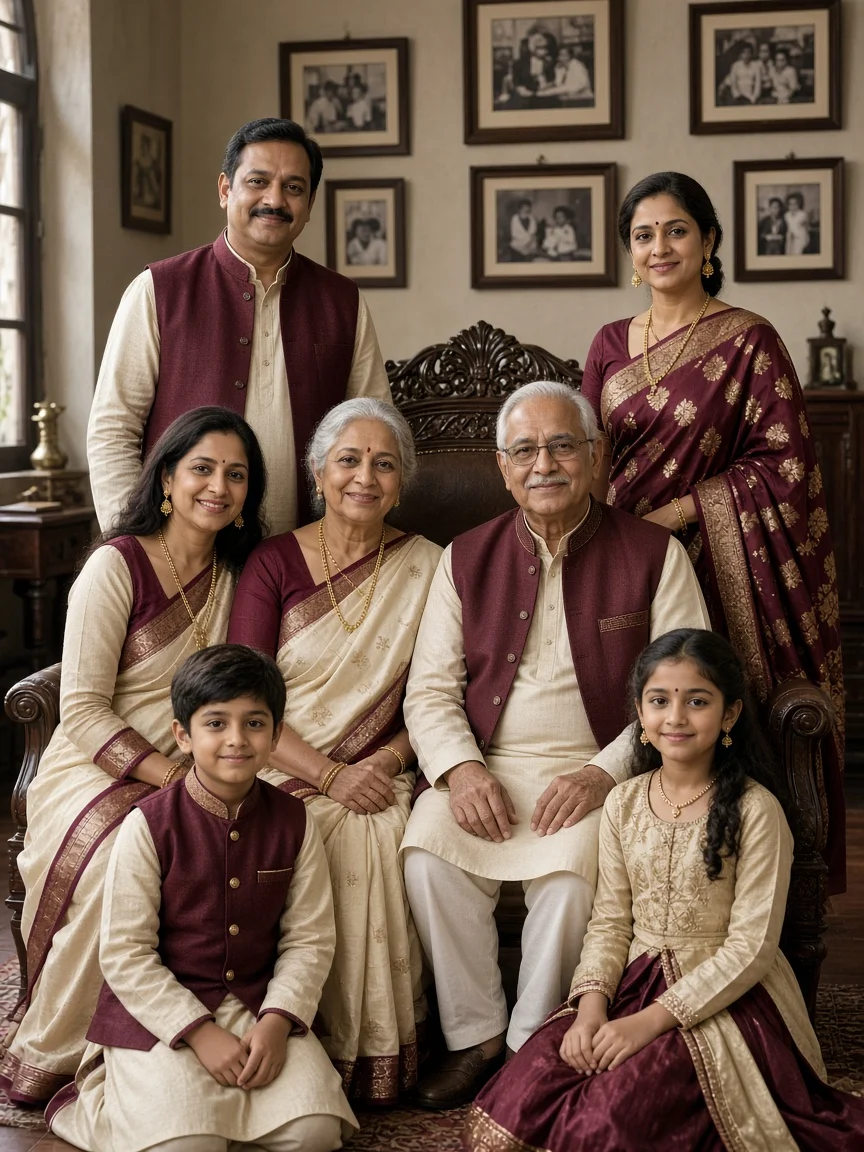
ChatGPT Indian Family Photo Prompt: 10 Joint Family Portrait Ideas
Ten ChatGPT Indian family photo prompts with images: three-generation heritage living room, beige studio, Kerala veranda, Punjabi courtyard, Sunday chai breakfast, garden walk, grandparents storytime, palace arches, reception stage and Holi blessing, plus multi-face mapping, colour planning and fixes.
Nancy · · 17 min read
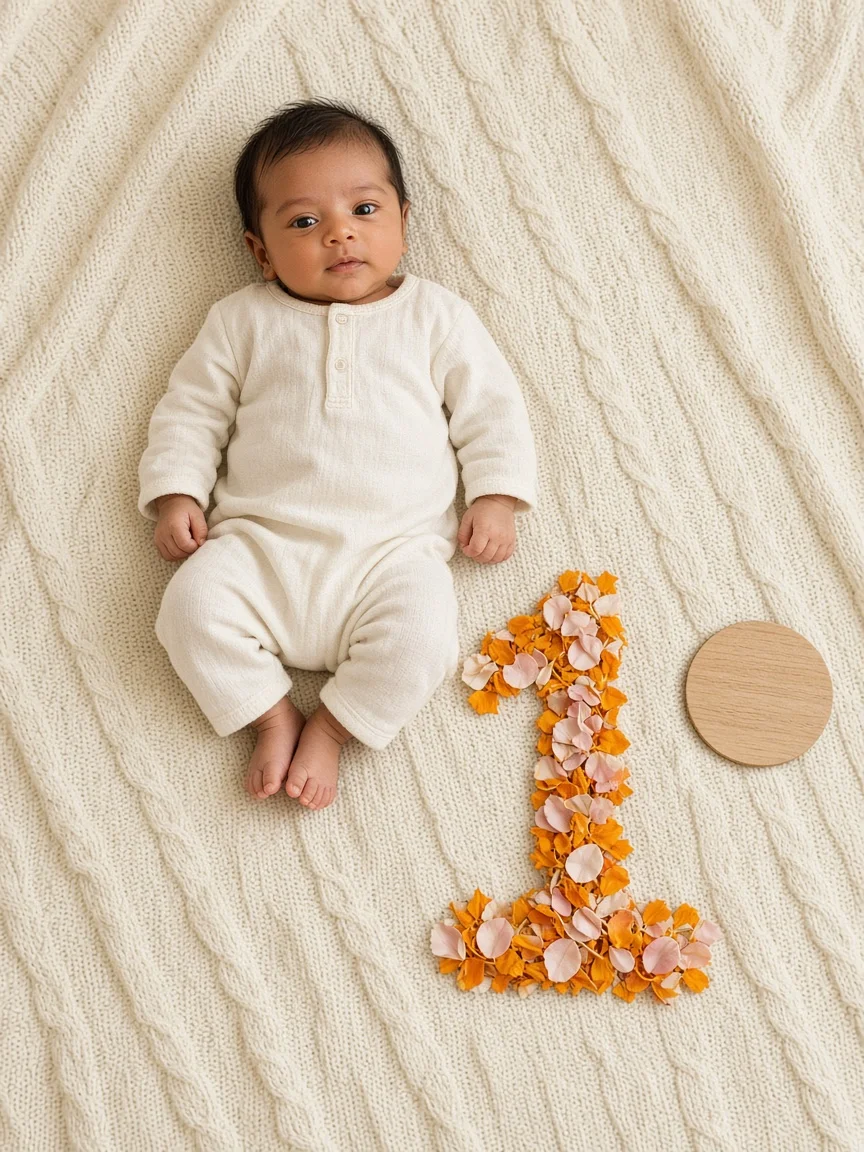
1 Month Baby Photoshoot Prompt Girl
Plan a one month baby girl photoshoot with 10 original Indian, home and Pinterest-inspired AI prompts, practical editing help and responsible safety guidance.
Nancy · · 18 min read
Comments
No comments yet. Be the first!