Winter Prompt for Boys: 10 Free AI Photo Editing Ideas
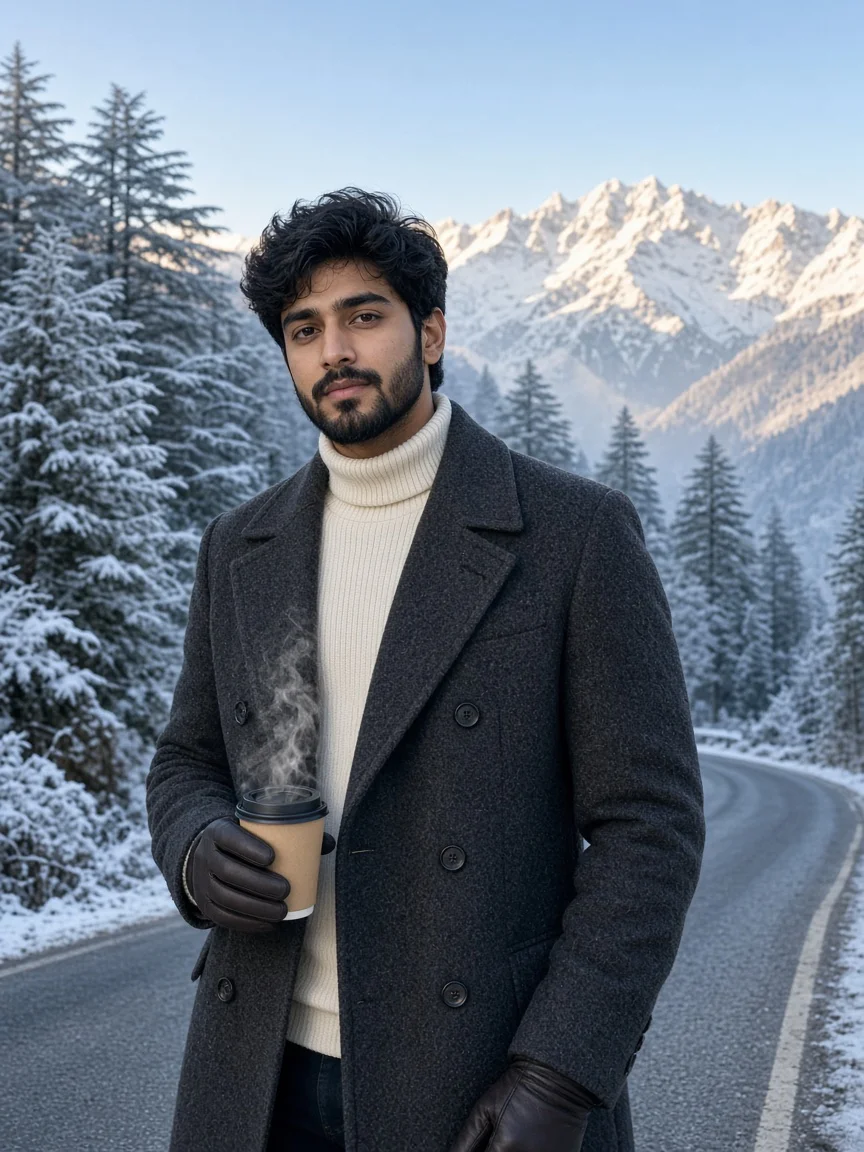
Table of contents
- Why winter prompts work best as a wardrobe and lighting brief
- Build the prompt around a real wardrobe and a clear hero
- Start with a selfie that preserves useful identity landmarks
- Oversized Cream Fleece in an Urban Winter Fog
- Manali Morning Coffee and a Charcoal Wool Coat
- Leather and Shearling on a Foggy Highway
- A practical Gemini or ChatGPT winter editing workflow
- A Cabin Fireplace and Chunky Cable-Knit Wool
- Matte Black Puffer in a Lantern-Lit Night Market
- Caramel Corduroy and a Vintage Camera in Shimla
- Matching winter texture to Indian winter weather and light
- Forest Green Varsity on a Misty University Path
- Charcoal Tweed and Kashmiri Pashmina in Srinagar
- Camel Wool and Espresso Cashmere in Alpine Light
- Buffalo Plaid Around a Mountain Campfire
- Choose a final edit for its consistency, not just its drama
- Export and crop the best winter image for its actual use
Why winter prompts work best as a wardrobe and lighting brief
A good winter prompt for boys free should do more than add snow to an ordinary selfie. Winter offers tactile clothing, distinct indoor-and-outdoor light, and natural gestures that give an adult Indian man a specific photographic presence. This guide turns those ingredients into ten original, copyable AI prompts: fleece streetwear on a foggy lane, structured wool in Manali, a shearling biker jacket, a cozy cable-knit cabin, a matte down jacket in a market, caramel corduroy in Shimla, campus varsity styling, a Srinagar pashmina, camel-coat resort tailoring and buffalo-plaid camp clothing.
The copyable instructions work as a starting point for Gemini, ChatGPT or an editor accepting an uploaded reference. They do not guarantee likeness. “Natural skin pores” and “85mm” are style clues, not identity locks. Think of them as a helpful layer on top of a good initial portrait, not as a substitute for one. Keep your face and hair comparison image beside the edit and make sensible changes based on the actual result.
Keep consent and authorship clear when using someone else’s portrait, and avoid implying you visited a destination just because a generated backdrop says Manali, Shimla or Gulmarg. Describe winter outfits as aesthetic shifts unless you truly wear and own them. There is no need to present a composite campsite or highway portrait as actual amateur evidence of a trip or activity.
Build the prompt around a real wardrobe and a clear hero
The textured pieces here matter more than “8K” or “ultra realistic.” Heavy cream fleece offers a matte, soft surface for fog; a charcoal wool trench creates clean lapels and a straight winter silhouette; a shearling collar gives the face a small light border. Irish cable knitting catches low indoor light, while a matte black down jacket keeps shiny reflection away from your face. Corduroy ribs, herringbone tweed and a woven pashmina supply texture without putting conspicuous branded motifs everywhere.
Choose one hero garment and let the rest serve it. For the campus look, forest-green varsity and grey joggers do the work, with one backpack for everyday credibility. At a resort, camel overcoat, espresso turtleneck and gloves require no additional scarf or logos. Near a campfire, red buffalo plaid should stay the only vivid accent. Adding ski goggles, a fur stole, multiple watches and a second coat will increase layering mistakes instead of giving stronger realism.
Keep function consistent with weather. Wool and thermal clothing make sense around a snowy valley, whereas a casual cream fleece can suit a city with mist rather than a severe blizzard. A pashmina muffler is an accessory for early-morning Srinagar chill, not an excuse to cover your jaw in the very picture meant to retain identity. The campfire image deliberately specifies sitting at a reasonable distance and hands away from the flames. The biker concept is a stationary fashion portrait beside a parked bike, not unsafe fog riding.
Start with a selfie that preserves useful identity landmarks
Use a well-lit selfie taken in day or neutral indoor light. The camera should be roughly at eye height and at least an arm’s length away to avoid stretched nose or cheeks. Keep the forehead, ears and jaw largely unobstructed; avoid dark sunglasses, thick masks, enormous collar folds or hands over the beard line. If the original hair is visible, do not expect a beanie prompt to preserve the same hairline exactly. Consider removing the headwear from the prompt or ask to preserve the related facial landmarks because attention to the eyes and cheekbones still matters.
Provide a source with a clean background and natural daylight on both sides of the face where possible. Overly dramatic side-lighting may leave one side in shadow when the AI editor interprets an overcast city or snowy scene. Turn off smoothing, face-shape adjustment and aggressive night-brightening filters. A moderate three-quarter view is fine for a fashion portrait, but mention which direction your body should face when editing—for example, “maintain slight left shoulder angle”—so the final output changes the environment without changing the person completely.
Leave room around your original shoulders and torso for the new jacket or coat. If you only have a tightly cropped headshot, a jacket shoulder and plausible collarbone are generated rather than sourced, so review for misaligned necks and false body proportions. A second source with a normal standing photo can offer body reference in tools supporting it. Do not supply multiple unrelated selfies and label them all as “me”; ambiguity about which face to use produces some of the most common identity mistakes.
Oversized Cream Fleece in an Urban Winter Fog
This is the least formal winter direction and a strong choice for a foggy city morning. The oversized cream hoodie contrasts the charcoal beanie, while headphones around the neck supply an everyday detail without a logo. Limit breath vapour to a small amount at mouth level; a huge smoke-like cloud will make the street look fantastical. Soft fog should hide background visual noise, not erase your lower face. Try sage or mocha if your wardrobe is darker, but do not tint your skin to match the trend colour.
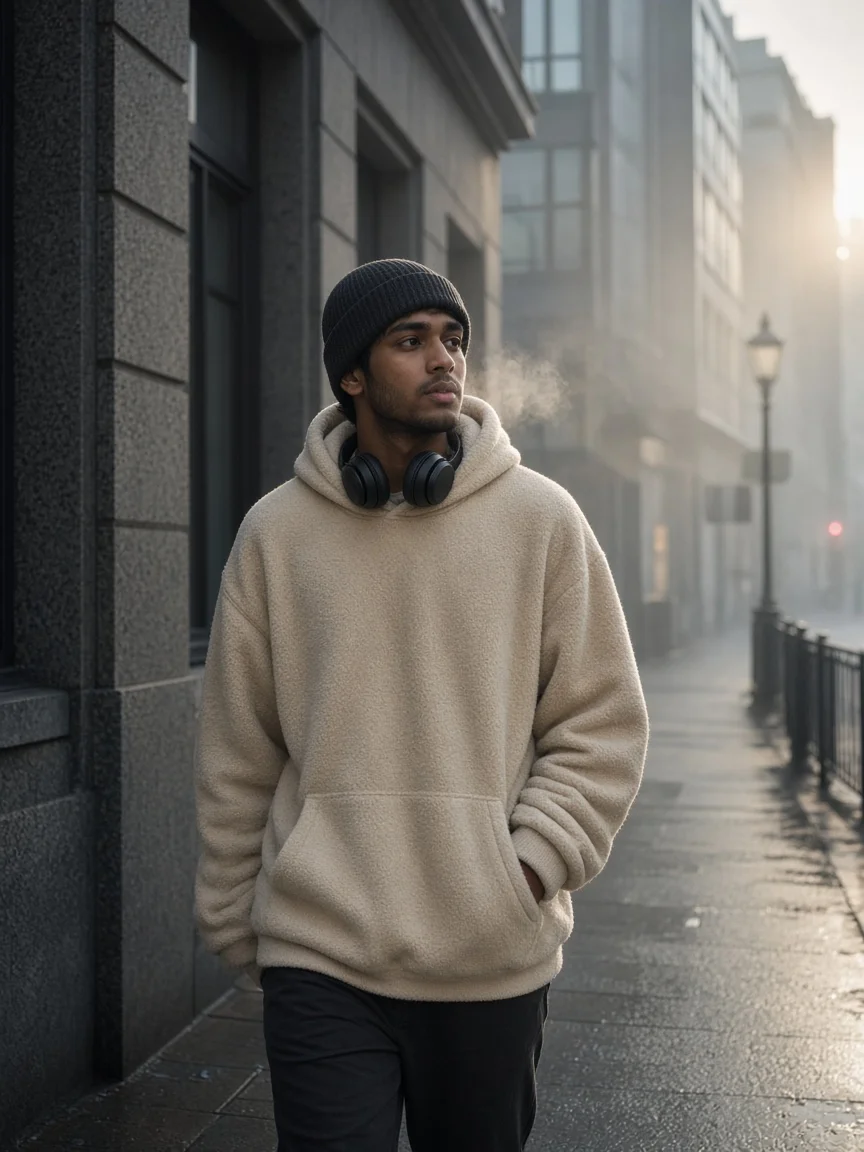
Edit my clear permitted selfie into a natural winter streetwear portrait of the same Indian man in his early twenties. Retain my facial geometry, dark hairline, natural beard and medium brown complexion. Place me walking along a quiet misty urban lane wearing an oversized heavyweight cream fleece hoodie, a charcoal ribbed beanie and matte-black over-ear headphones loosely around my neck; dark casual trousers and a relaxed authentic walking posture. Add only a faint breath plume in cold morning air. Soft filtered sunlight through light fog with muted stone and glass architecture in soft background focus. Natural skin texture and visible anatomy, honest 85mm editorial perspective, no extreme blue cast, no lettering, no watermark. Vertical 3:4.
Manali Morning Coffee and a Charcoal Wool Coat
The featured winter portrait combines charcoal wool, ivory knitting and a modest coffee cup prop. A 50mm direction keeps forest and mountains more recognisable than aggressive background blur. Steam works best as two thin visible curls rather than a giant burst from the lid. Gloves can hide awkward hands, but if you want the finger detail, remove them from the clothing instruction and source a natural cup-holding pose. A saturated orange coffee cup is unnecessary—the white cup and grey-green mountain palette already carry the scene.
Create a sophisticated winter travel photograph using my provided adult Indian male reference, keeping my eyes, face, beard pattern and actual age recognisable. Style a tailored charcoal double-breasted wool coat over an ivory turtleneck and dark trousers. On a hillside road inspired by Old Manali, I stand in soft cold daylight holding a plain takeaway coffee cup with two thin wisps of steam, using dark leather gloves with correct hand anatomy. Deodar pines with light frost and clear distant snowy Himalayan ridges remain recognisable behind me at moderate 50mm depth. Balanced exposure protects warm skin undertones against the pale environment, real wool weave and fine knitted texture, vertical 3:4. No travel logos or watermark; do not imply a journey performed if captioning.
Leather and Shearling on a Foggy Highway
Leather and shearling create strong contrast, but both are independently reflective. Matte leather grain and a cream fabric collar should be described separately to prevent glossy plastic-looking sleeves. Keep the stationary motorcycle on a quiet roadside shoulder, not in the middle of a highway riding path. A little moisture on chrome is more convincing than heavy rain and fog plus glaring sunrise at once. For actual motorcycling a proper helmet, safe gear and safe conditions always take priority over an aesthetic pose.
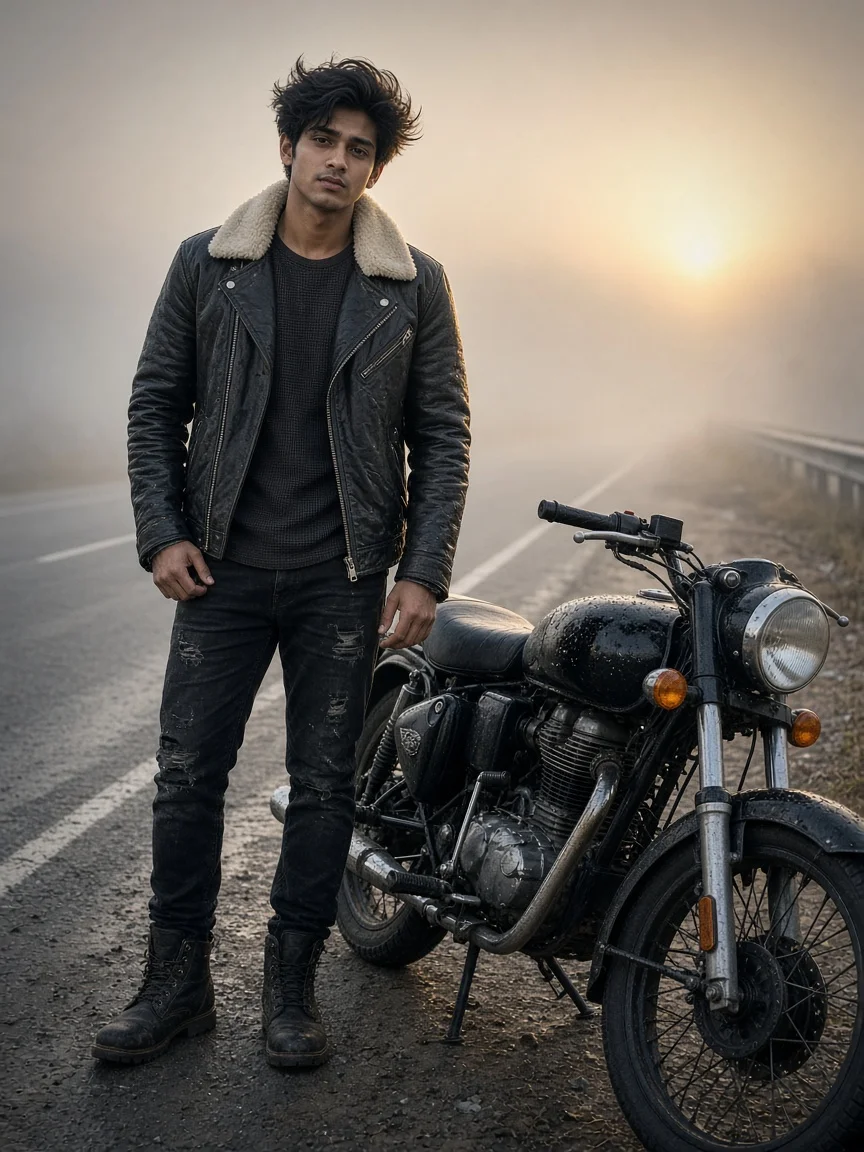
Use my clear reference for a cinematic stationary motorcycle winter fashion image, retaining my real male Indian face and actual physique. I stand confidently beside a parked unbranded classic black road motorcycle on a safe quiet highway shoulder at dawn, not riding or simulating unsafe driving. Style a distressed black leather biker jacket with a cream shearling collar over a dark waffle thermal, black denim and sturdy boots, hands relaxed and anatomically true. Tiny dew droplets on tank chrome and sleeve for texture. Diffused golden rays cut through pale fog behind shoulders while soft fill retains my skin tone. Detailed leather grain and warm wool lining, photographic body proportions and restrained colour grade, vertical 3:4, no text or watermark.
A practical Gemini or ChatGPT winter editing workflow
Open your image-capable tool and choose a single concept. Start with “Use my reference” rather than “Indian handsome boy,” which may introduce an unrelated aesthetic stereotype. Add accurate age and personal details such as hair length, closely trimmed beard or broad frame if they must remain unchanged. Do not include a generic eye colour or “perfect jawline” that your reference lacks. Ask to retain your face and change the wardrobe or backdrop in the same instruction, then identify what should not be modified.
If the editor changes your hair or beard and keeps your eyes, remove headwear and declare the beard explicitly; if your face becomes too pale under snow, request balanced exposure and retention of the source’s Indian undertones—these are review cues rather than magical formula words. Return to your unedited input instead of repeatedly processing the generated version. Each pass can gradually alter your likeness and fabric texture. A fresh generation with a smaller set of constraints often works better than repeated facial-rescue instructions in an old conversation.
Apply optics as aesthetic guides. A medium portrait viewpoint has enough space for a puffer jacket and a cup; a full-length campus portrait requires the original body dimensions and an accurate walking stance. Do not add an extreme f/1.0-style effect to a scene where you still want campus bricks or Himalayan shape. For Midjourney and other interfaces supporting explicit character-reference or style-reference controls, such functions are distinct from these written descriptions and vary by version. Your comparative critique remains essential.
A Cabin Fireplace and Chunky Cable-Knit Wool
The cabin scene is an exercise in two-colour-temperature lighting rather than outdoor winter. Warm enclosed light illuminates one cheek while snowy window daylight supplies soft cool fill on the other. Excessive golden firelight will change your complexion; excessive blue from the snowfall will flatten it. Cable-knit knitting must remain raised and textured, with independent loops at the neckline, rather than a flat painted grid. Enclose the fireplace as a domestic setting and keep the seated pose physically comfortable and scale-consistent with the armchair.
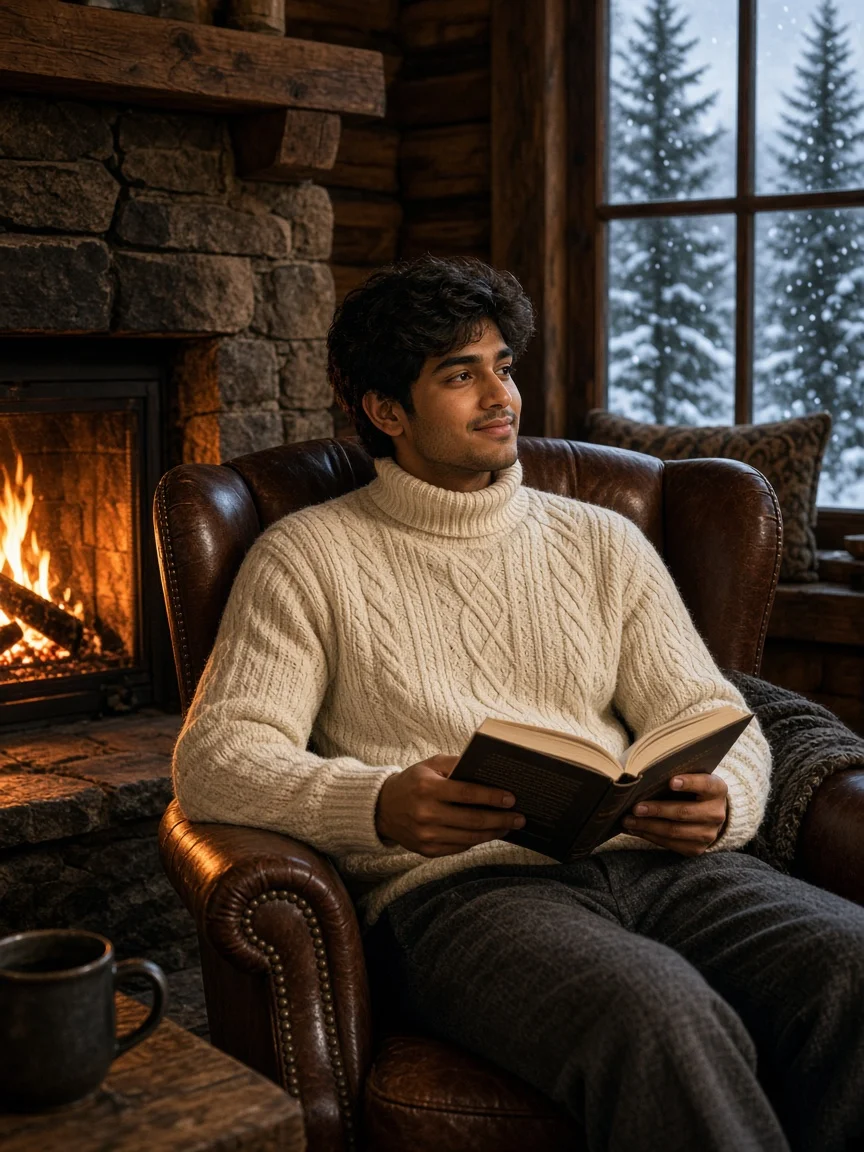
Transform my authorised daylight reference into a cozy indoor winter lifestyle scene with my recognisable Indian facial features and accurate beard detail, keeping the same adult man. I sit comfortably in a weathered dark brown leather armchair in a timber mountain cabin, reading an open blank-page hardcover book with truthful hand anatomy. Style a thick off-white Irish cable-knit turtleneck and charcoal flannel trousers. An enclosed stone fireplace provides low warm illumination from one side; a window with snow and dark pines delivers soft cool fill on the other rather than overexposing my face. Detailed stitches, leather patina and rustic timber, relaxed natural expression, 50mm indoor lifestyle photo, vertical 3:4, no text and no watermark.
Matte Black Puffer in a Lantern-Lit Night Market
Night market edits can overwhelm Indian skin with orange and purple spill. Ask for one dominant warm lantern light and a quiet secondary fill, not five contradictory neon sources. Matte quilting differentiates this from cheap shiny nylon; describe its fabric and construction explicitly. Vendor steam belongs behind the subject and light breath near the mouth, each with different density and opacity. Keep background signs unreadable and subdued so AI-generated lettering does not distract from clothing and face.
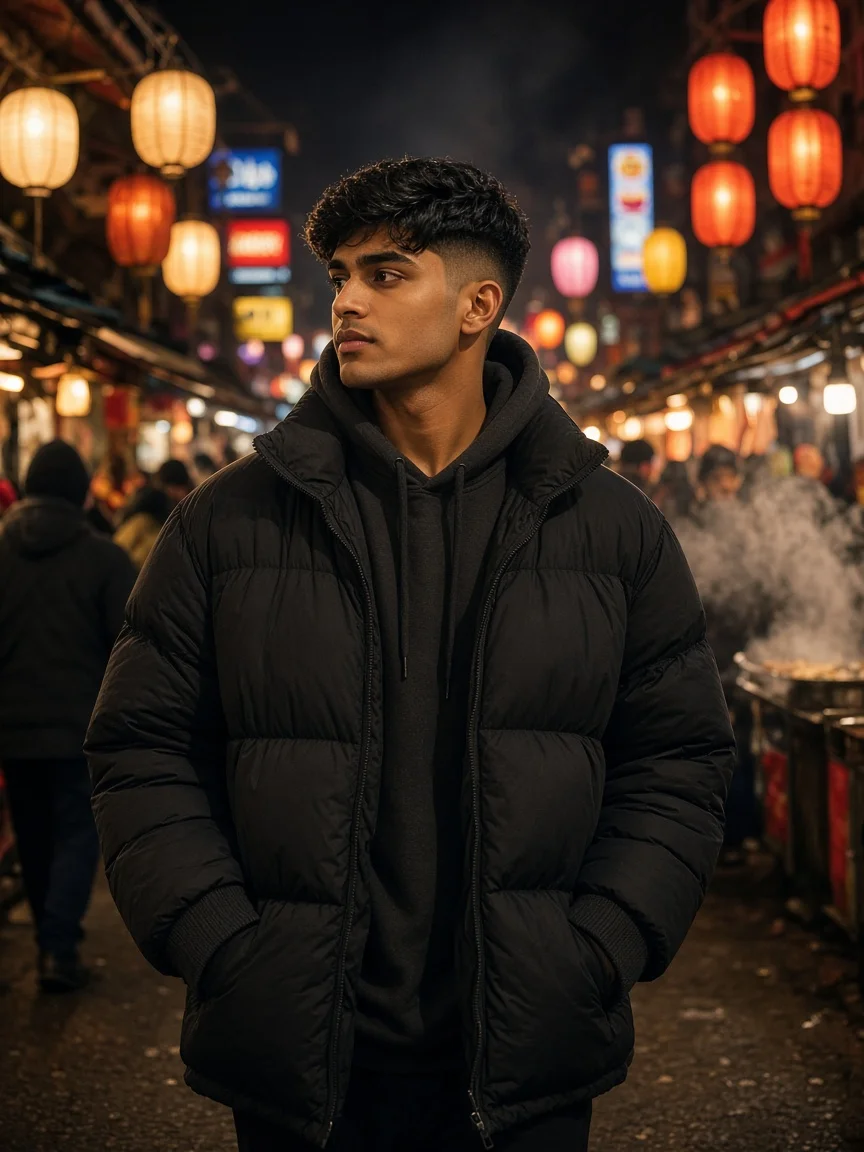
Use my permitted reference to create a candid Indian male winter street image at night. Retain natural national skin undertones, facial structure, eyes, hairline and available stubble. Dress me in a premium matte-black oversized down puffer jacket with distinct practical quilting over a dark charcoal hoodie. I walk through a lively night market with distant crowds, amber lanterns, vendor steam and blurred neon points, keeping steam in the background separate from only a slight breath mist near my mouth. Light my face with believable warm stall spill but preserve real detail and avoid bright blue or orange overlays. Neutral momentary expression and hands naturally in pockets, 85mm photography look, vertical 3:4 no readable stall branding.
Caramel Corduroy and a Vintage Camera in Shimla
The Shimla corduroy look is an outdoor travel-lens example where a useful prop improves posture. A camera strap across the chest should lay naturally against the jacket and not emerge from your elbow; repair dangling straps or remove the camera completely if it appears twice. Earthy caramel and olive harmonise with pine bark and frost. A moderately frosted pine branch tells the season’s story without covering everything in a thick blue-white overlay. Guidelines on quiet ambient scenery are useful for profile pictures too, not only full travel frames.
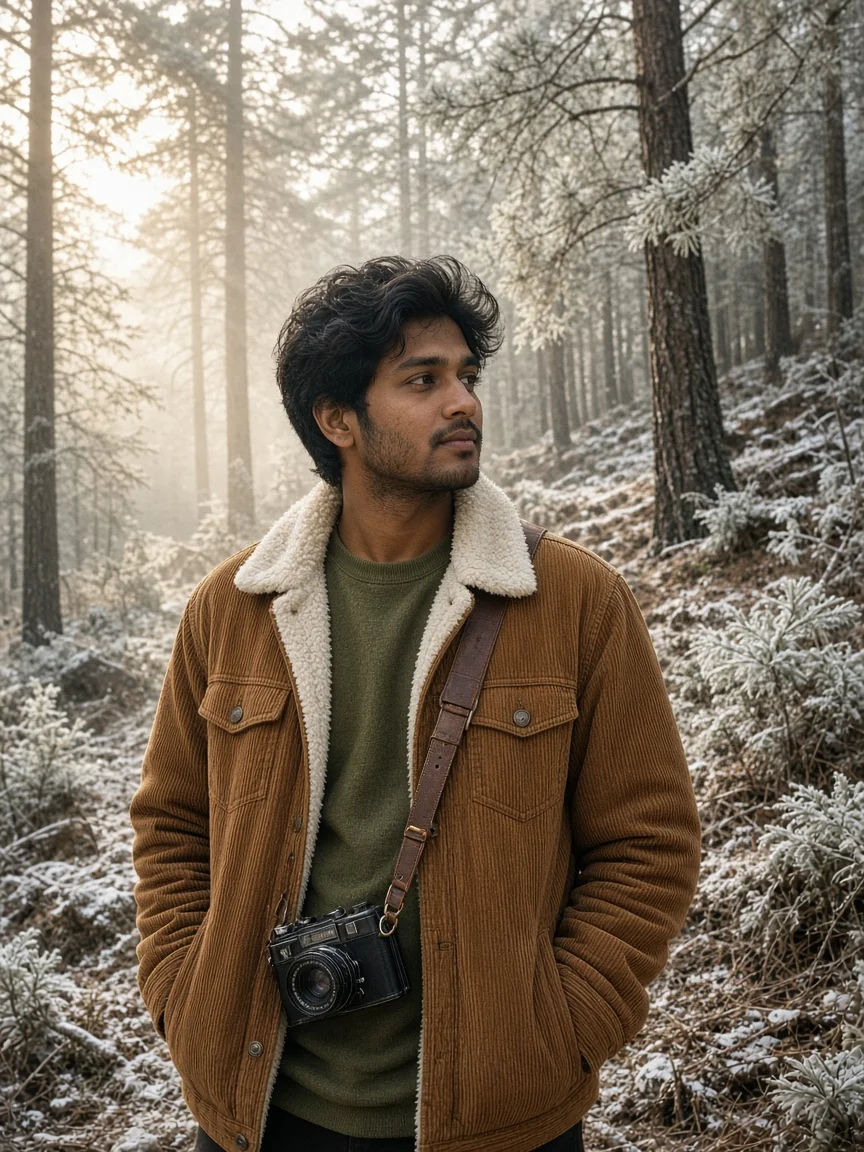
Create a quiet Shimla pine-forest winter portrait from my provided reference of an Indian adult man. Keep the same real features and frame a candid paused-on-the-trail moment. Style a caramel corduroy trucker jacket with an ivory sherpa collar over an olive crewneck and a simple unbranded vintage black 35mm film camera hanging from a worn brown leather strap across my torso. Hands rest naturally in accessible jacket pockets without distortions. Thin morning mist behind frosted pine needles, subtle frost on ground foliage and a modest angled sunbeam give depth without theatrical white overlays. Visible fine corduroy ribs and plush fleece, natural warm complexion and respectful outdoor travel feel, vertical 3:4 50mm editorials. No text or watermark.
Matching winter texture to Indian winter weather and light
A textured pashmina in a Srinagar corridor or a tweed jacket in Chinar season presents a distinct North Indian context compared with the generic alpine-coat look. Name a meaningful pattern only when you want it visible, such as restrained sozni embroidery. Avoid putting sheer fantasy scarf fabric beside a formal blazer. The scarf should follow shoulder velocity and gravity without becoming a painted second collar. Names of place, fabric and craft are not interchangeable; a truthful description in a caption adds editorial value beyond the picture itself.
For other traditional Indian portrait palettes, our anniversary couple guide includes silver zari, Paithani silk and pashmina choices when a completed batch draft is published. On Kerala-inspired textile styling, existing Onam saree prompts discuss avoiding a uniform over-yellow white balance. 1980s look AI prompts can help separate intentional fashion-era nostalgia from generic vintage filters, especially for the varsity and classic-motorcycle ideas.
If the scene involves a shared couple portrait, use the winter shawl concept in wedding anniversary AI prompts rather than forcing the male subject into a faux group scene. Existing Radha Krishna couple prompts serve a devotional concept rather than documentary winter, so keep the subject treatment explicit in your prompt. A strong article-inspired portrait fits a deliberate use: menswear reference, travel-memory art or a seasonal social profile—not all three in one aesthetic soup.
Forest Green Varsity on a Misty University Path
The campus look relies on relative scale as much as clothing. A forest-green wool body and cream sleeve contrast should map the varsity silhouette, with no university crest or invented lettering. One backpack shoulder avoids strange double backpacks; both legs should appear aligned with your direction of walking. Red-brick architecture and an early sunbeam have a calm academic feel, but if you want a recognisable real campus, use a permitted background reference from that specific location instead of implying an anonymous university in the prompt.
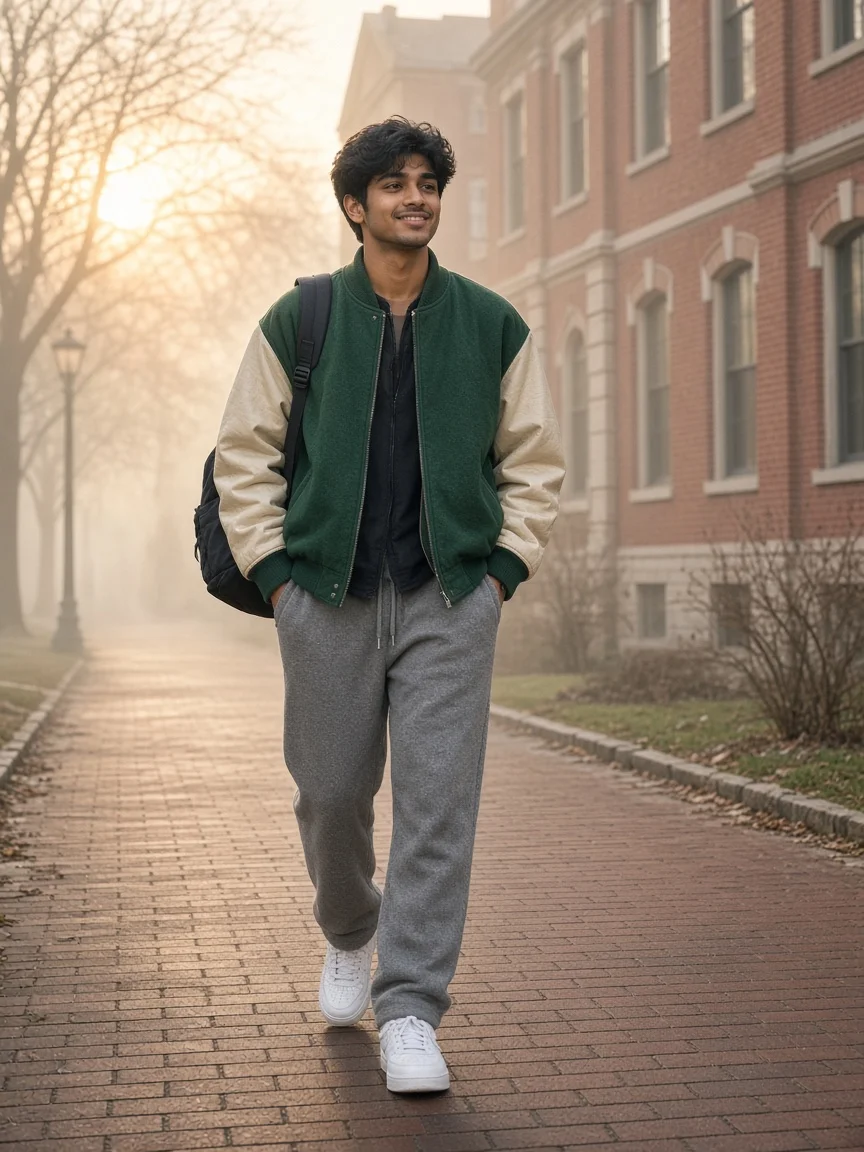
Edit my own Indian adult male reference into a stylish university-winter morning portrait. Preserve my identity rather than generating an unrelated student. Dress me in an oversized forest-green wool varsity bomber with plain cream leather sleeves and no insignia, grey fleece joggers, clean neutral white trainers and one simple dark backpack over a single shoulder. I walk naturally along a broad brick campus path with classic red-brick academic architecture softly receding behind, a gap between the buildings diffusing early sun rays into the light fog. Full-length or three-quarter composition with correct sneakers, fingers and comfortable walking proportions, authentic skin and wool textures, cold-season campus ambience, vertical 3:4, no university logo and no watermark.
Charcoal Tweed and Kashmiri Pashmina in Srinagar
This is a winter-heritage editorial rather than a general “Kashmir snow” picture. Charcoal herringbone looks structured at the shoulder, black merino fills the neck layer and burgundy embroidery supplies craft detail. Golden-rust Chinar leaves with a light frost on their veins contrast with the cloth’s fine threads. Early winter rather than heavy snow allows the leaves and textile pattern to stay visible. Keep head, scarf and hands readable, since overlapping neck layers can be one of the first regions a generation changes unexpectedly.
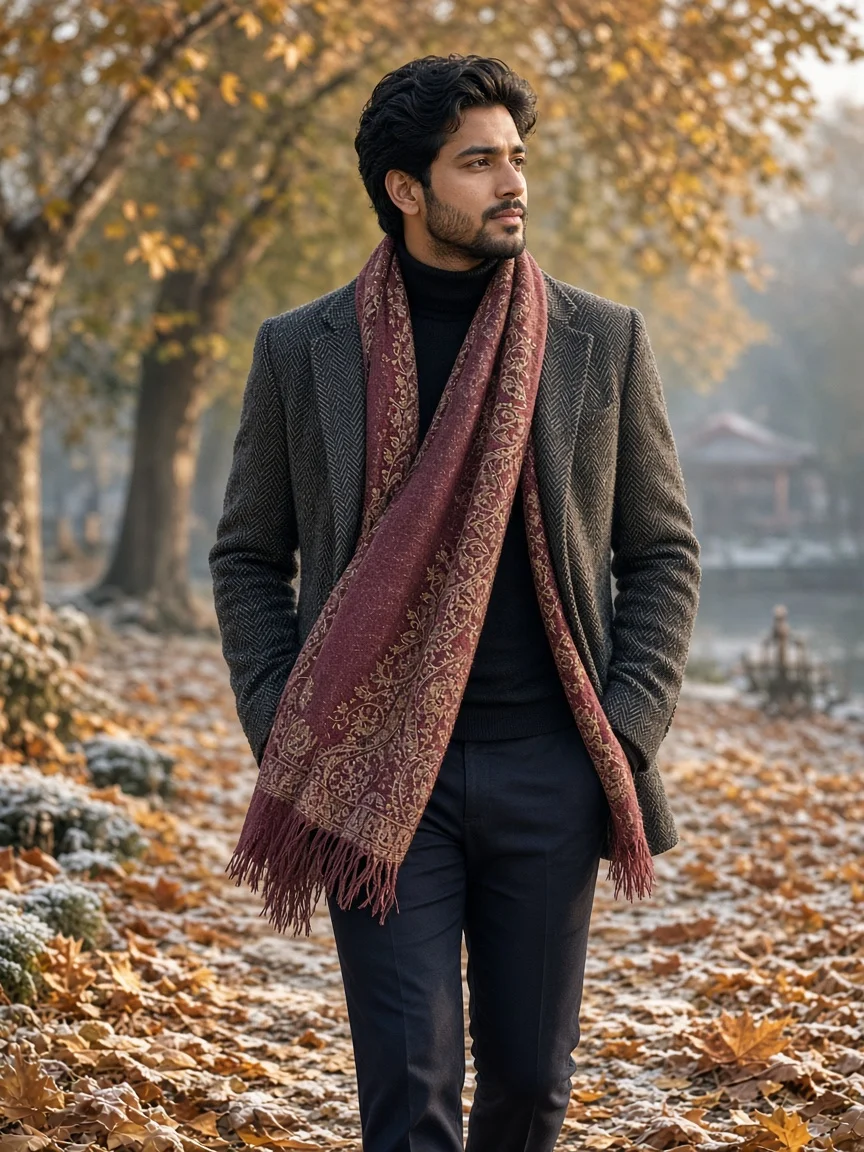
Generate an elegant cultural portrait of me as the same Indian man from my uploaded reference on a Srinagar Chinar garden path in early winter. Maintain my age, hairline, facial structure, natural beard and complexion. Style a charcoal herringbone wool tweed blazer over a fitted black merino turtleneck and dark trousers, with a softly draped burgundy Kashmiri pashmina muffler featuring subtle sozni floral embroidery. The fabric should lie naturally around neck and shoulders without tightening the chin. Golden-rust fallen Chinar leaves carry a touch of frost on the ground. Warm side-angled winter sunlight highlights the weave and embroidery without whitening skin. Respectful relaxed stance, 85mm high-end photo look, vertical 3:4, no text or watermark.
Camel Wool and Espresso Cashmere in Alpine Light
Resort style should resist visual excess. Double-breasted camel wool with espresso cashmere has warm material contrast but limited colour saturation, letting snow and natural sky frame the subject. High-altitude sunlight can be both bright and diffused through skin: ask for preserved brown undertones, not whitening. One pair of smooth leather gloves preserves a clean hand region. Tall peaks should sit in the background with a moderate decrease in detail rather than becoming a pasted jagged wall behind one coat lapel.
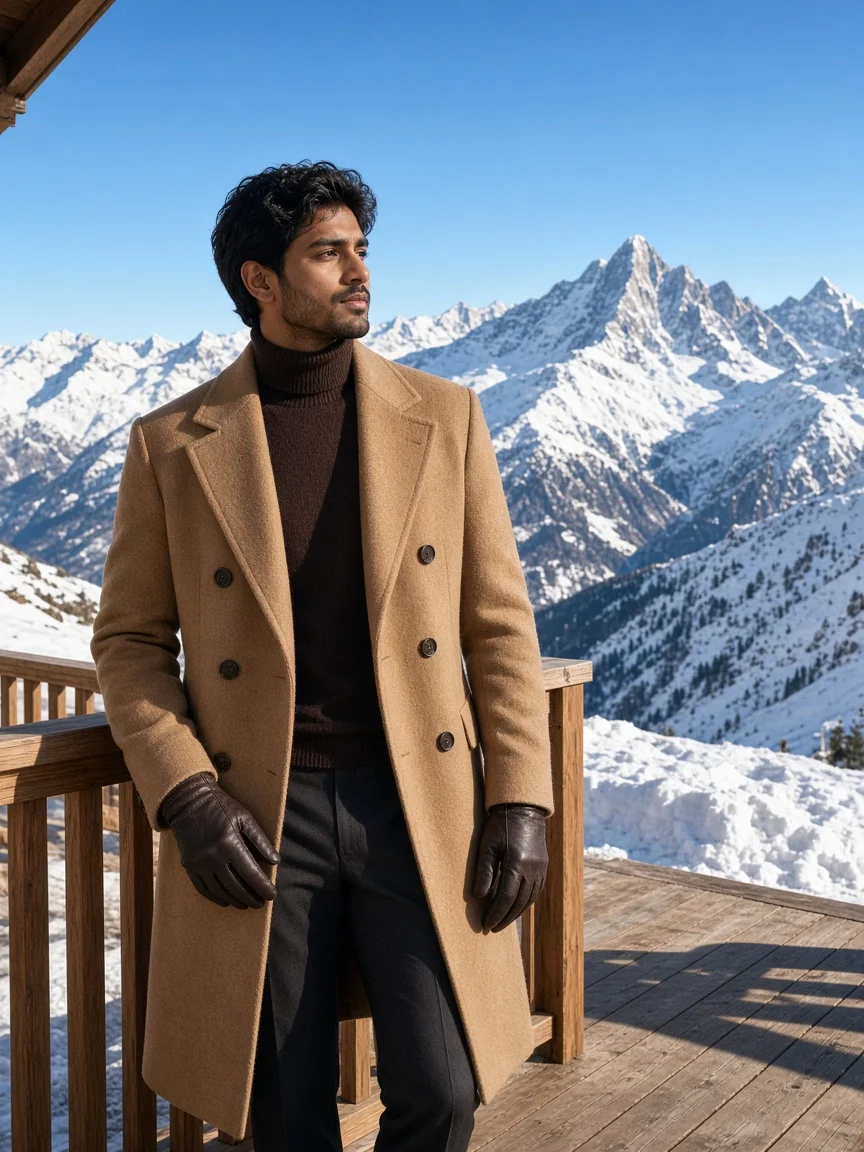
Use my permitted selfie to create a quiet-luxury alpine resort editorial preserving my distinctive Indian male face and natural age. Dress me in a properly shaped double-breasted camel wool overcoat over an espresso-brown cashmere turtleneck, tailored dark trousers and dark leather gloves. I stand on a rustic wooden sun terrace with a distant panorama of snowy mountain ridges beneath a crisp blue sky. Bright sunlight on snow should be balanced by natural bounce fill so my skin texture never washes out or becomes artificially tan. Fine wool nap, cashmere knit and refined but not theatrical body posture, 85mm fashion editorial perspective, vertical 3:4, no expensive logos, branding or printed words.
Buffalo Plaid Around a Mountain Campfire
The campfire scene uses a deliberately small controlled flame and a distant seat. Warm firelight touches one cheek while a soft blue night fill keeps the other readable, another approach to outdoor mixed light. Buffalo plaid should obey the folds and side seam of a winter jacket, not remain as a flat checkerboard stuck on the collarbones. A few glowing embers may add atmosphere, but a simple charcoal beanie keeps your face readable. Avoid repeated chest flames, extra logs, sparks near face including beard, or leaving an open unguarded fire if attempting real evening photography; a digital scene is preferable for convenience.
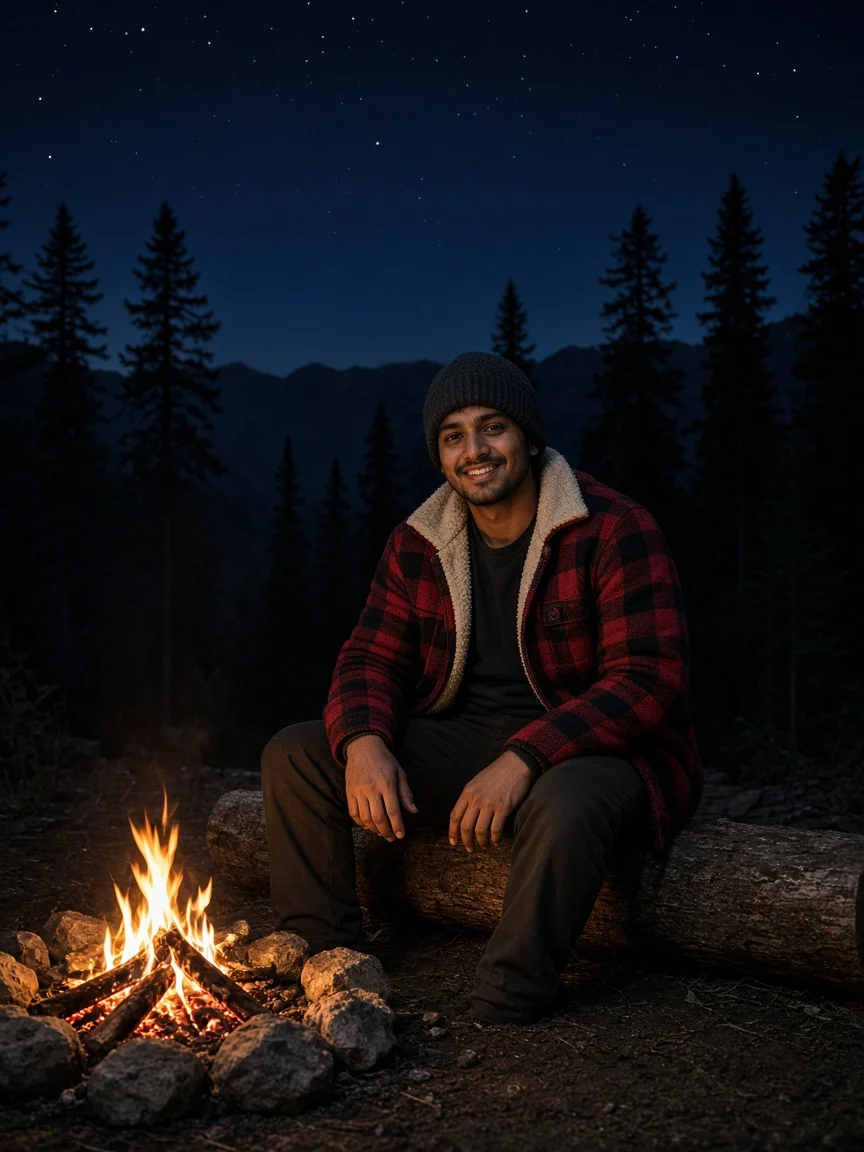
Create a winter camping portrait of the same Indian man from my permitted reference, dressed warmly in a red-and-black buffalo plaid flannel jacket with visible sherpa-lined collar over a dark thermal top, dark trousers and charcoal knit beanie. I sit safely on a sturdy log at a reasonably distant location from a modest controlled campfire in a sparse mountain clearing, hands resting naturally on my knees away from the flame. A quiet comfortable smile and believable real face look towards camera or the fire. Light one cheek with minimal warm orange fire glow and a cool dark-blue night ambient fill, preserving natural complexion and eyes. Silhouetted pines and clear stars behind, realistic low-light grain, vertical 3:4, no spectacle spark storm, text or watermark.
Choose a final edit for its consistency, not just its drama
Cold scenes contain good physics cues: breath condenses in very cold air, warm coffee releases a small amount of steam, snowflakes rest briefly on fabric and sun rays lose sharpness in fog. These should be arranged in a sensible hierarchy. Fog should stretch into background distance but not equally cover everything, snow exposure should preserve jacket texture, and bright background skies should not remove the face’s tonal range. Excessively blue cooling may match a snow cliché but shift brown skin into an inconsistent grey-lavender patch.
Retouching requires checking attachment points: how headphones sit at the ears, whether a backpack disappears into a jacket, the place a collar meets a jaw, buttons stopped at a wool coat, the cup held by both or one hand, and camera strap passing across the chest. A scarf loop should not pierce a sleeve; the motorcycle mirror should not become an arm. Silhouette and contact errors remain visible at full resolution even if a small social preview looks fine. Reject an unrealistic anatomy version and preserve your nearest original.
Disclose a winter destination was composited if the audience would read the image as a record of travel, and use your own citation-worthy location name and description. Avoid marking a Srinagar autumn scene as “heavy winter in Gulmarg” when Chinar leaves are the actual environmental cue. The final result is best viewed as a fictional, personalised photo illustration unless the underlying photo and scene genuinely happened, and should never be used to suggest dangerous driving or real-to-life conditions falsely.
Export and crop the best winter image for its actual use
Save a full vertical three-by-four quality master before creating story and square crops. A square avatar typically centres the eyes more than the beanie or mountain peak so sufficient headroom matters. A 9:16 story crop needs quiet foreground at the bottom for a caption. For a phone clock background, keep facial details in an available uncovered region rather than under time or widget overlays. Practical placement guidance appears in our iPhone lock screen wallpaper prompts.
Do not upscale a small image just to claim it is suitable for high-resolution print. Review an actual download’s dimensions and choose an appropriate thumbnail feed image. A heavily atmospheric night portrait may show compression blockiness in its blue shadows; reduce extreme blacks or preserve some shadow texture rather than testing prints from a tiny social-app copy. Print on the intended surface to see matte fleece, suede-like corduroy and wool separation properly. Maintain a file of the prompt, original input, intermediate and selected export.
A winter prompt Gemini boy search should ultimately yield a wardrobe transformation that still looks like you. Build this around your own casual outfit or preferred structured silhouette, make the cold air ambiguous only when the original weather is unclear, and give each lighting effect a plausible source. A Manali coffee portrait, a calm campus, a pashmina walk or a cabin book portrait can then serve as useful seasonal variations instead of a repetitive wall of blue snow scenes.
Frequently asked questions
How do I use a winter prompt for boys in Gemini or ChatGPT?
Upload a clear daylight reference into an image-capable tool, paste a theme and identify the person whose face should remain. Ask for the precise outfit and background, then check facial likeness, body attachment and lighting before selecting a result.
How can I preserve my Indian skin tone under snow and fog?
Use an evenly lit unfiltered source with correct skin colour. Request balanced exposure and retention of source undertones, but review rather than rely on the exact phrase. Reduce blue or orange light effects if they shift the face away from the original appearance.
Which winter clothing descriptions produce the richest textures?
Try heavyweight cream fleece, charcoal wool coat, chunky cable knitting, matte quilted down, corduroy with sherpa, herringbone tweed and woven pashmina. Give one lead garment and ask for details matching its weight and weave rather than piling on generic winter accessories.
Can I put snowfall into these portrait prompts?
Yes, for a creative composite. Use a few softly falling white flakes and only a little accumulation on hair and shoulders so the face stays clean. Ensure clothing and travel context explain the snow; avoid imposing a blizzard on an early Chinar or indoor scene.
How do I stop the tool from altering my hairline or beard?
Upload a clear unobstructed facial photograph and describe the actual haircut, beard line and age. If a beanie hides the original hairline, remove that accessory or expect only partial identity matching. Uncoloured eyes, jaw and cheeks should match the source.
Is the motorcycle scene safe to recreate on a real highway?
Do not turn it into active riding in fog. The visual direction explicitly uses a stationary motorcycle on a quiet roadside shoulder for a static fashion portrait. Real road safety, appropriate precautions and full riding gear always take precedence over photography.
Which aspect ratio works for Instagram Stories and profile photos?
Use the vertical 3:4 image as a master. Keep generous headroom for a 9:16 story crop and centre the face away from overlays. For an avatar square, leave even lighting and a clear facial region rather than relying on the mountain and jacket for identity.
What should I say if the winter destination background is AI generated?
Briefly describe it as AI-styled or a digital backdrop when a post may suggest an actual trip. Keep the original selfie, do not invent travel captions or dates, and let the focus remain on the winter look rather than presenting a fictional trip as factual.
Related articles
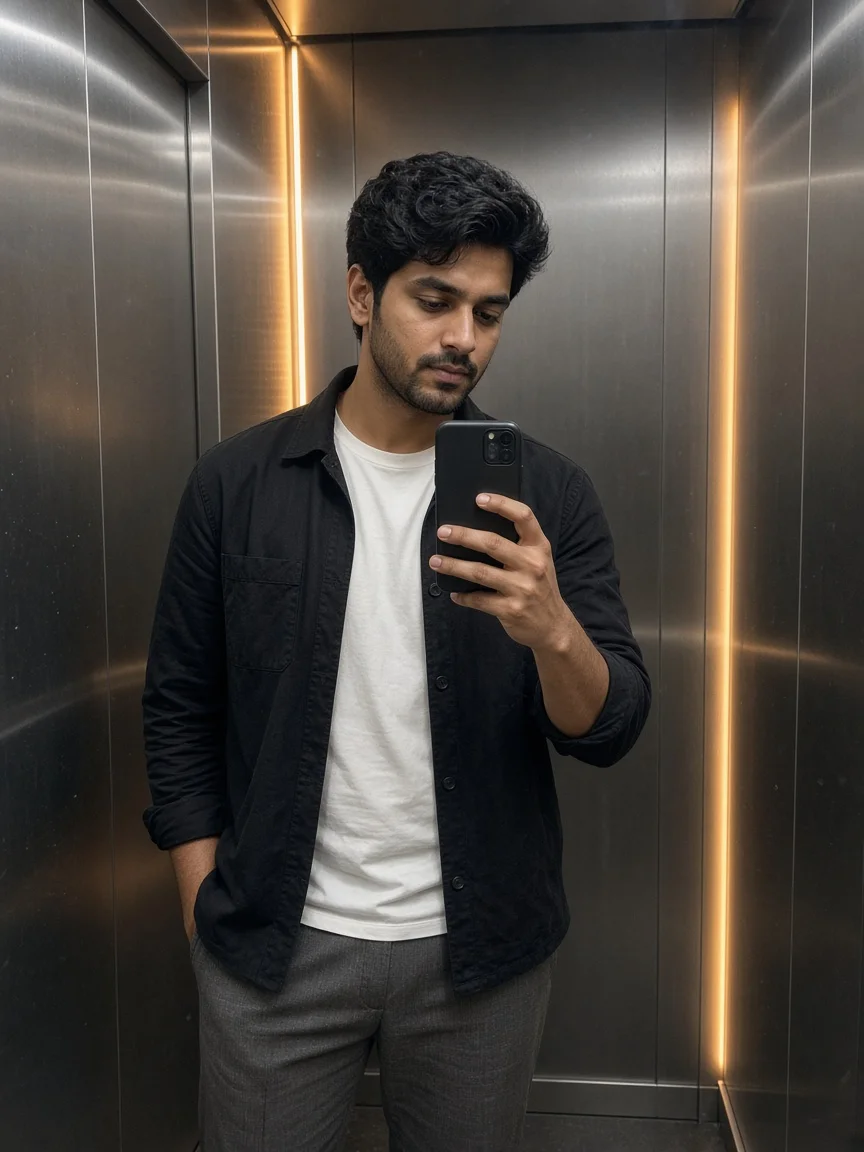
Mirror Selfie Prompt ChatGPT: 10 Aesthetic Boys Mirror Selfie Ideas
Ten mirror selfie prompts for ChatGPT and Gemini with real results: luxury elevator, golden hour bedroom, Y2K flash, gym, Diwali chikankari kurta, groom in velvet bandhgala, boutique fit check, café washroom, halo mirror and hostel room, plus phone-and-mirror physics, restyle steps and privacy tips.
Nancy · · 16 min read
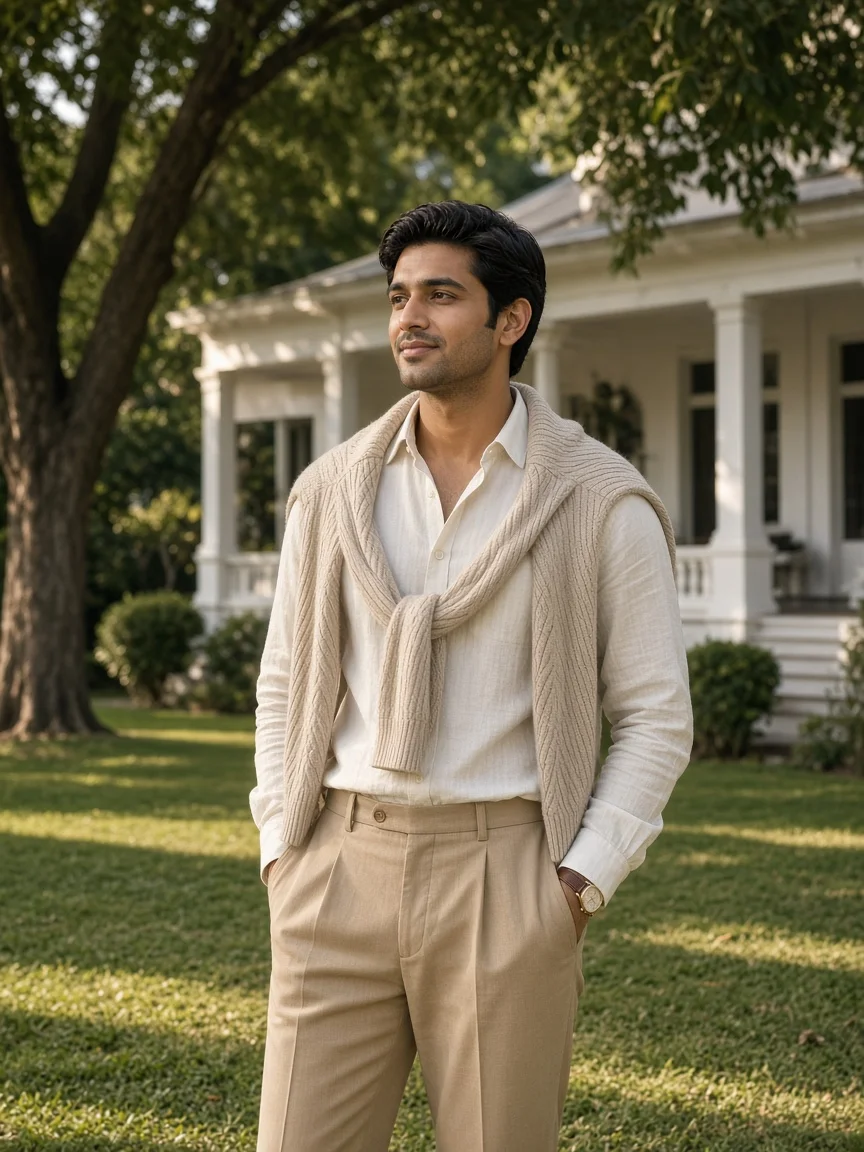
Old Money Prompt Gemini: 10 Quiet Luxury Looks for Indian Men
Ten old money prompts for Gemini with real results: Lutyens bungalow linen, Jaipur polo blazer, Kolkata library velvet, Ooty cricket whites, seafront camel coat, Udaipur bandhgala, Goa veranda, Mussoorie vintage car, ballroom tuxedo and haveli khadi, plus a quiet luxury wardrobe guide and fixes.
Nancy · · 17 min read
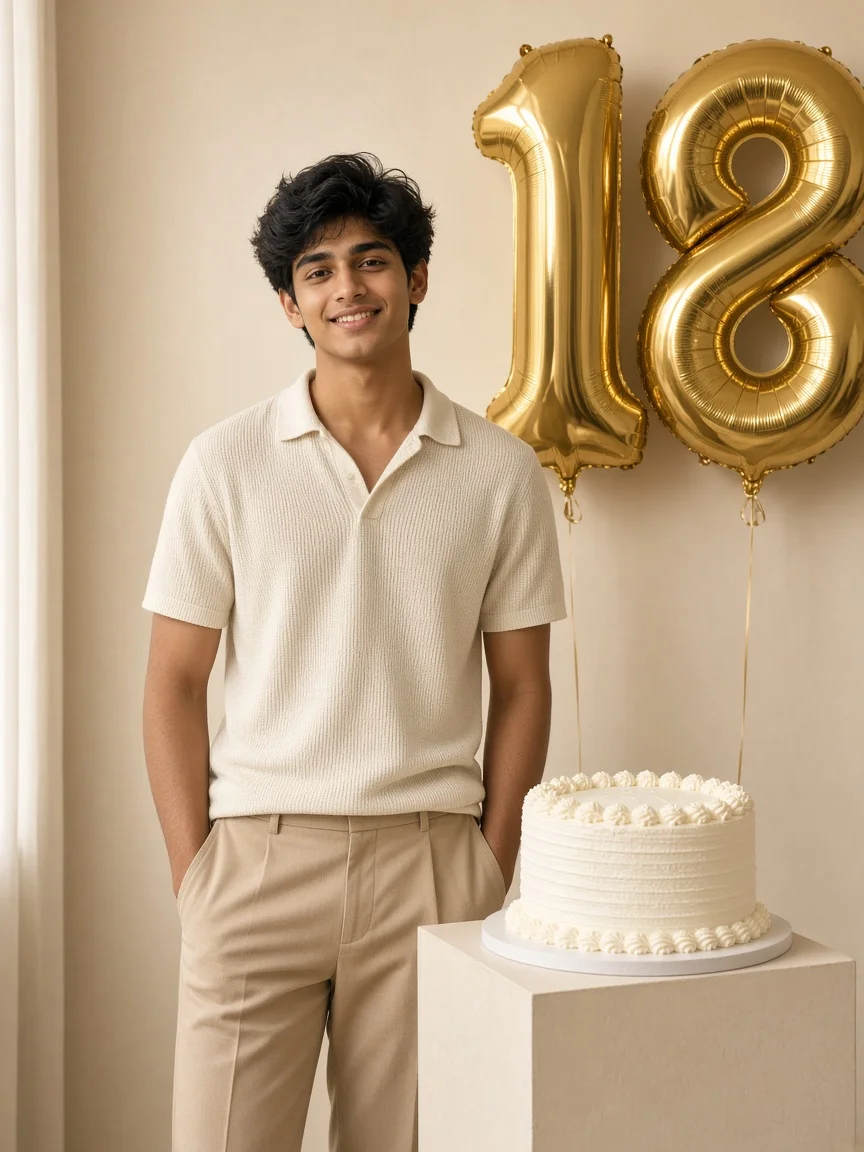
ChatGPT Birthday Prompt for Boy: 10 AI Photo Ideas + Wishes
Ten ChatGPT birthday prompts for boys with images: minimal 18th studio, rooftop sparkler cake, neon midnight cake cutting, aarti with Maa, old-money study, gamer controller cake, beach bonfire, dad's bike gift, rockstar loft and first birthday cake smash, plus face-lock steps, wish and caption prompts and safety tips.
Nancy · · 17 min read
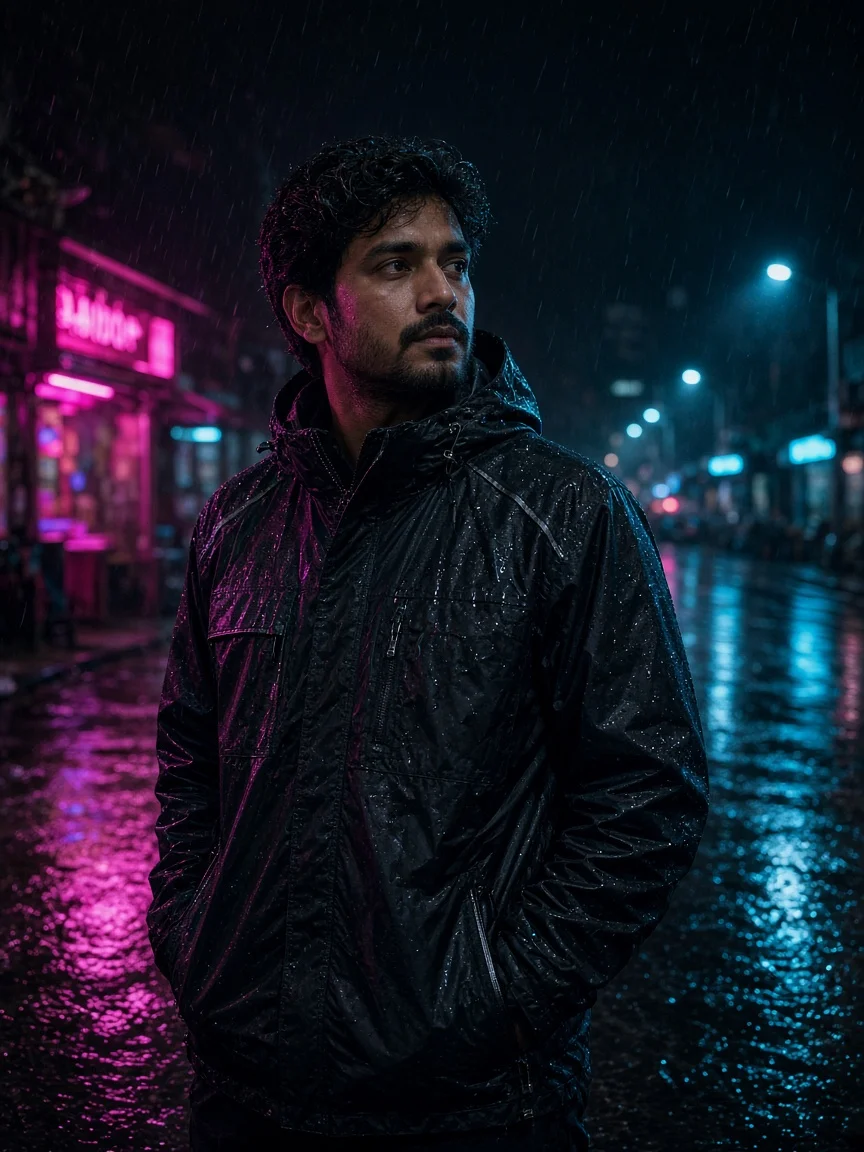
Midnight Prompt for Boys Instagram: 10 Dark Aesthetic AI Photo Ideas
Ten midnight prompts for boys on Instagram with images: neon rain street, rooftop direct flash, empty metro platform, cutting chai, fuel station cafe racer, bridge fog noir, parking garage, old city lantern lane, Padmini under the Milky Way and Himalayan campfire, plus night lighting words, face-lock tips and fixes.
Nancy · · 17 min read
Comments
No comments yet. Be the first!