Romantic Couple AI Prompts Black and White: 25 Ideas
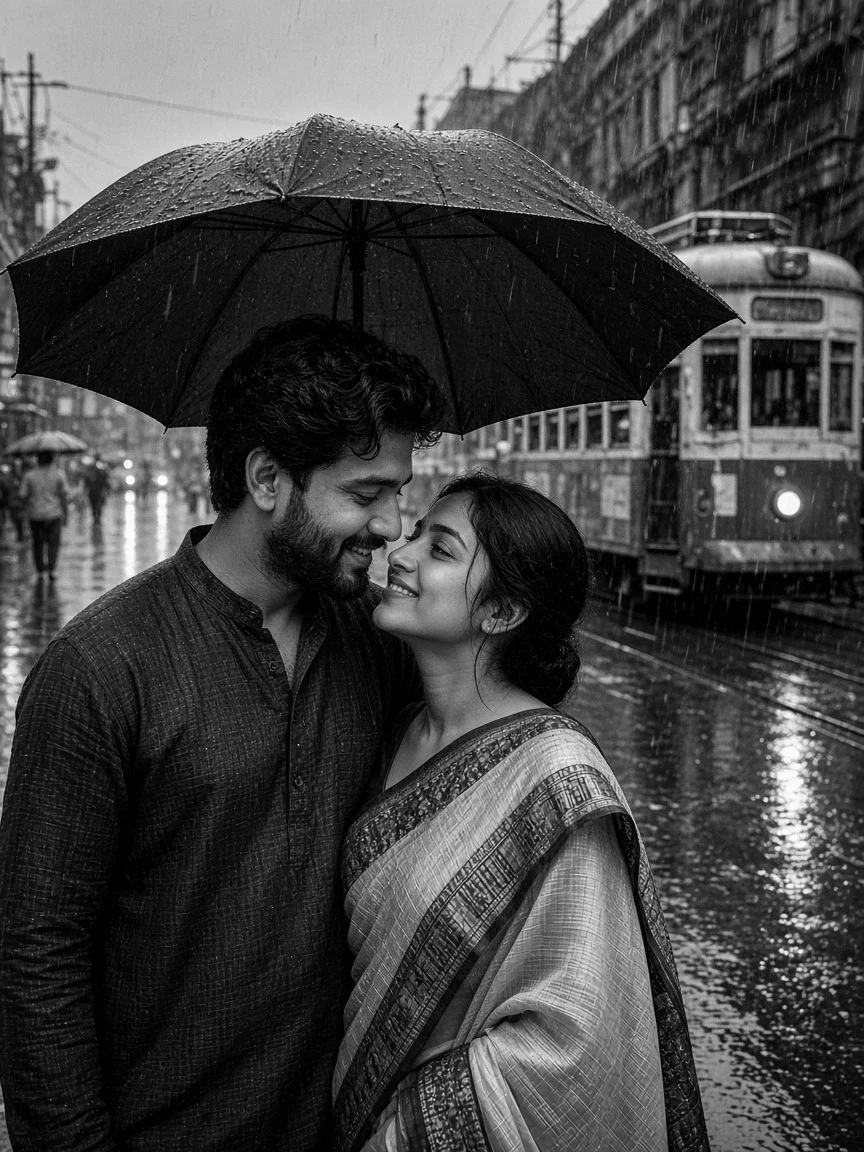
Table of contents
- Why Black and White Works for Romantic Portraits
- High-key, low-key, chiaroscuro, noir and silhouette
- Contrast, Outfits and Texture: Build Separation before Conversion
- 25 Romantic Couple AI Prompts in Black and White
- 1. Kolkata Monsoon Tram Portrait
- 2. Laughter along Marine Drive
- 3. A Forehead Kiss in Gentle Drizzle
- 4. Foggy Walk beside the Tram Tracks
- 5. Kulhad Chai on the Rooftop
- Palace, Textile and Heritage Portraits
- 6. Velvet Sherwani in a Palace Courtyard
- 7. Amber Fort Wedding Archway
- 8. Jharokha and Jaali Shadow Patterns
- 9. Windswept Mehrangarh Terrace
- 10. Conversations in a Wooden Tram
- Cinematic Streets, Window Light and Studied Lighting
- 11. A Vintage Roadster Fashion Editorial
- 12. Fairy Lights and a Quiet Promise
- 13. French New Wave Street Story
- 14. Midnight Café behind a Rain Window
- 15. A Rembrandt-Lit Studio Portrait
- 16. High-Key Affection at a Window
- 17. A Palace Dance Silhouette
- 18. An Embrace at Coastal Dawn
- Everyday Intimacy and Complete Visual Stories
- 19. Geometry on a Spiral Staircase
- 20. A Slow Dance in the Home Kitchen
- 21. Film Noir on a Bombay Balcony
- 22. A Railway Platform Farewell
- 23. Poetry in an Old Library
- 24. The Saree Pallu in an Antique Mirror
- 25. After the Rain: Reflections in a Dark Lane
- Poses That Look Intimate, Not Performed
- How to Use These Prompts in Gemini and ChatGPT
- Film Looks and Lens Language: What the Names Add
- Editing an Existing Colour Photo into Black and White
- Quick Troubleshooting for Common Failures
- Conclusion
These romantic couple AI prompts in black and white turn familiar Indian settings into photographs with mood, gesture and tonal depth. You will find 25 original concepts for Gemini, ChatGPT and other image tools, from an umbrella beside a Kolkata tram to a palace jharokha, Marine Drive laughter and a kitchen slow dance.
Monochrome is not a rescue filter. Removing colour makes you notice whether a hand merges into a sleeve, a face disappears into a wall or a white saree loses its folds. The guide below therefore covers both copyable prompts and the photographic decisions that make those prompts believable.
Every example image here is AI-generated and illustrative, not documentary evidence of a visit to a fort, tram or station. Adapt locations, clothes and gestures to your own story; a useful prompt should produce a relationship, not merely two decorative people.
Why Black and White Works for Romantic Portraits
A colour photograph can unite a couple through matching clothes. Monochrome has to do it through light, skin tones, repeated shapes and touch. An ivory kurta against a darker saree, two profiles rim-lit by a streetlamp and one genuine glance often communicate more than a dramatic background.
In printed darkroom language, the Zone System helps you plan tones from featureless black to paper white. You need not measure zones when prompting AI: simply ask for bright facial midtones, deep blacks with texture, and clothing lighter or darker than its background. A silver-gelatin look comes from rich separation and clean highlight transitions, not extreme HDR.
High-key, low-key, chiaroscuro, noir and silhouette
- High-key: dominated by luminous whites and soft grey shadows; ideal for a window, pregnancy portrait or understated engagement.
- Low-key: dominated by dark tones with selective light on faces, hands or jewellery.
- Chiaroscuro: a sculpted contrast of light and shade, especially useful for palace and studio images.
- Film noir: directional light, urban architecture and emotional tension; romance can stay tender within that visual language.
- Silhouette: figures reduced to dark outlines against a bright area. Separate arms, chins and clothing so the gesture remains legible.
Choose colour instead when the clothes, flowers or ritual symbolism carry essential information. A crimson sindoor, yellow haldi or nuanced textile pattern may deserve its own colour series. Our Radha Krishna couple love prompts use those colours meaningfully, while a quiet flute or lotus gesture could also be remixed here in monochrome.
Contrast, Outfits and Texture: Build Separation before Conversion
Green and red can become nearly identical grey after desaturation. Judge the luminance of an outfit, not its hue. Use your camera’s monochrome preview or take a phone test in black and white before the session. Keep one partner slightly lighter, and place dark hair against a lighter background where possible.
| Combination | Why it works | Watch for |
|---|---|---|
| Velvet sherwani + light embroidered lehenga | Absorptive dark fabric beside reflective zari | Blown-out embroidery |
| Cotton saree + textured kurta | Natural folds, weave and approachable mood | Both mid-grey against concrete |
| Dark suit + pale silk saree | Clean tonal hierarchy and specular highlights | Face merging into dark lapel |
| Linen, chiffon, Jamdani, Rajputi poshak | Material character remains visible without colour | Waxy skin from over-smoothing |
Jewellery should catch small highlights, not become white patches. Saree borders, a maang tikka, kulhad rims and old timber reward side lighting. Avoid excessive pinstripes or very fine checks that create moiré. If the background already carries lace, jaali and furniture detail, simplify the clothing.
25 Romantic Couple AI Prompts in Black and White
Copy a card, replace generically described clothing with your preferred regional or contemporary outfits, and keep only lighting that suits the location. Negative instructions such as “no text” do not guarantee perfection; always inspect faces, fingers, reflections and architecture.
1. Kolkata Monsoon Tram Portrait
Ask the pair to pause beneath the umbrella before looking at one another. Side lighting keeps their faces separate from the tram; expose for skin and allow the wet street to become dark.
Photorealistic vertical 3:4 black and white Indian couple beneath a black umbrella on a rain-wet Kolkata street, heritage tram softly blurred behind. Woman in textured Jamdani saree, man in dark kurta, quiet shared smile, 50mm documentary photograph, soft rim light, natural pores, subtle Tri-X grain, sharp faces, no text.
2. Laughter along Marine Drive
Use a longer lens or step back on the promenade rather than crowding the couple. Make the laugh genuine: give them a private joke, not a generic “laugh candidly” instruction.
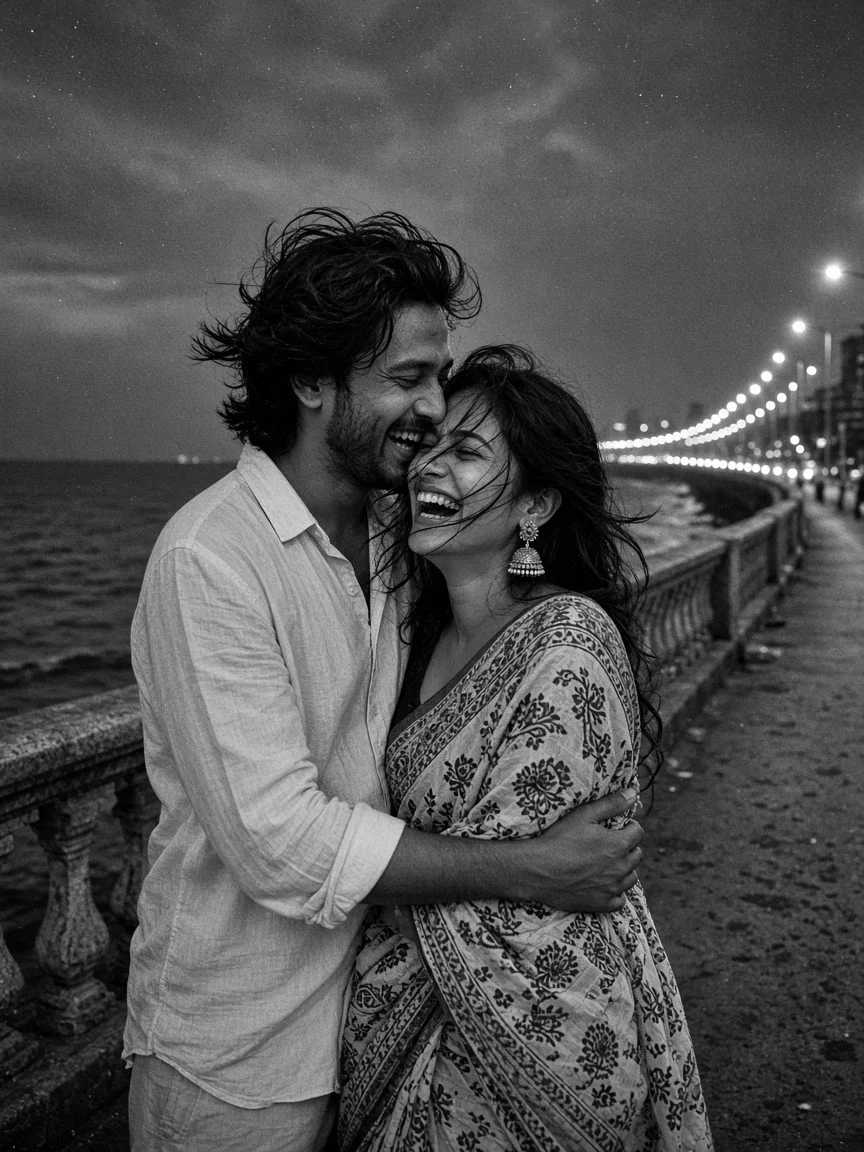
Photorealistic vertical 3:4 monochrome romantic couple laughing on Mumbai Marine Drive promenade after rain. Elegant cotton saree and casual blazer, curved seafront and repeating streetlamp bokeh, expressive eyes, gentle wind, Leica M6-inspired 50mm candid frame, silver midtones and restrained grain, natural Indian faces, no text.
3. A Forehead Kiss in Gentle Drizzle
A forehead kiss reads best in profile. Separate their heads slightly and raise an off-camera light to eye level so the kiss does not merge both faces into one dark shape.
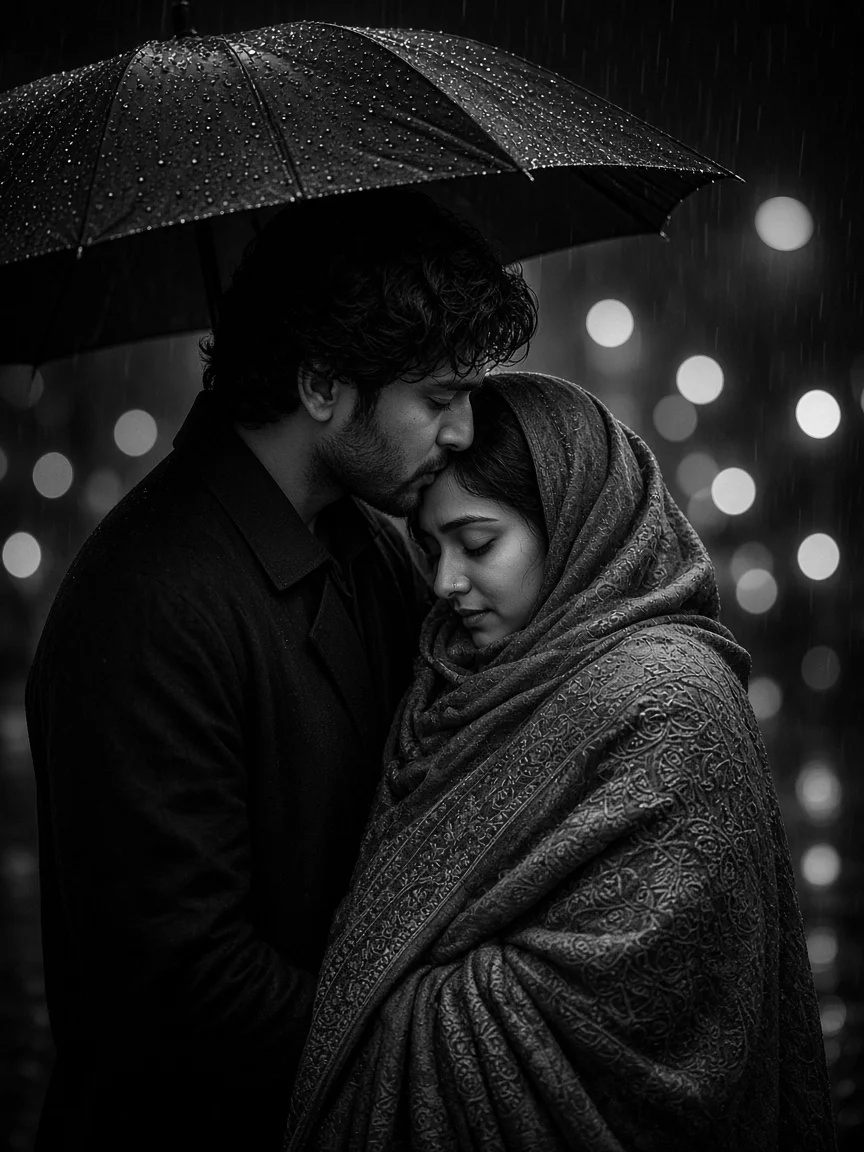
Photorealistic vertical 3:4 black and white couple in light city drizzle under a transparent umbrella, tender forehead kiss in side profile, woman in subtle embroidered saree and man in dark jacket, raindrops catching a streetlamp behind them, shallow depth of field, 85mm compression, detailed skin, Kodak Double-X 5222 mood, no words.
4. Foggy Walk beside the Tram Tracks
Treat the tracks as a leading line, never as a suggestion to enter a working route. An AI setting is safer than recreating this on active infrastructure. In a real shoot, use a quiet, legal pedestrian lane.
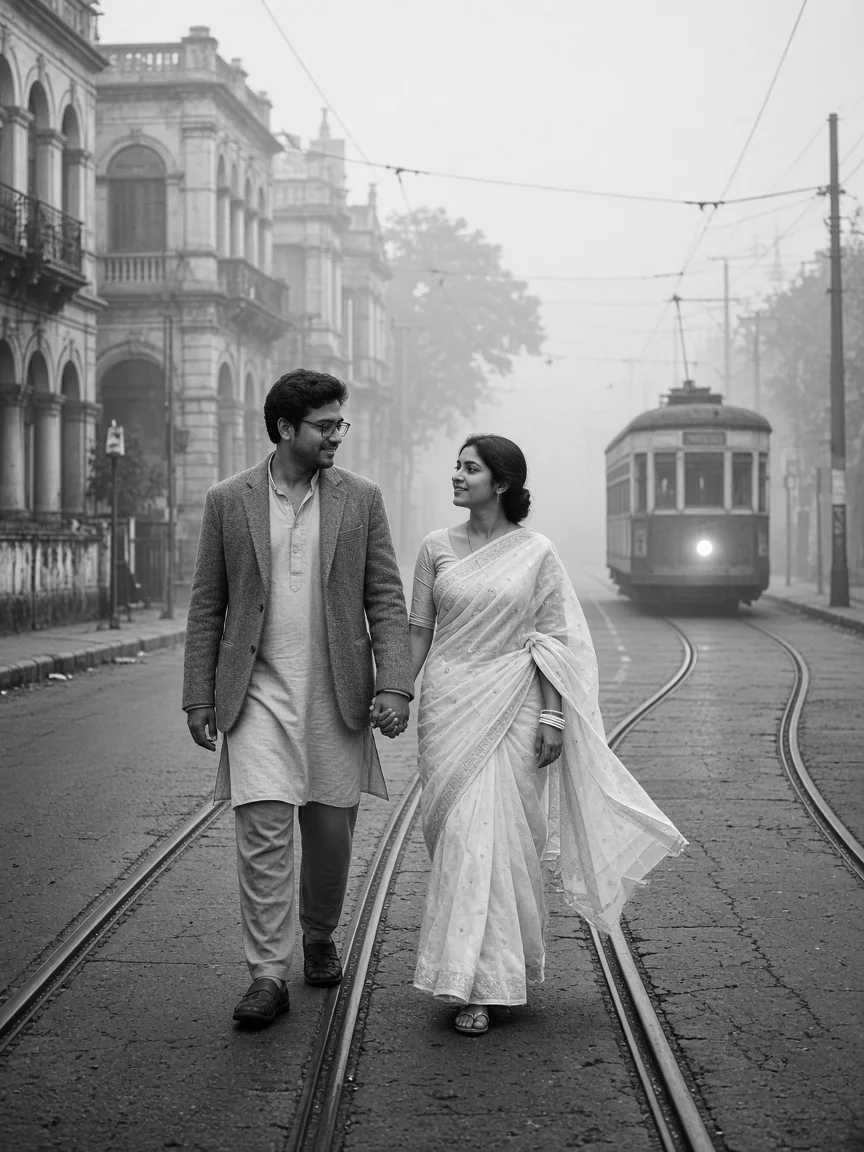
Photorealistic vertical 3:4 black and white romantic Indian couple walking on a safe heritage depot sidewalk beside old tram tracks, morning fog, woman in light Jamdani saree and man in textured ivory kurta, relaxed handhold, low eye-level 35mm documentary framing, soft luminance contrast, fine Ilford FP4 Plus-like grain, no vehicles approaching, no lettering.
5. Kulhad Chai on the Rooftop
Two clay cups become tonal props rather than distractions. Keep them below the chin and place a small warm lamp behind hair and shoulders to suggest cool evening separation without adding colour.
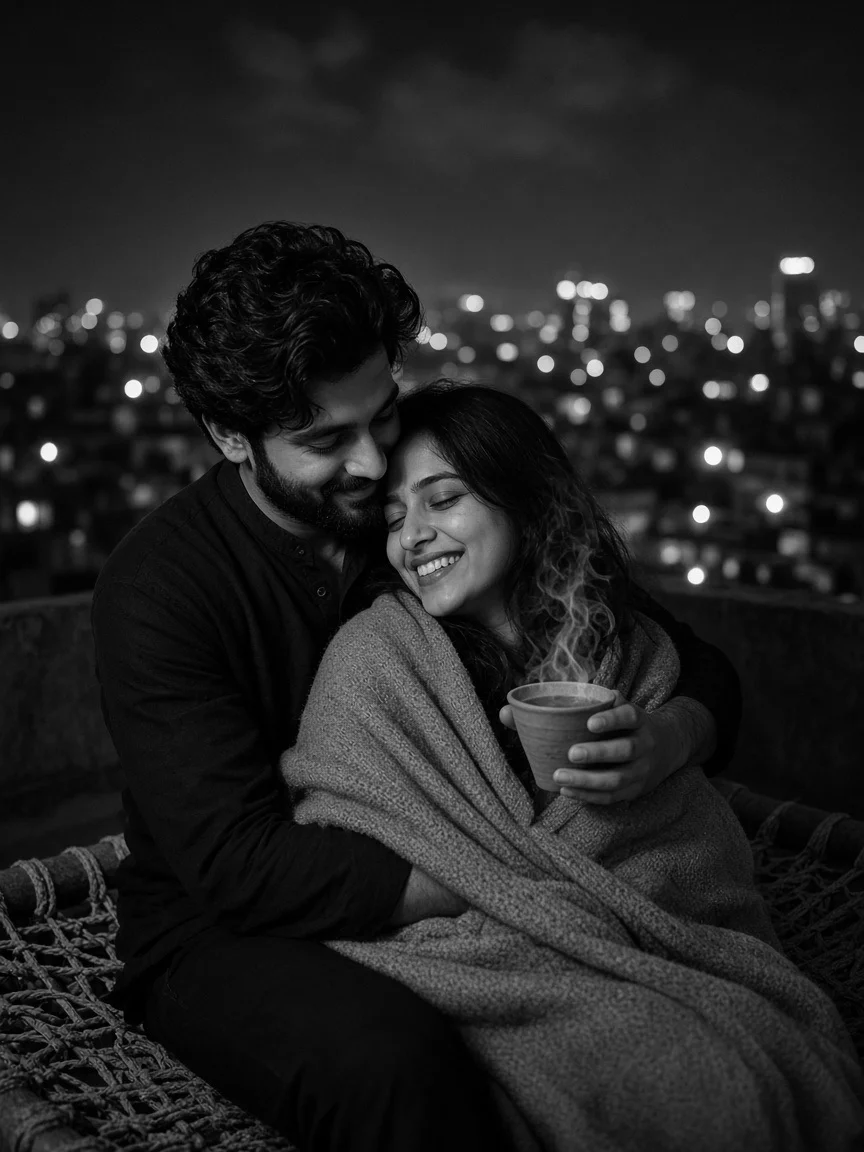
Photorealistic vertical 3:4 monochrome rooftop portrait of Indian couple sharing kulhad chai under one shawl, modest terrace with water tanks and distant Kolkata lights, seated comfortably away from the edge, soft window-style fill and backlight, genuine conversation, cotton and wool texture, Hasselblad-like medium-format clarity, delicate silver-gelatin highlights, no text.
Palace, Textile and Heritage Portraits
These prompts use clothing and architecture as tonal layers. They are imagined compositions: seek permission and follow visitor rules at actual heritage sites.
6. Velvet Sherwani in a Palace Courtyard
Velvet absorbs light while zari reflects it. Position the key light diagonally across expensive fabric and keep silver embroidery below pure white so its pattern remains visible.
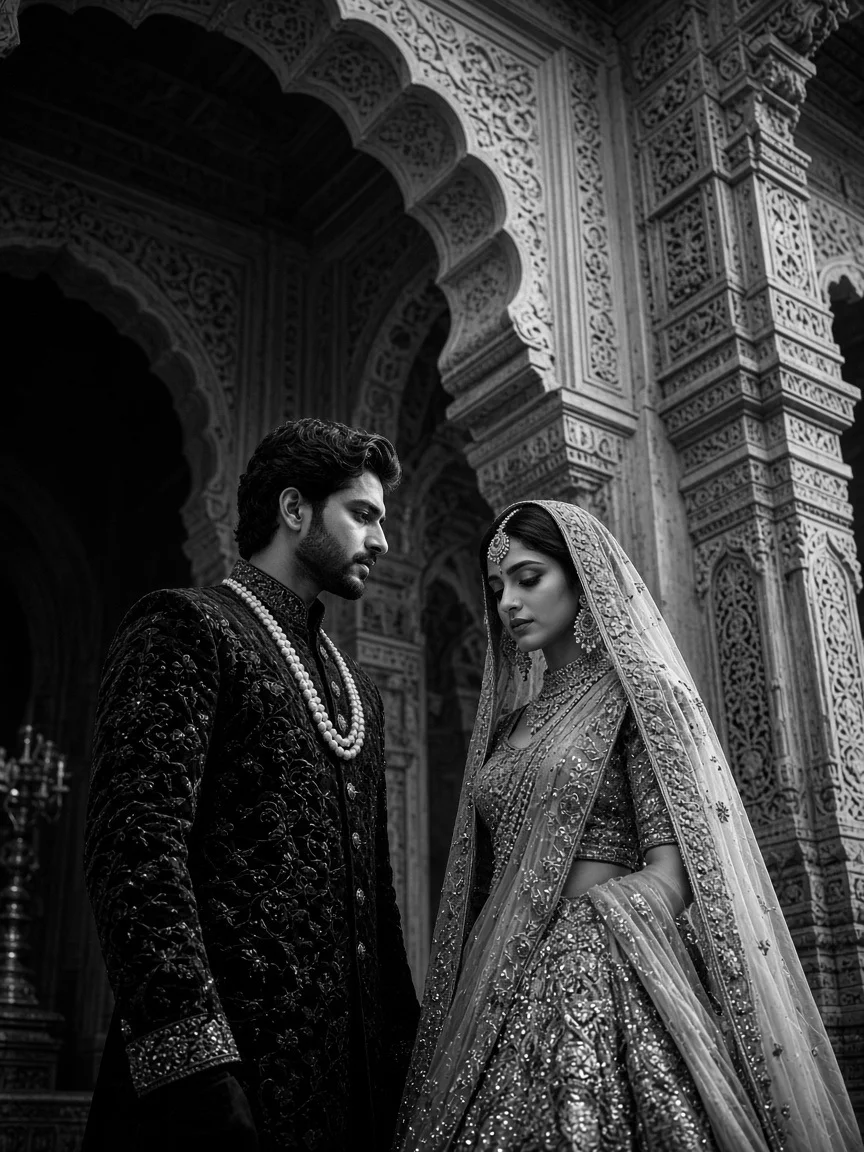
Photorealistic vertical 3:4 luxury palace-courtyard portrait of Indian pre-wedding couple, man in midnight-black velvet sherwani and woman in light heavily embroidered lehenga, restrained hand clasp and eye contact, sandstone arches, directional side light, deep charcoal velvet and preserved zari detail, formal 85mm editorial monochrome photograph, realistic skin, no text.
7. Amber Fort Wedding Archway
Place the couple within an arch but a few steps in front of it; this avoids tangents through heads and makes people sharper than the stonework. Check symmetry and fabric edges.
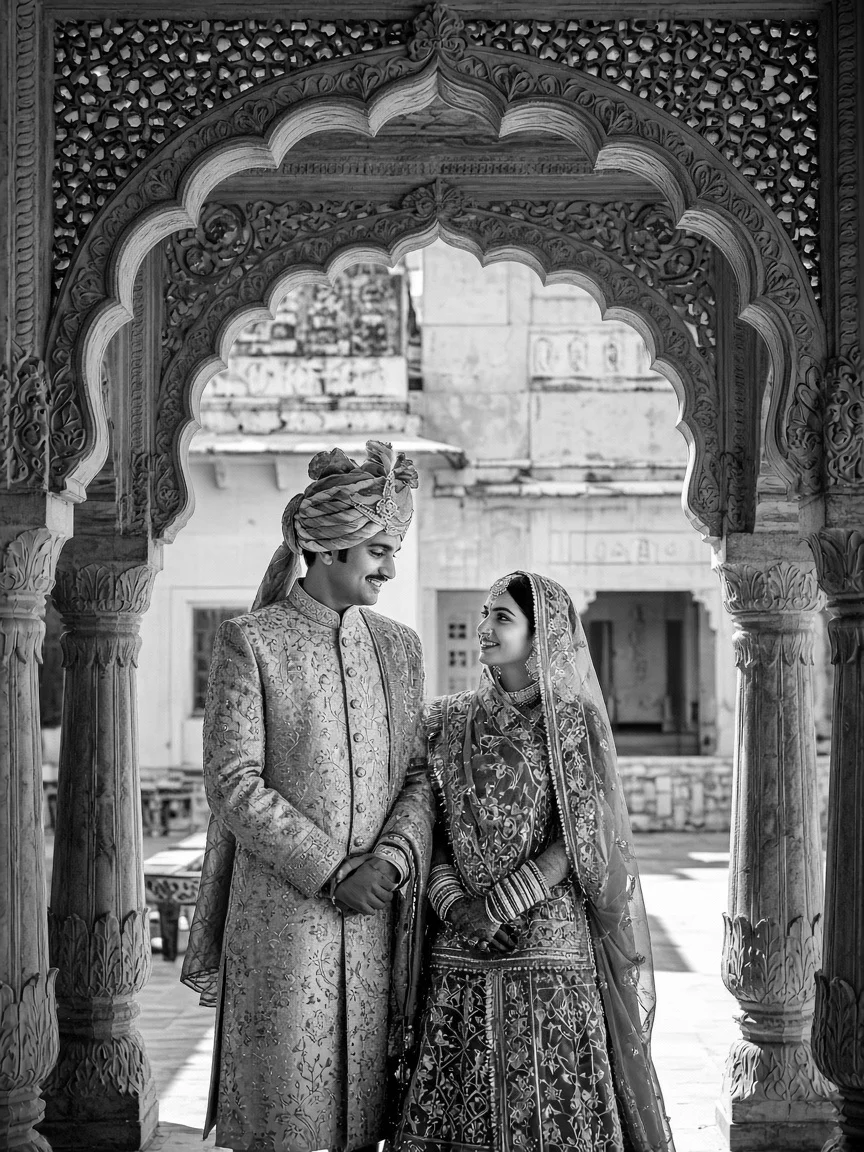
Photorealistic vertical 3:4 black and white Indian wedding couple beneath a grand Amber Fort-inspired carved arch, bride in Rajputi poshak with scalloped odhani and groom in pale embroidered sherwani, both in three-quarter view with serene expressions, morning side lighting, intricate stone and cloth textures, balanced highlights and shadow detail, 50mm fine-art image, no text.
8. Jharokha and Jaali Shadow Patterns
Patterned light should support a face, not conceal an eye. Move the pair or the light until lattice shadows fall on clothing and one cheek; use a soft reflector for the darker eye.
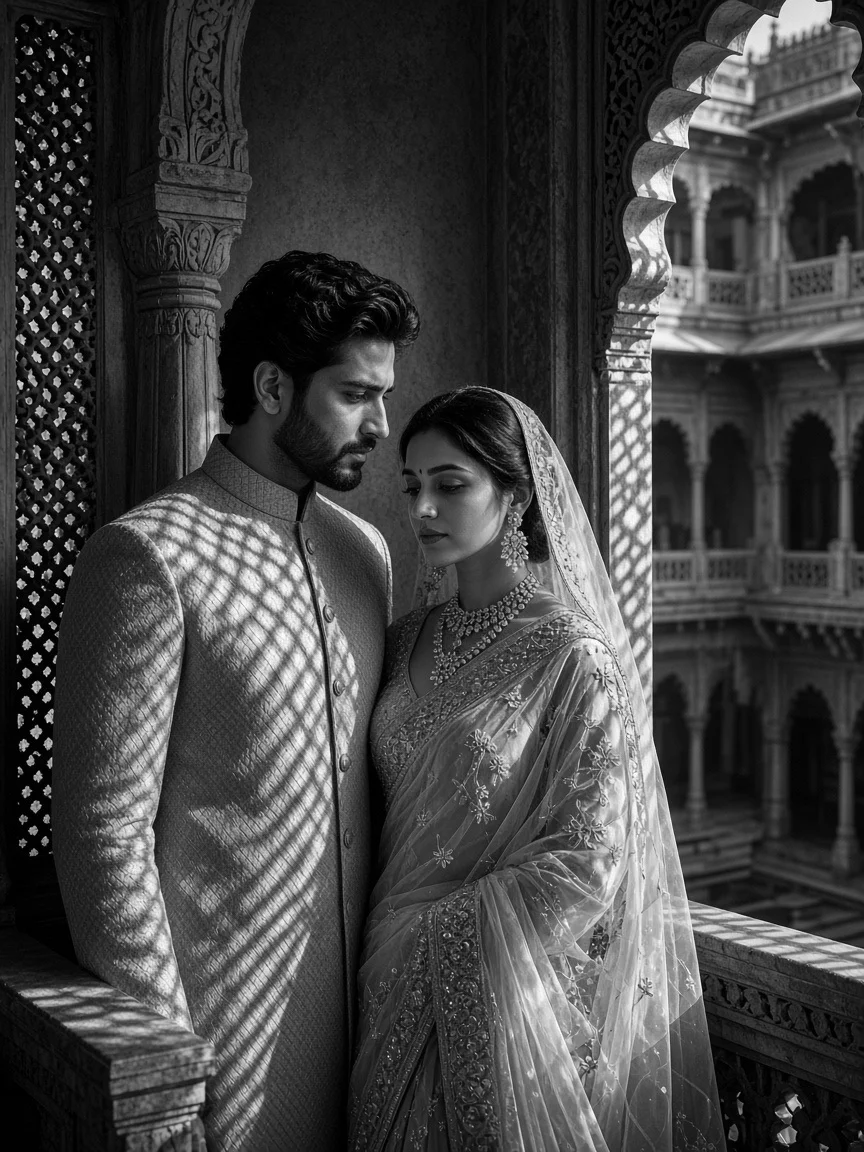
Photorealistic vertical 3:4 monochrome Indian couple beside carved stone jharokha, jaali lattice shadow stripes crossing their shoulders and one cheek, woman in light silk saree and man in dark bandhgala, gentle proximity with separated profiles, Rembrandt-influenced side light, sharp eyes, chiaroscuro, Ilford HP5 Plus texture, realistic architecture, no text.
9. Windswept Mehrangarh Terrace
Wind is useful for a dupatta but not for an unstable roof-edge pose. Ask for movement away from the parapet and keep enough depth of field that the city is recognisable without overpowering them.
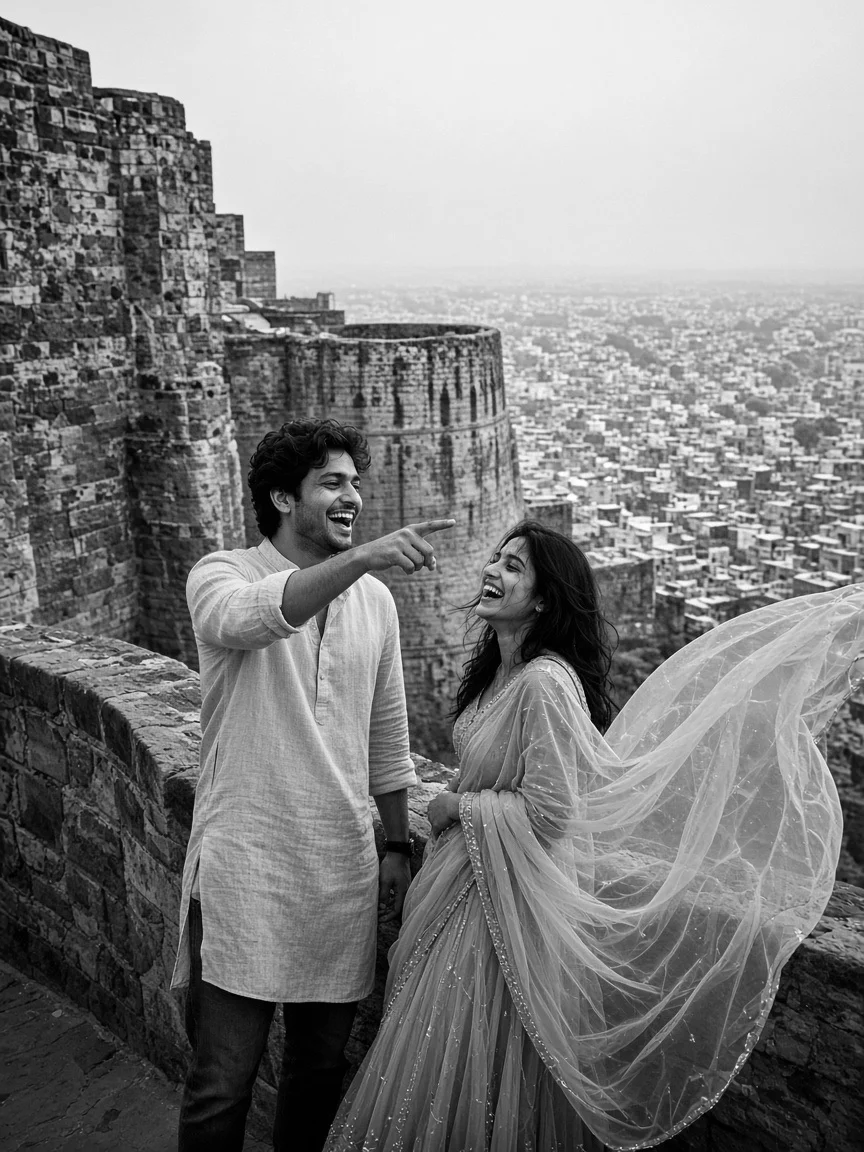
Photorealistic vertical 3:4 black and white couple on a secure Mehrangarh Fort-inspired terrace overlooking Jodhpur, windswept saree pallu and tailored achkan, woman leaning gently against partner, elevated 35mm camera view, cloud-filtered sun, sculpted shadows, medium film grain, clear faces against subdued cityscape, no text.
10. Conversations in a Wooden Tram
An interior has natural frame-within-frame geometry. Light from the window should model both profiles; if using a real heritage tram, arrange permission and keep the carriage safely stationary.
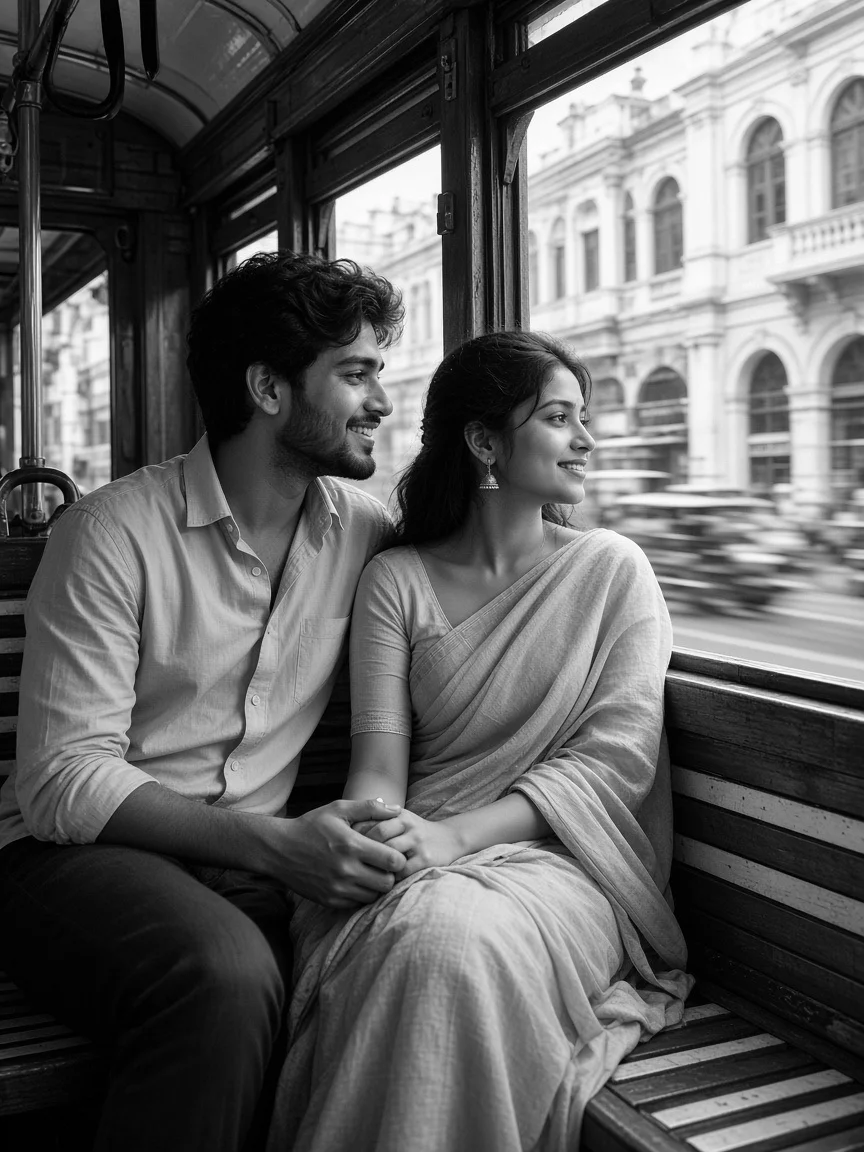
Photorealistic vertical 3:4 cinematic black and white couple in stationary vintage Kolkata wooden tram, woman by the window in cotton saree, man opposite in pressed kurta, affectionate eye contact across worn bench, shafts of daylight through wooden blinds, rich dark timber grain, Leica M3 35mm frame, quiet 1950s atmosphere, no text.
Cinematic Streets, Window Light and Studied Lighting
The next concepts shift from place-led romance to deliberate visual language: editorial glamour, French New Wave movement, soft high-key light and darkroom-inspired studio contrast.
11. A Vintage Roadster Fashion Editorial
A large prop can reduce romance to a catalogue pose. Place the couple close together beside the car and let their shared gesture—not chrome—be the brightest focal point.
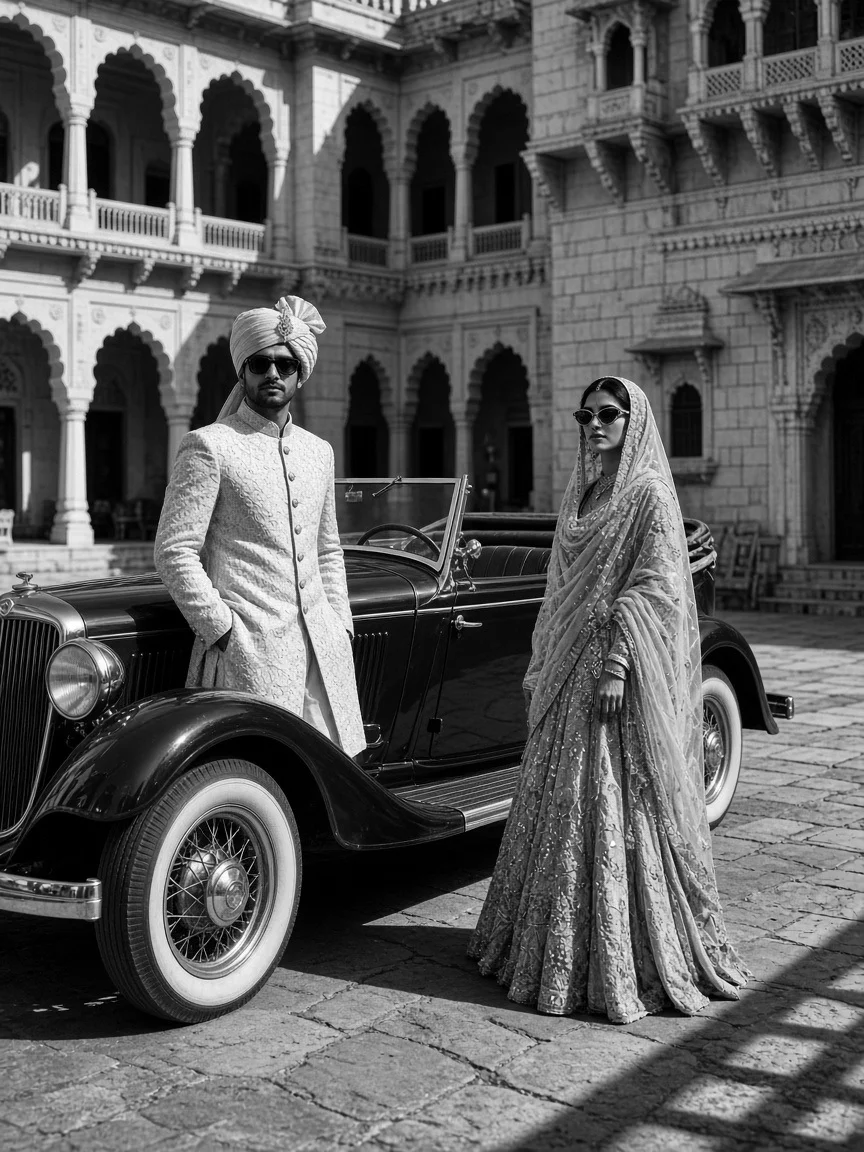
Photorealistic vertical 3:4 high-fashion monochrome Indian couple beside a polished 1950s vintage roadster in a heritage courtyard, woman in architectural silk saree and man in sharply tailored dark suit, relaxed shoulder touch, low sunlight outlining chrome, hard-soft contrast, 50mm magazine composition, deep blacks and crisp specular reflections, no logos or lettering.
12. Fairy Lights and a Quiet Promise
Large bokeh needs physical distance between the couple and lights. Request soft circles rather than bright dots on hair, and keep the pair’s outline cleaner than the background.
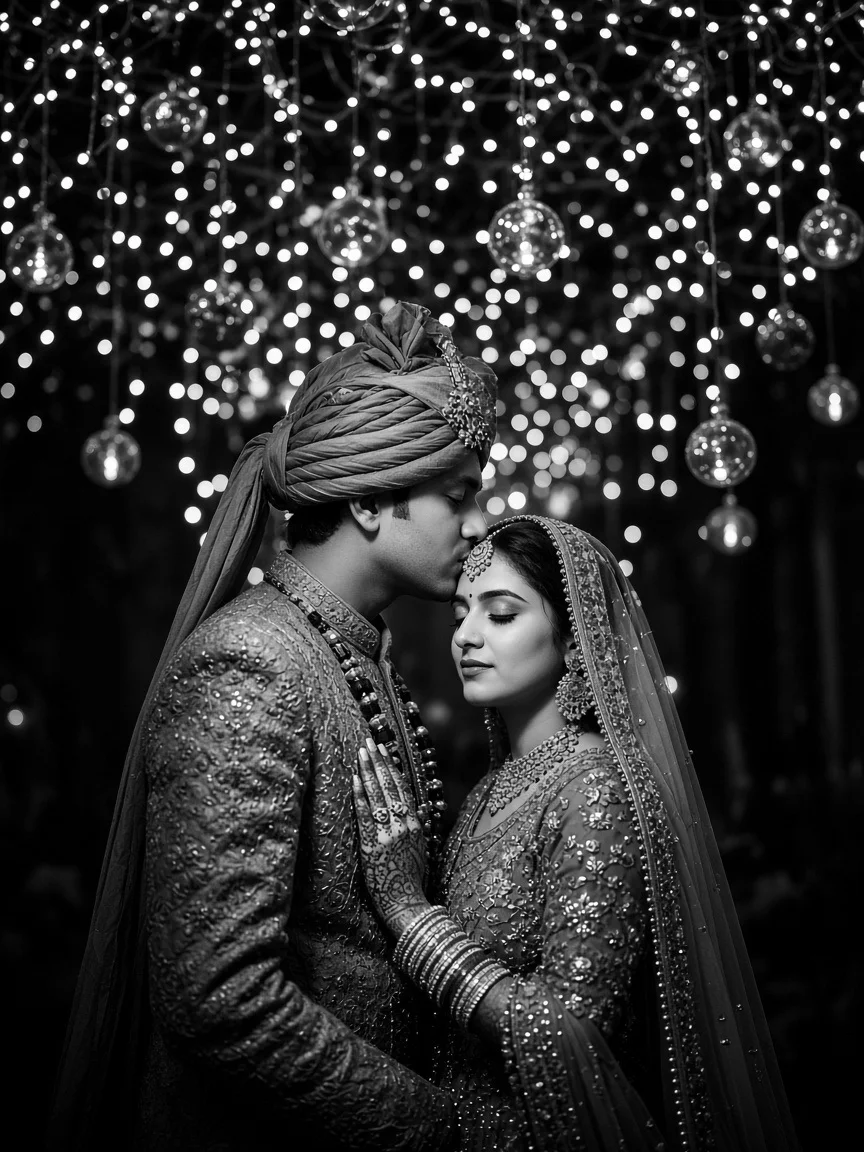
Photorealistic vertical 3:4 black and white engaged Indian couple exchanging a quiet promise, gentle forehead touch with eyes closed, woman in embroidered lehenga and man in dark sherwani, distant fairy lights rendered as soft circular bokeh, dark uncluttered background, 85mm f/2 appearance, delicate highlight rolloff, natural living skin and film grain, no text.
13. French New Wave Street Story
Borrow the wandering intimacy and small imperfect gestures of 1960s French New Wave, rather than copying another film frame. Let the couple cross the frame naturally; preserve slight, intentional grain.
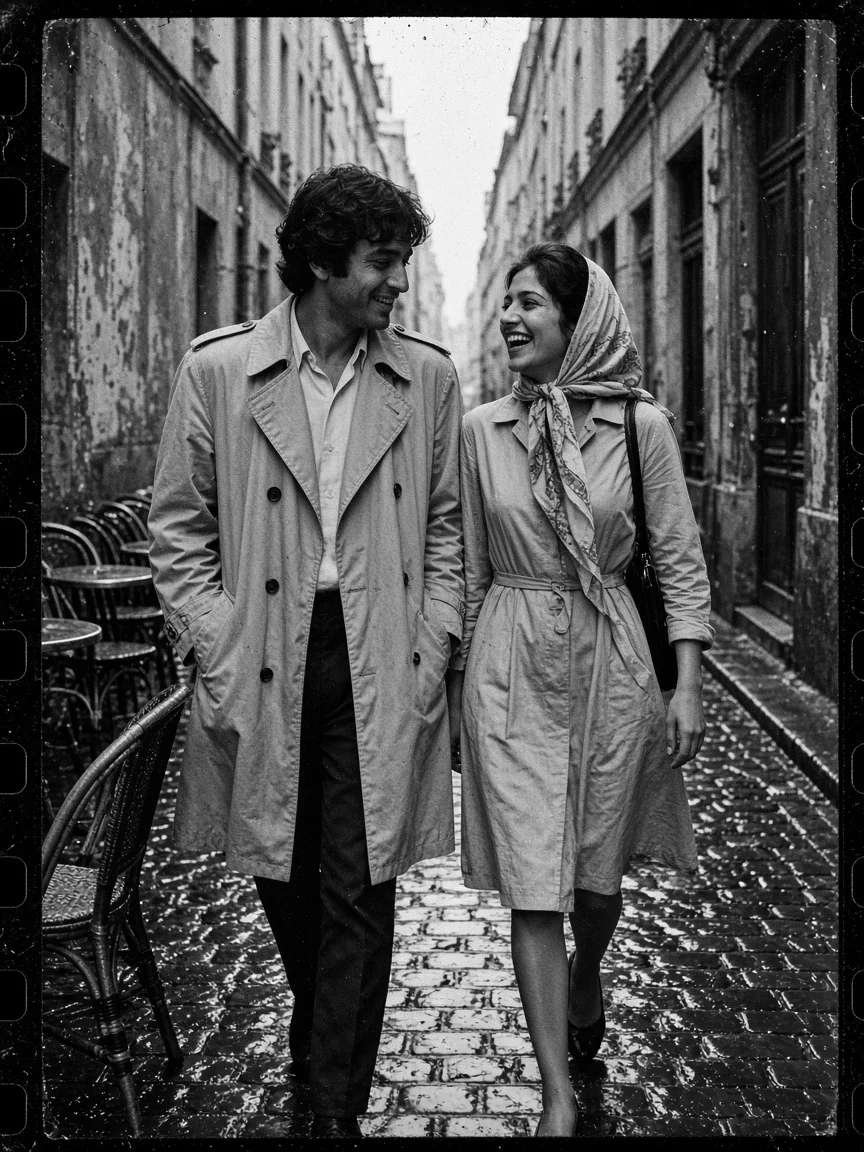
Photorealistic vertical 3:4 black and white 1960s French New Wave-inspired Indian couple walking arm in arm through a narrow Parisian lane, woman in knee-length dress and headscarf, man in slim suit, spontaneous glance, cobbled wet street, handheld 35mm street-photo energy, modest grain and soft contrast, authentic candid emotion, no text.
14. Midnight Café behind a Rain Window
Reflections can veil the moment or tell it. Ask for rain only at the edges of the frame, leave a clear patch for the faces, and place a soft café lamp below forehead height.
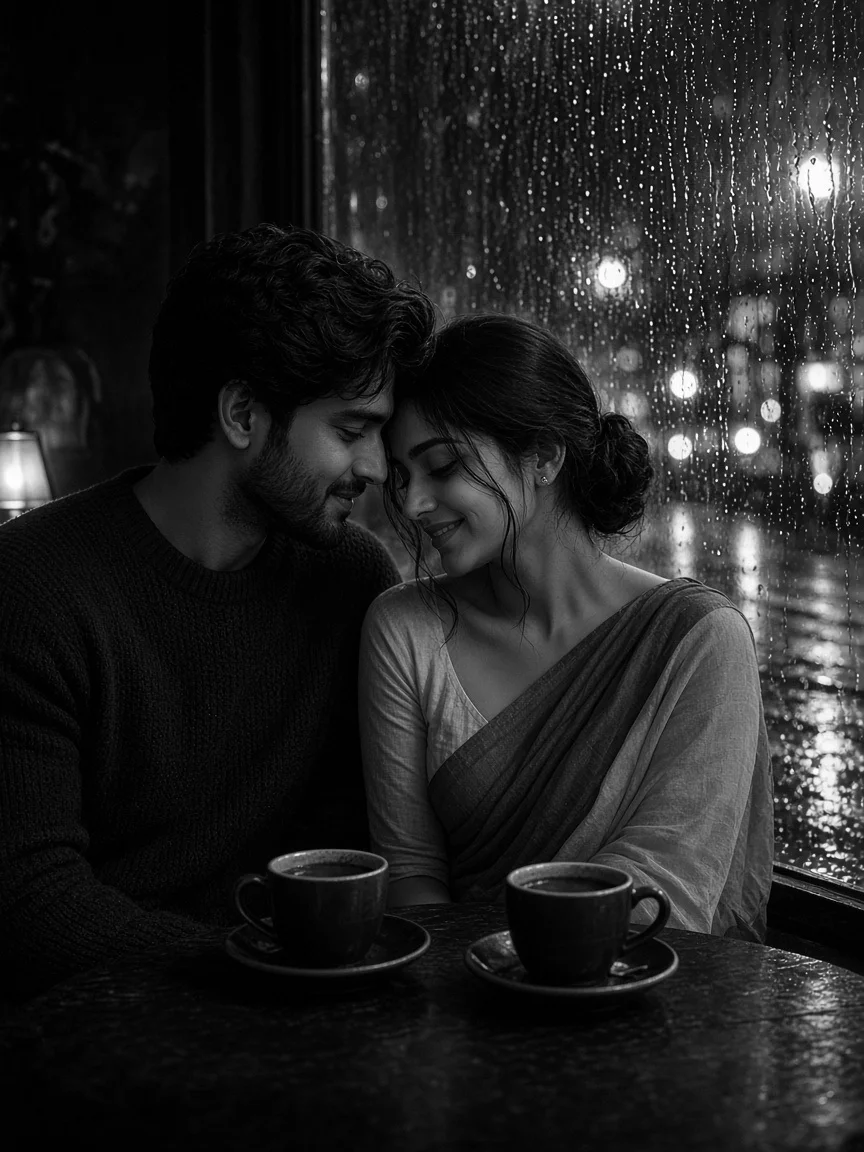
Photorealistic vertical 3:4 noir monochrome Indian couple sharing coffee inside a small café at midnight, viewed through rain-streaked window with a clear area around both faces, woman in draped saree and man in dark shirt, quiet laughter, tabletop side light, wet reflected city bokeh, Kodak Tri-X 400-inspired shadow depth, cinematic intimate realism, no text.
15. A Rembrandt-Lit Studio Portrait
For classic Rembrandt lighting, place the key light above and about 45 degrees to one side. A small triangle of light should appear on the shadow-side cheek; modify the angle until both eyes are readable.
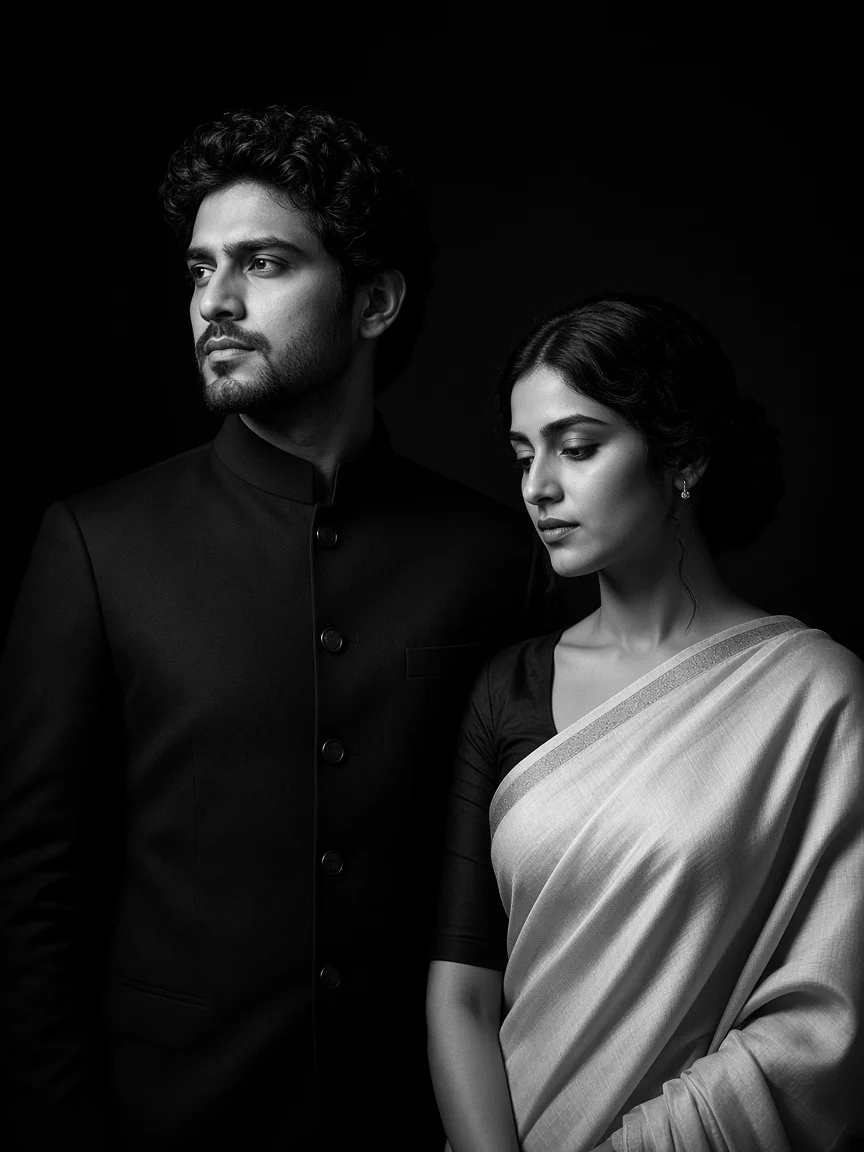
Photorealistic vertical 3:4 black and white studio couple portrait using Rembrandt lighting above and 45 degrees camera left, Indian woman in textured silk saree and man in matte bandhgala, restrained cheek-to-cheek pose facing camera in three-quarter view, small triangle on shadow cheek, both eyes visible, grey seamless background, realistic pores, medium-format silver-gelatin detail, no text.
16. High-Key Affection at a Window
High-key is a tonal treatment, not simply an overexposed photo. Keep detail in pale clothing by separating bodies from the background with posture and a controlled grey rim on shoulders.
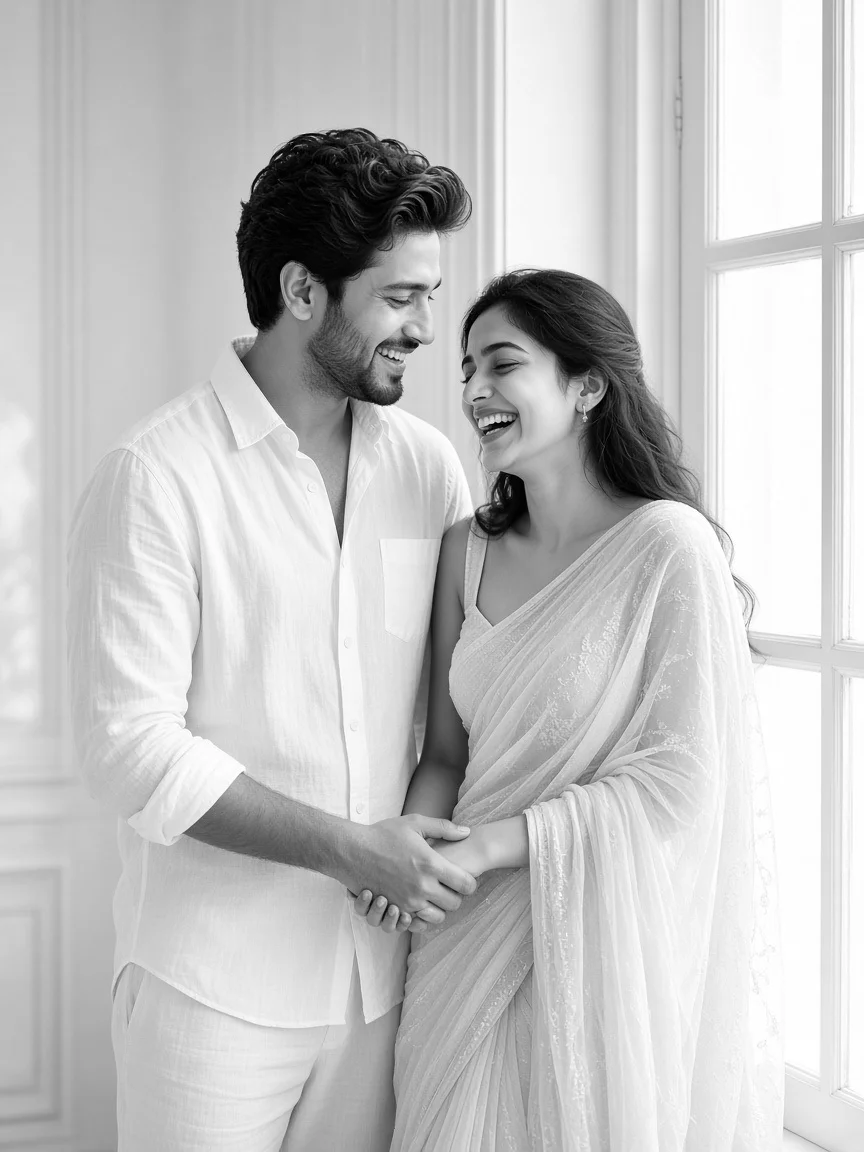
Photorealistic vertical 3:4 high-key black and white Indian couple in luminous white-curtained window room, woman in pale chiffon saree and man in light linen shirt, soft embrace with foreheads nearly touching, bright neutral background and well-exposed mid-grey skin, delicate fabric detail, minimal shadows, almost grainless clean T-Max 100-inspired rendering, no text.
17. A Palace Dance Silhouette
Silhouettes need instantly legible outlines. Keep the hands apart from torsos, avoid a face-on hug, and frame the architecture evenly so a dark body does not disappear inside a dark pillar.
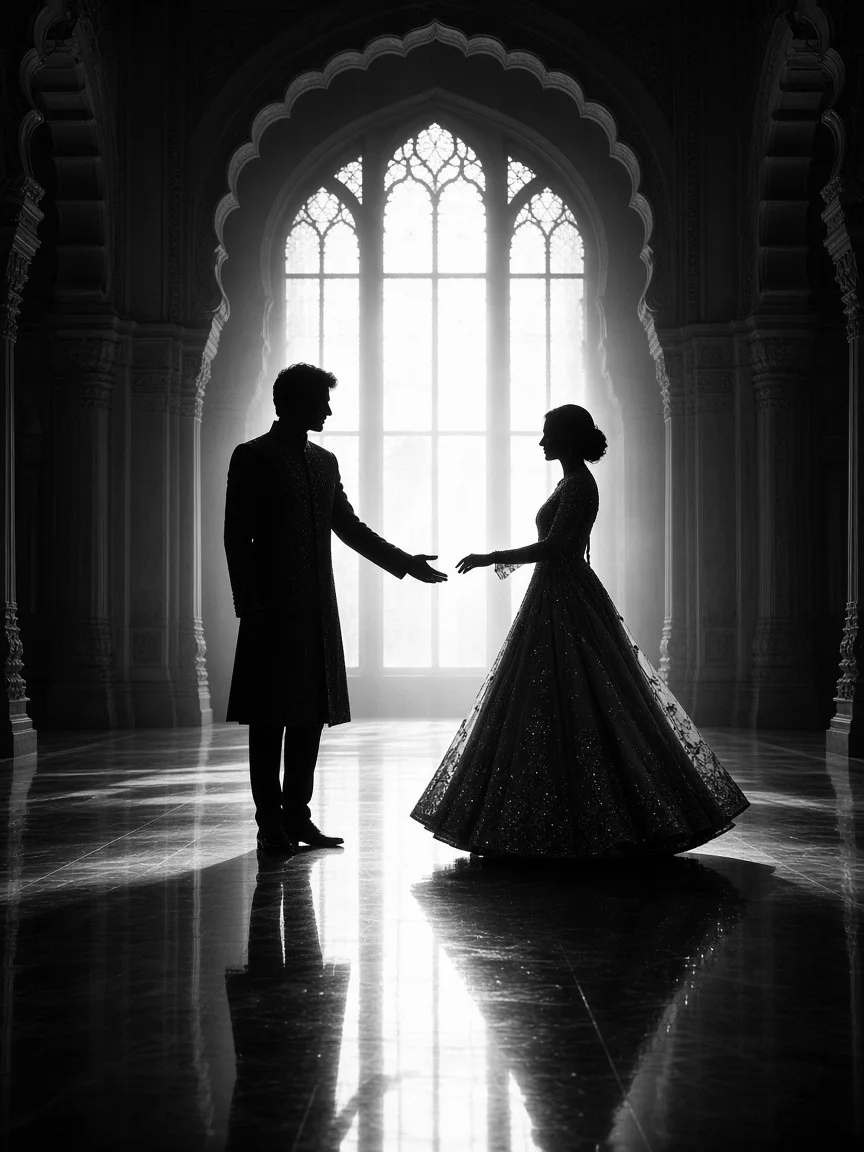
Photorealistic vertical 3:4 black and white silhouette of Indian couple performing one gentle dance step beneath a monumental palace arch, woman’s lehenga flare distinct from man’s sherwani, joined hands held clear of bodies, bright luminous courtyard behind, completely dark foreground figures with readable profiles, symmetrical 35mm composition, crisp edges and subtle film grain, no text.
18. An Embrace at Coastal Dawn
An empty horizon is not always empty of distractions. Place it below the neck or above the heads, and use a low, steady tripod position to layer water, skin and sky.
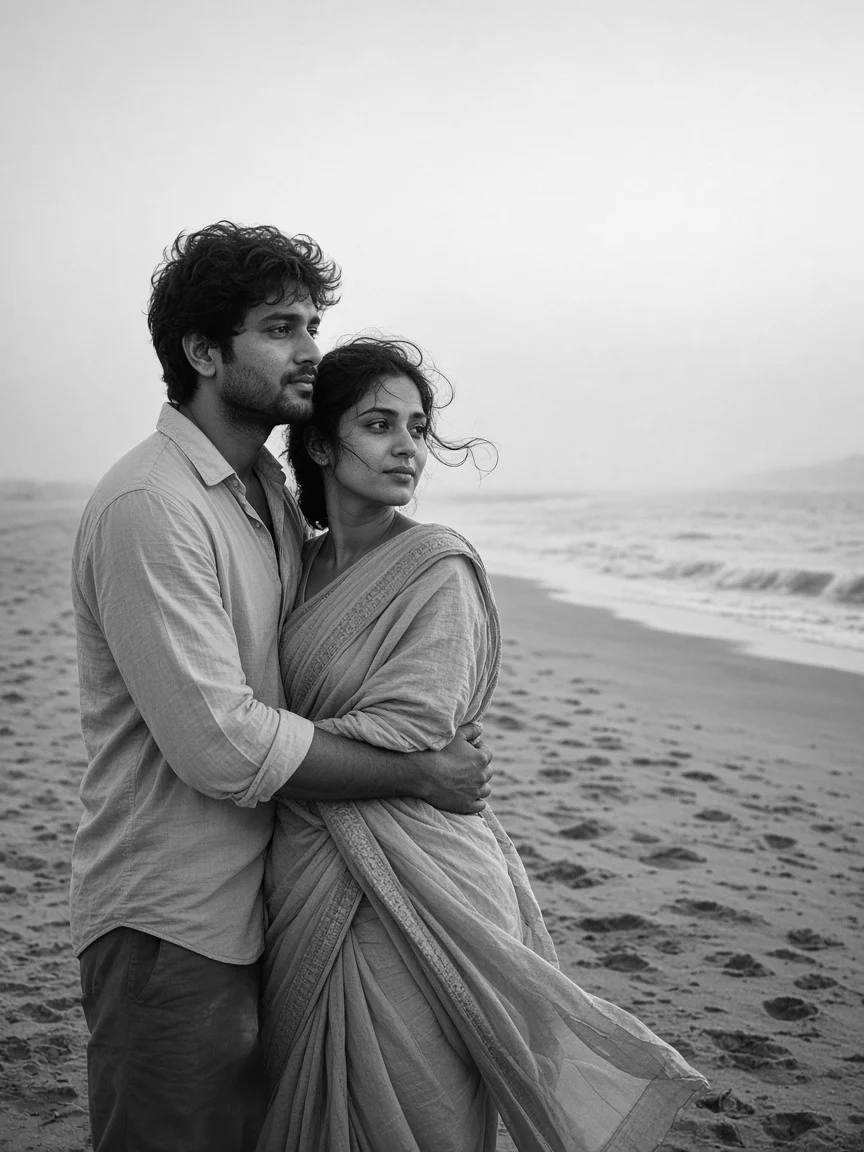
Photorealistic vertical 3:4 soft monochrome Indian couple embracing on a quiet beach at dawn, woman in flowing saree with dupatta wrapped securely and man in rolled-sleeve linen shirt, foreheads touching, horizon above head height, backlight through coastal mist, smooth sky and delicate wave highlights, low-contrast Ilford FP4 Plus-style silver print, realistic texture, no text.
Everyday Intimacy and Complete Visual Stories
The final concepts show how a single action—a slow dance, a shared book or an adjustment of a saree—can carry a monochrome portrait without elaborate scenery.
19. Geometry on a Spiral Staircase
Use architectural geometry to lead toward, not away from, the pair. Shoot from a stable landing and avoid leaning a real camera or person over a stairwell for an AI-inspired angle.
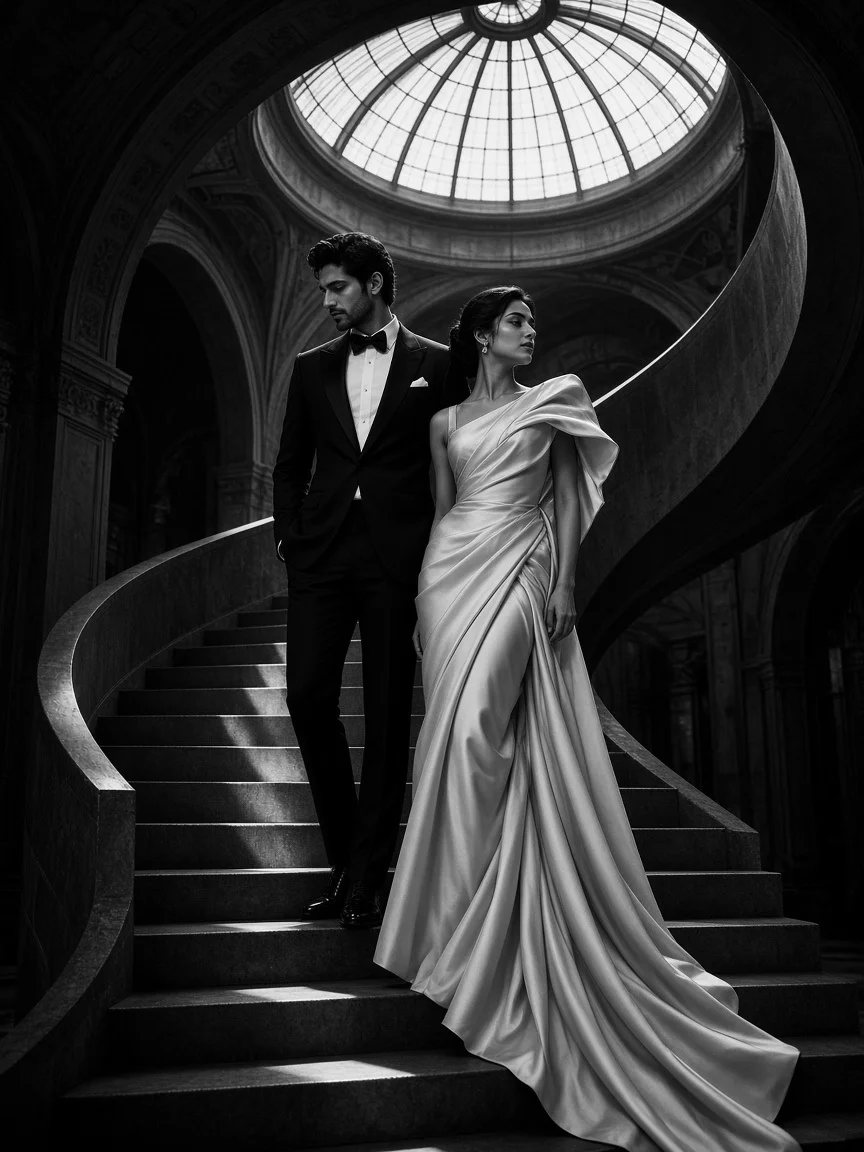
Photorealistic vertical 3:4 black and white editorial Indian couple on a sweeping modern spiral staircase inspired by Milan fashion photography, woman in sleek dark saree gown and man in light tailored suit, intimate look upward, high overhead camera angle, polished rails forming curved leading lines, controlled bright skylight, clean blacks and geometric whitespace, no text.
20. A Slow Dance in the Home Kitchen
Domestic intimacy often outlasts grand locations. Clear unsafe clutter but keep personal objects; one overhead lamp is enough if you add faint reflected fill to the faces.
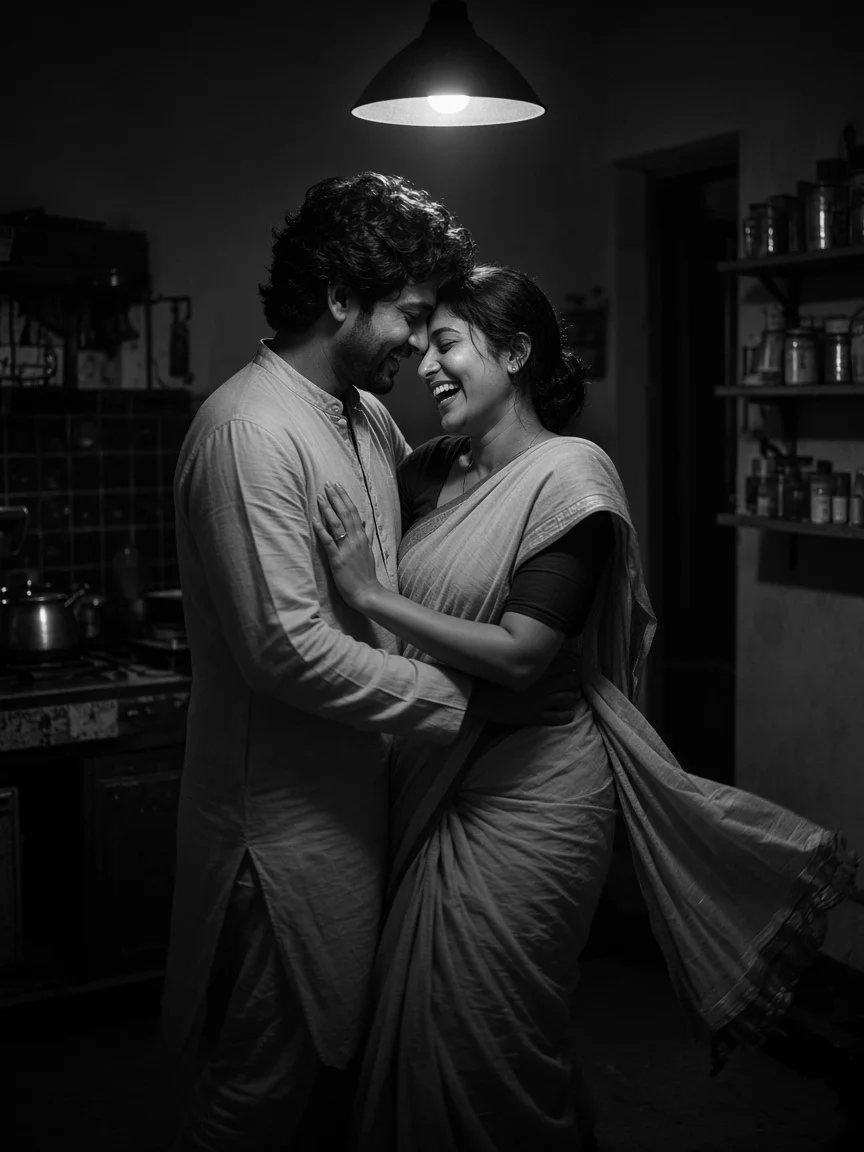
Photorealistic vertical 3:4 black and white Indian couple slow dancing barefoot in a modest home kitchen at night, woman in comfortable cotton saree and man in simple kurta-pyjama, heads resting together, single pendant light above and gentle reflected fill, table with two mugs, authentic lived-in details, soft shadows, unobtrusive grain, natural 35mm snapshot, no text.
21. Film Noir on a Bombay Balcony
Noir is a controlled relationship between attraction and uncertainty. The venetian-blind pattern should cross clothing and the wall without slicing through both eyelines; otherwise the photograph becomes a lighting trick.
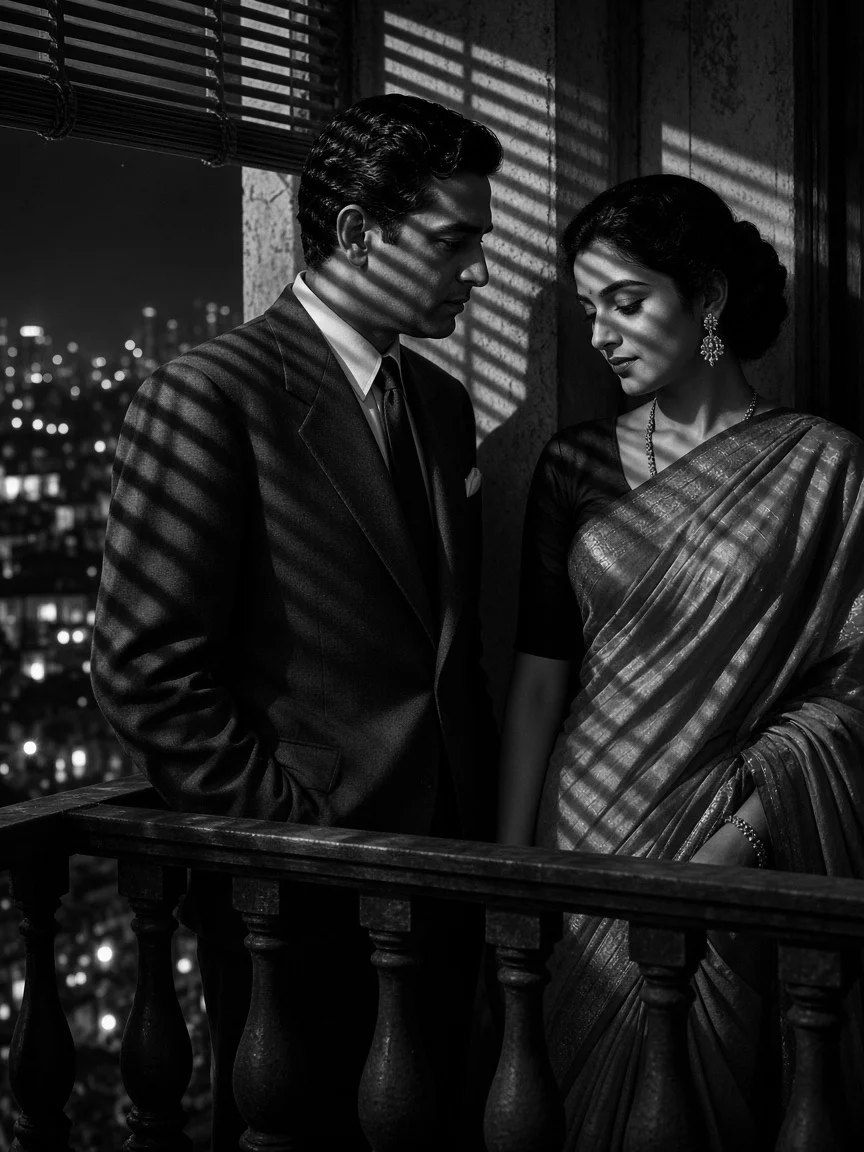
Photorealistic vertical 3:4 classic film-noir black and white Indian couple on a 1950s Bombay apartment balcony, man in tailored dark suit and woman in elegant satin saree with low bun, affectionate guarded glances, venetian blind shadows primarily on wall and shoulders, city bokeh below, hard directional key light, chiaroscuro, restrained Tri-X grain, no text.
22. A Railway Platform Farewell
An almost-touch and a backward glance can suggest a whole story. Keep the farewell tender, not tragic, and use this heritage carriage only as an imagined scene rather than trespassing at a real station.
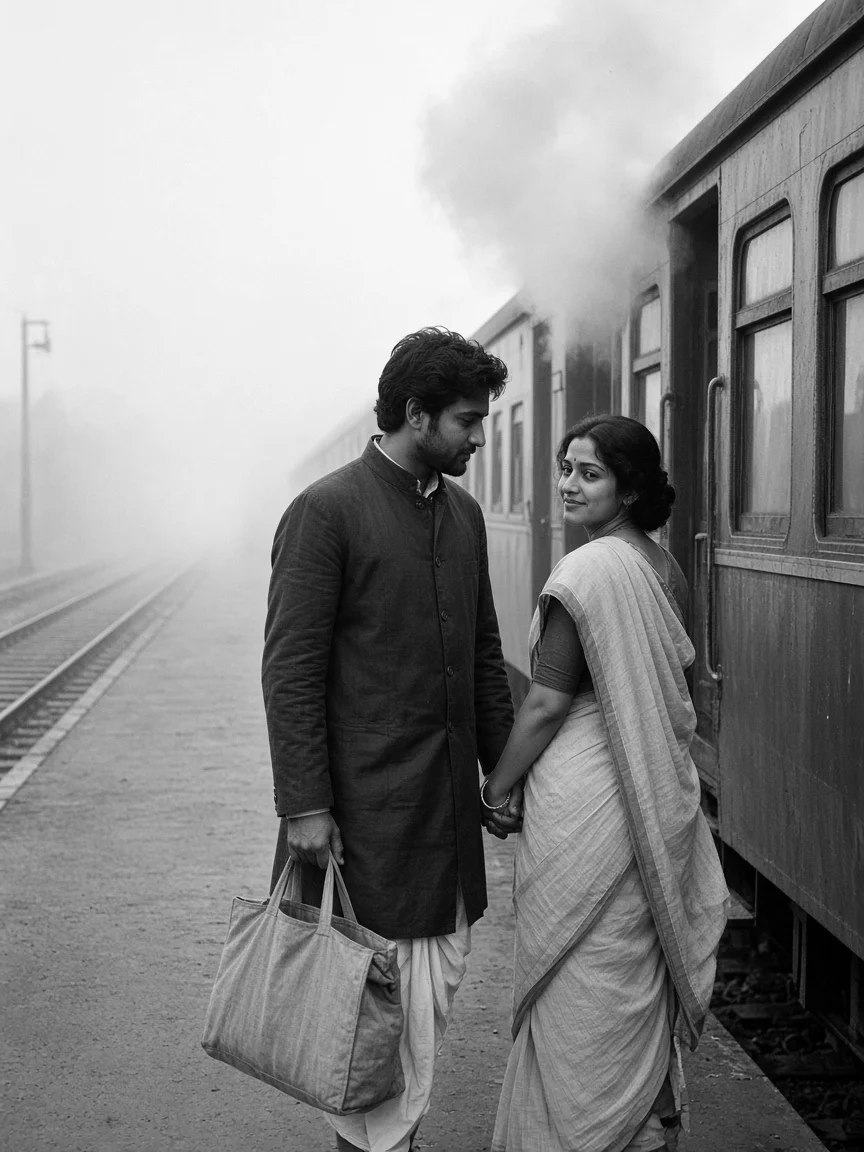
Photorealistic vertical 3:4 nostalgic monochrome Indian couple on an empty heritage railway platform beside stationary vintage steam train, woman in cotton saree looking back with a wistful smile as man in textured coat holds her hand, canvas bag and drifting steam, rails leading into fog, soft silver midtones and deep carriage blacks, 35mm cinema-realism, no text.
23. Poetry in an Old Library
Give both people the same activity, not one person a book and the other a vacant stare. Ask them to read a favourite passage silently and react naturally.
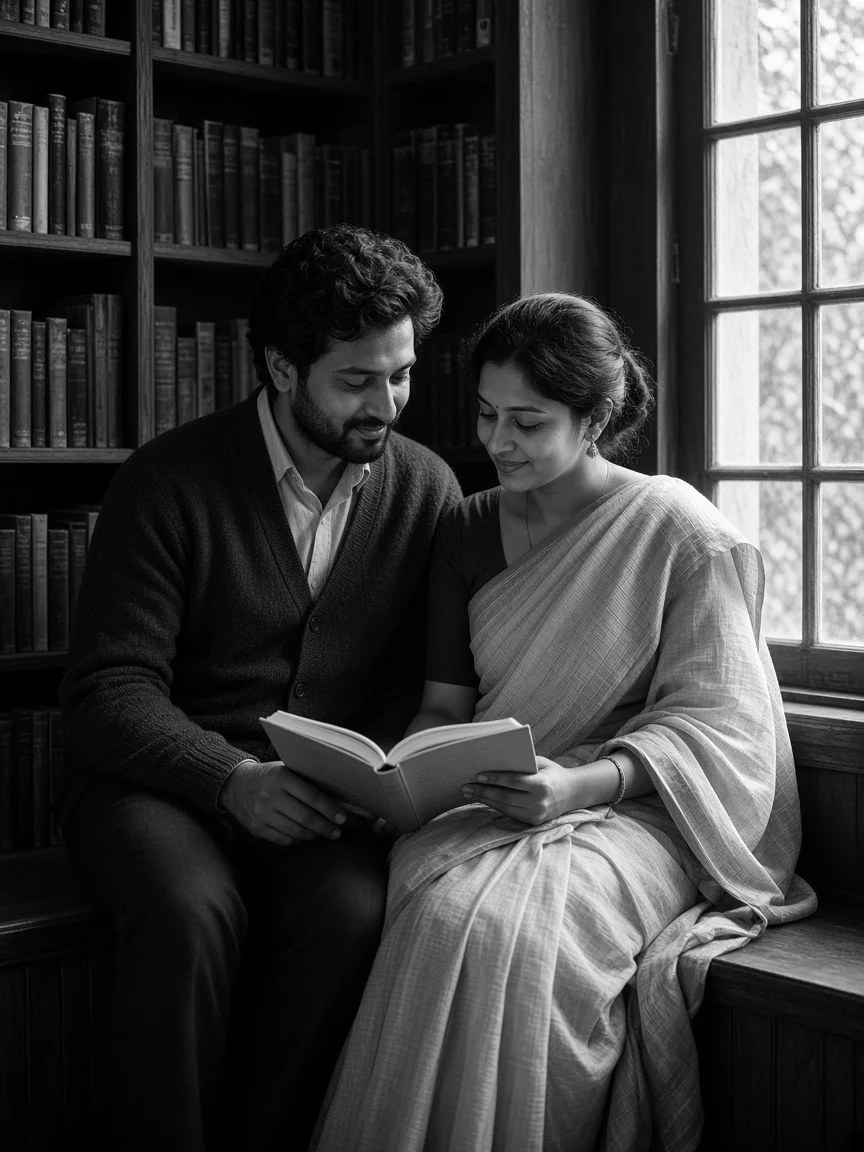
Photorealistic vertical 3:4 black and white Indian couple seated in an old library window alcove sharing a poetry book, man in knitted cardigan and woman in handloom saree, heads inclined toward the pages with soft knowing smiles, tall dark bookshelves and bright side window, balanced low-key lighting, woven fabric and realistic skin, quiet 50mm photograph, no readable text.
24. The Saree Pallu in an Antique Mirror
Focus on the mirror reflection rather than the backs of heads. Two planes of focus and too many gestures confuse AI; ask for one simple pallu adjustment and a clear shared gaze in reflection.
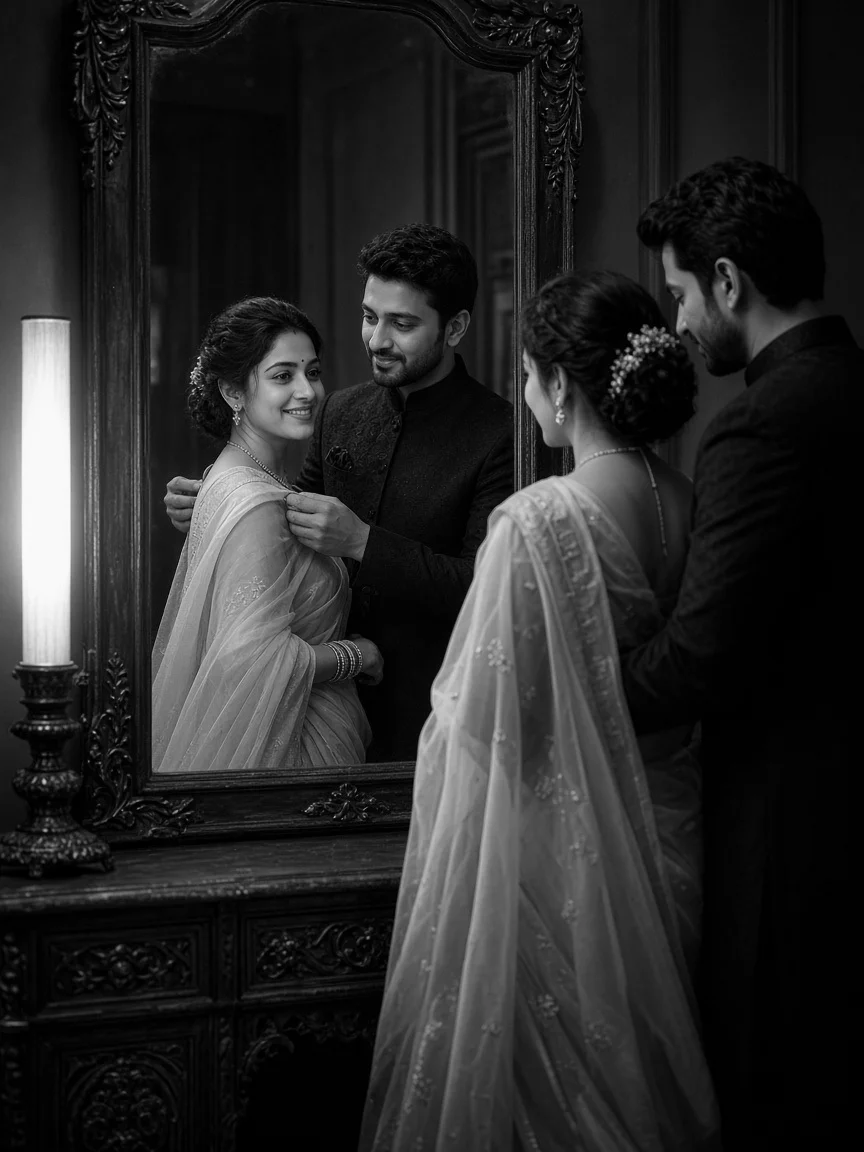
Photorealistic vertical 3:4 black and white Indian anniversary couple before an antique carved mirror, man gently adjusting woman’s saree pallu over her shoulder, both affectionate faces clearly visible in the reflection, woman’s small gajra and jhumkas detailed, single shaded vanity lamp, low-key chiaroscuro, layered foreground and mirror composition, realistic fabric and pores, no text.
25. After the Rain: Reflections in a Dark Lane
A low viewpoint can double a silhouette in a wet road. The reflection should be recognisable but less bright than the subjects; retain the darkest blacks near them, not everywhere.
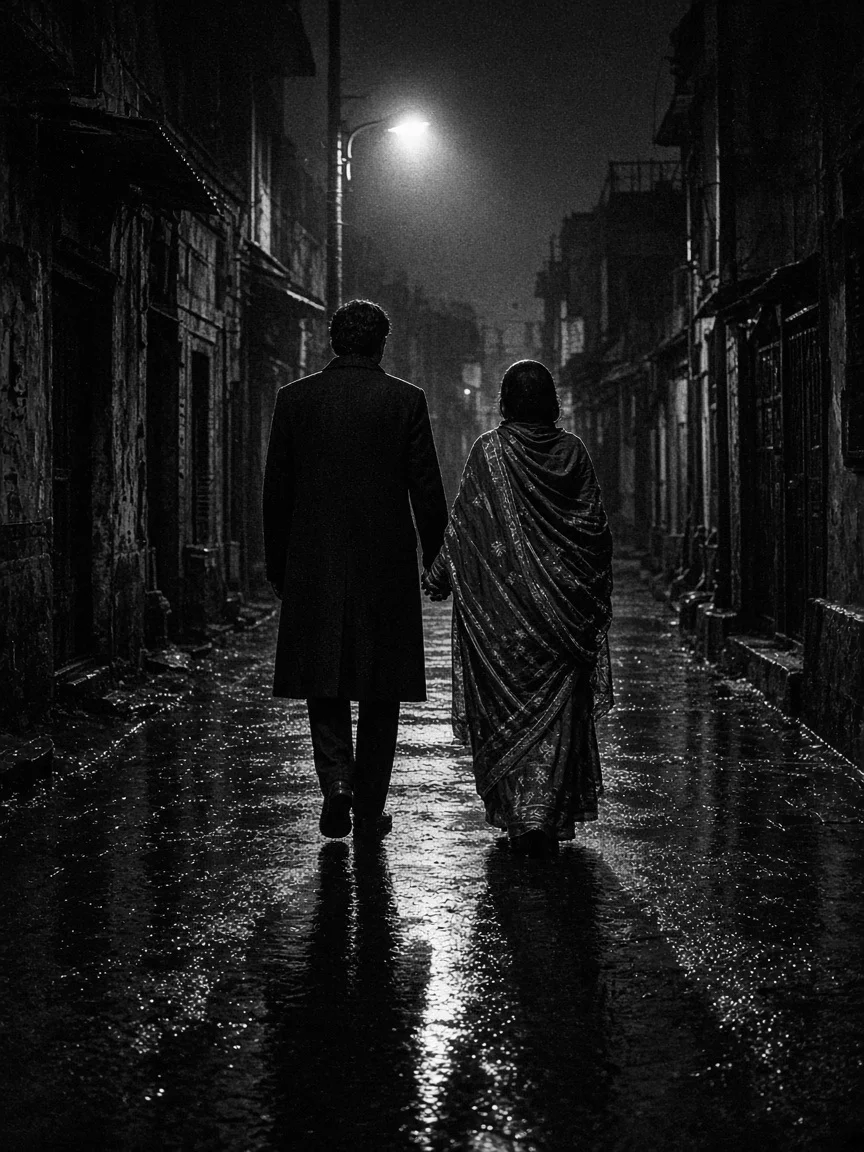
Photorealistic vertical 3:4 noir black and white Indian couple walking away hand in hand through a narrow rain-wet old city lane, man in long coat and woman in silk saree with shawl, single overhead streetlamp creating rim light and full reflections on cobblestones, dark textured walls, atmospheric mist, deep shadows with silver wet highlights, 35mm cinematic frame, no text.
Poses That Look Intimate, Not Performed
Romance benefits from an action with a beginning and end. Ask one partner to offer chai, adjust a shawl, tuck a loose strand behind an ear or lead a single dance step. Photograph just before and after the gesture, when the couple forgets the instruction. Consent matters for kisses and close poses: agree on them first.
- Walking: give the pair a topic to discuss and use 1/500 second or faster to avoid accidental blur.
- Seated: turn knees and shoulders slightly toward each other; leave space between their faces.
- Standing embrace: place hands visibly on a shoulder, upper arm or waist without flattened fingers.
- Profiles and kisses: offset the heads enough to reveal one eye and a clean outline.
- Camera-aware frame: after candid shots, ask both to look into the lens for one formal, less self-conscious portrait.
For two people at different depths, f/2.8–f/4 is a safer starting range than f/1.4 on a full-frame camera. When both faces share a plane, adjust aperture to suit your desired background. Focal lengths are aesthetic shorthand in an AI prompt: “35mm environmental portrait” includes more setting; “85mm close portrait” reduces it.
For softer window posing and family-friendly intimacy, see our traditional maternity photoshoot ideas at home. The same advice about clean hands, gentle profiles and secure seating works for anniversary portraits as well.
How to Use These Prompts in Gemini and ChatGPT
- Generate without references first. Paste one card and specify vertical 3:4, a square post or landscape 3:2. Choose only one aesthetic anchor: for example Tri-X 400 street grain or clean T-Max 100 studio detail.
- Revise one variable. If the faces are too dark, ask for soft reflected fill rather than adding “HDR, 8K, ultra-detail.” If the couple merges, request slightly separated profiles and unclasped hands.
- Supply reference photos responsibly. In a tool version that supports image input, use clear, recent photographs of both consenting adults with no sunglasses, extreme angle or face occlusion. State that these are two adults and preserve each identity, age, natural Indian skin tone, facial proportions and skin pores.
- Preserve the chosen background. Ask to change lighting or clothing while retaining composition, rather than regenerating everything. Mask/inpaint individual problems when your editor supports it.
- Review the export. Hands, duplicated jewellery, extra limbs, impossible mirrors and tram/rail geometry need inspection. Keep substantial AI changes disclosed when sharing a photo as a personal memory.
Reference-photo add-on: “Use the supplied photos only to preserve the identities of these two consenting Indian adults. Transform the scene into authentic black and white, retain natural features and skin texture, and do not substitute either face. Keep their written consent private; do not reproduce or invent identifying text.”
Gemini and ChatGPT capabilities differ by account, model and date. Do not infer consent from having someone’s picture, and do not upload a minor’s photo or a third party’s private image without appropriate permission. For a reminder-and-ritual-led alternative, browse our Karwa Chauth couple portrait prompts.
Film Looks and Lens Language: What the Names Add
AI may not reproduce the chemistry of an actual film stock. Treat these labels as visual references, compare the results, and remove a name if it just makes every frame harsh.
| Reference | Useful prompt effect | Best-fit scenes |
|---|---|---|
| Kodak Tri-X 400 | Visible grain, robust blacks and documentary contrast | Rain, café, balcony, street |
| Ilford HP5 Plus | Forgiving midtones with moderate grain | Jharokha, home, ordinary window light |
| Ilford FP4 Plus | Fine texture and gentle tonal separation | Fog, dawn, detailed textiles |
| Kodak T-Max 100 | Clean fine grain and crisp high-key detail | Bright window, modern staircase |
| Kodak Double-X 5222 | Cinematic low-light texture | Drizzle, vintage urban scenes |
“Leica Monochrom” can suggest a committed monochrome capture; “Leica M3/M6 + 35mm” suggests street-scale context. “50mm” gives a natural general portrait; “85mm” implies a tighter view and stronger background compression. A Hasselblad reference is useful for medium-format tonality and deliberate square or near-square styling, though this article uses vertical 3:4. These are not authenticity claims about how an AI image was captured.
For low-light points of light beyond the couple, our Diwali AI prompt and festive lighting guide offers useful individual-lamp and bokeh ideas. For era-specific hairstyles and deliberately nostalgic imperfections, our 1980s retro AI photo guide is a helpful companion. Keep film grain moderate: it should survive at final viewing size without resembling a dirt layer.
Editing an Existing Colour Photo into Black and White
- Correct first. Duplicate the layer or work from RAW; fix exposure, white balance, noise and obvious distractions before conversion.
- Use a dedicated monochrome adjustment. In Lightroom, Camera Raw, Photoshop or a capable mobile editor, use B&W or a channel mixer instead of saturation at −100. This preserves control over how original colours map to grey.
- Adjust channels gently. Darkening blue can deepen sky; adjusting red and orange changes lips, skin and warm clothing. Extreme moves create halos or grey blotches, especially on deep skin tones.
- Set black and white points. Retain printable shadow texture and bright detail. “Deep blacks” does not mean crushed faces; “high-key” does not mean clipped sarees.
- Dodge and burn locally. Use low-opacity masks to lift an eye, darken a competing sign and guide attention toward joined hands. Keep transitions gradual and avoid uniformly sharpening both skin and background.
- Add restrained grain last. Match it across composited regions, export, and inspect at both thumbnail and full size. Upscale only after anatomy and detail are sound.
AI retouching may hallucinate pores, eyelashes and fabric patterns. Do not replace a real face to make it look “better.” Reduce denoise and beauty smoothing, preserve natural pores and asymmetry, and keep before-and-after versions. Save a high-quality master before exporting a smaller JPEG or WebP.
Quick Troubleshooting for Common Failures
| Problem | More effective correction |
|---|---|
| Muddy grey image | Specify one true black, luminous skin midtones and a restrained bright highlight; then protect facial fill. |
| Plastic skin | Remove “flawless,” request natural pores and fine fabric texture, and avoid aggressive denoise. |
| Two faces merge | Separate profiles, simplify contact, name left/right positions and inpaint the affected faces. |
| Wrong reflection | Reduce mirror or rain complexity; specify exactly one reflection and matching pose. |
| Too much grain or crushed noir | Request finer grain, open shadow texture and a controlled key-to-fill ratio. |
| Monochrome contains a tint | Request neutral monochrome only, then convert cleanly and inspect RGB channels/export settings. |
Conclusion
The strongest black and white couple AI portrait is built from one truthful gesture and a deliberate arrangement of tones. Choose a setting, place lighter clothing against darker surroundings, name the light source and protect both faces. Use the 25 cards as flexible starting points, then edit selectively rather than piling on grain, sharpness and drama.
Frequently asked questions
How do I write a good romantic couple AI prompt in black and white?
Describe two distinct adults, their clothing and one clear gesture, then name the location, camera framing and light. Add tonal instructions such as luminous facial midtones, textured blacks and preserved highlights. Finish with natural pores and negative instructions for text or watermarks, but review every result.
Can Gemini or ChatGPT convert my existing colour couple photo to black and white?
Where your tool supports image editing, upload a photo with both people’s consent and ask for neutral monochrome, preserved identities, realistic pores and controlled channel-style tonal separation. Check hands and facial details. For more precise control, use a RAW editor’s B&W mixer rather than relying only on AI.
What clothes look best for a monochrome couple photoshoot?
Choose different luminance levels: a dark velvet or matte bandhgala beside a lighter embroidered saree or lehenga works well. Linen, Jamdani, silk and cotton provide useful texture. Avoid both partners wearing exactly the background’s grey level, and check a monochrome test before shooting.
What is the difference between high-key, low-key and noir?
High-key images use bright backgrounds and gentle shadows, low-key portraits use predominately dark tones with selective light, and noir adds hard urban light, deep shadow and narrative tension. Any of these can be romantic when both faces and gestures remain readable.
How do I prevent grey, mushy or plastic-looking AI portraits?
Request a full but controlled tonal range, natural pores and one directional light instead of excessive sharpening or “flawless skin.” Correct exposure before converting, lift shadow detail locally and use subtle grain. If necessary, regenerate only the flawed face or fabric area.
Which film stock should I mention in an AI prompt?
Tri-X 400 suits gritty street and noir scenes, HP5 Plus gives flexible midtones, FP4 Plus suits quiet fine detail, T-Max 100 supports clean high-key portraits, and Double-X 5222 suggests cinematic low light. They are aesthetic references, not proof an AI image was shot on film.
Which aspect ratio is best for these prompt cards?
Vertical 3:4 works well for couple portraits and this guide. Use 9:16 for Stories or Reels, square for profile or feed layouts, and horizontal 3:2 for an environmental cinema frame. State the ratio explicitly because a face crop that works in one may fail in another.
Related articles
Cinematic Double Exposure Couple Prompts Gemini: 10 Indian Landscape Blends
Ten cinematic double exposure couple prompts for Gemini with real results, blending Indian couples with Goa sunsets, Mumbai rain, Himachal forests, Udaipur diyas, the Spiti Milky Way, a Shillong café, Marine Drive on film, a stepwell, Varanasi and Kerala, plus technique, real-face and fix-it tips.
Nancy · · 17 min read
Radha Krishna Prompt for Couple Love: 25 Romantic AI Ideas
Create respectful Radha Krishna couple portraits with 25 romantic AI prompts, Vrindavan and Yamuna scenes, costume guidance, posing tips and Gemini editing advice.
Nancy · · 15 min read
ChatGPT Candid Photo Prompt: 10 Day-in-the-Life Couple Moments
Ten ChatGPT candid photo prompts that follow one Indian couple through a day: morning chai, shared earphones, a Mumbai auto, a Bengaluru walk, a Jaipur market, a Kasauli balcony, a sangeet, a hotel corridor, Sarafa jalebi and a railway reunion, plus candid vocabulary, consistency and face tips.
Nancy · · 18 min read
Couple Aesthetic Prompt ChatGPT: 10 Modern Indian Date Photo Ideas
Ten couple aesthetic prompts for ChatGPT and Gemini with real results: flash party, lift mirror selfie, café date, rainy windshield, rooftop blue hour, beach walk, flower market, bookstore, Jaipur scooter and penthouse skyline, plus outfit pairing, colour grades, face matching and captions.
Nancy · · 17 min read
Comments
No comments yet. Be the first!