Durga Ashtami Kanya Pujan Photoshoot Prompt: 10 Kanjak Puja Ideas
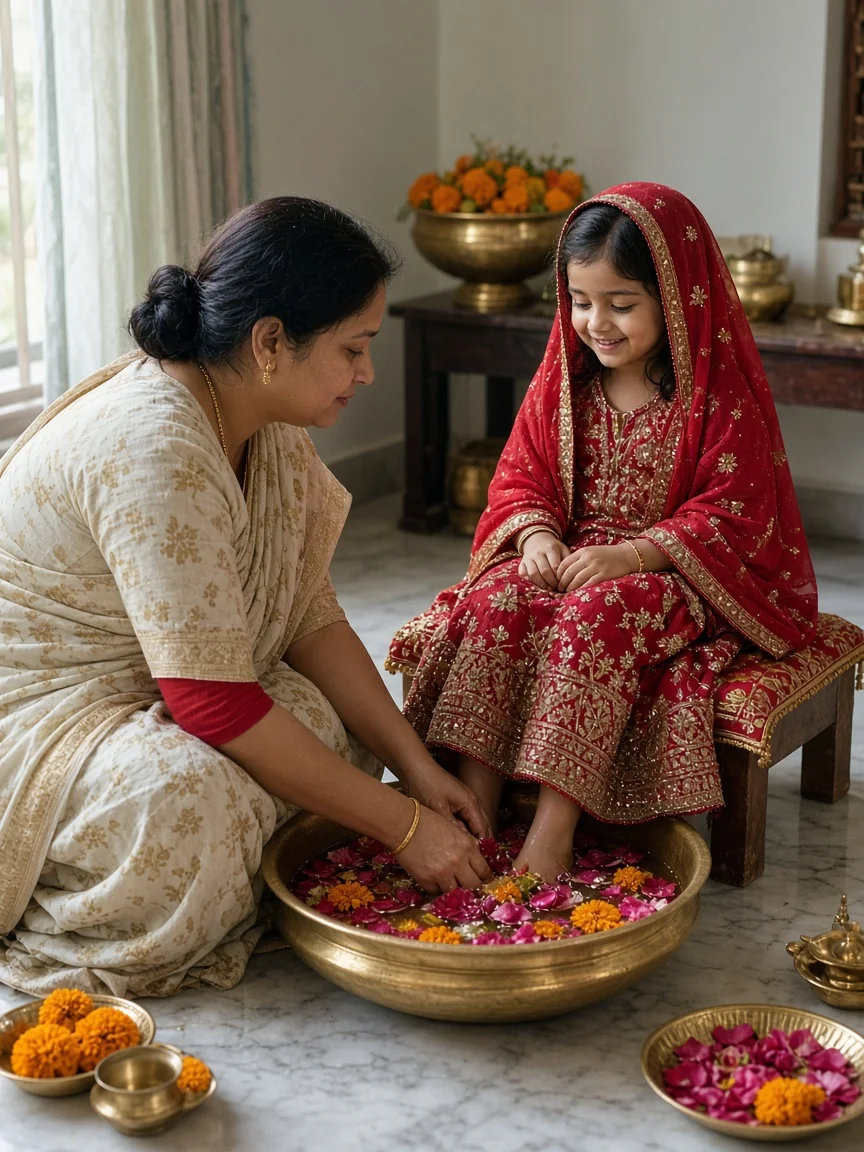
Table of contents
- What Kanya Pujan means
- The rituals, step by step
- Styling the little kanyas
- Lighting the Kanjak morning
- 10 Durga Ashtami Kanya Pujan photoshoot prompts
- 1. Charan Dhulai in a brass urli
- 2. Chandan-kumkum tilak close-up
- 3. Puri, kale chana and halwa bhog
- 4. Grandmother ties the mauli
- 5. Draping Mata ki chunari
- 6. Charan Sparsh blessing
- 7. Kanya aarti with a brass thali
- 8. Kanjak gift pouches
- 9. Bal Durga editorial portrait
- 10. Haveli courtyard Kanya Pujan
- Using your daughter's photo safely
- Tips for real Kanjak photos at home
- Choosing an AI tool for child portraits
- Gifts, food and decoration ideas
- More family and festive prompt guides on GAWKIN
- Final thoughts
On the morning of Durga Ashtami or Maha Navami, homes across North India fill with small guests. Little girls arrive in bright lehengas and red chunaris, sit in a row on the floor, have their feet washed and their foreheads marked with tilak, eat halwa, puri and kale chana from brass thalis, and leave with gifts and blessings. Kanya Pujan, or Kanjak Puja as it is lovingly called in Punjab, Delhi and Haryana, is one of the most joyful rituals of Shardiya Navratri, and also one of the hardest to photograph. Children move fast, the room is crowded, the light is often poor, and the adults are busy serving.
That is why so many parents now search for a Durga Ashtami Kanya Pujan photoshoot prompt. AI tools can recreate the warmth of the morning as a calm, beautifully lit picture, or help you plan the real photos you will take next year. This guide shares ten prompts with the images they produced, covering every stage of the ritual from Charan Dhulai to the farewell gifts. Each prompt is written for Gemini, ChatGPT, Grok or the GAWKIN generator, uses a vertical 3:4 frame, and shows Indian girls together with the mothers, grandmothers and fathers who make the day happen. You will also find the meaning behind each step, styling notes, lighting tips and, most importantly, guidance on using children's photos safely.
What Kanya Pujan means
During Navratri, devotees worship the nine forms of Maa Durga, the Navadurga. On Ashtami or Navami, many families close the fast by inviting young girls, usually aged between two and ten, and honouring them as living forms of the goddess. Traditionally nine girls are invited, one for each form, along with a small boy called the langur or langoor, who represents Bhairav or Hanuman ji. Families who cannot gather nine girls invite as many as they can; the feeling matters more than the number.
The idea at the heart of Kanya Pujan is humility. Adults, including elders, wash the girls' feet, touch them for blessings and serve them first. It teaches respect for girls in a simple, physical way that children remember. When you photograph the ritual, or recreate it with AI, try to show that reversal: grown-ups bending, serving and smiling, and the children seated, honoured and happy.
The rituals, step by step
Customs vary by region and family, but most Kanjak mornings follow a similar order. Knowing it helps you plan a shot list and write more accurate prompts:
- Welcome and Charan Dhulai: the girls are seated on a chowki or mat, and their feet are washed in a brass urli or thali with water, sometimes milk and flower petals.
- Alta and tilak: red alta may be applied to the feet, and a chandan or kumkum tilak with a few rice grains is placed on the forehead.
- Mauli or kalava: a red and yellow sacred thread, also called raksha sutra, is tied around the wrist for protection.
- Chunari: a red Mata ki chunari with gota or kinari border is draped over each girl's head.
- Bhog: the prasad of sooji halwa, puri and dry kale chana is served, often with a coconut piece or fruit.
- Aarti and Charan Sparsh: the family performs aarti and touches the girls' feet to seek blessings.
- Gifts: each girl receives a small gift, such as bangles, a hair clip, a pencil box, a coin or some money, often in a red potli pouch.
Each of these moments makes its own photograph, which is why the ten prompts below follow the same order. Shot together, they tell the complete story of the day.
Styling the little kanyas
Children look their best in comfortable festive clothes that let them sit cross-legged and eat without fuss. Lehenga-cholis, ghagras, pavadai skirts and simple anarkali suits all work. Red, pink, mustard, green and orange photograph beautifully against brass and marigolds, and a gota-patti or zari border catches morning light. In prompts, the words red gota-patti chunari, brocade lehenga and silver payal guide the AI towards authentic Indian craft instead of generic party dresses.
For adults, think of supporting colours. Mothers and grandmothers in cotton or silk sarees with contrasting borders frame the children without overpowering them, and fathers in plain kurtas keep the attention on the girls. Avoid heavy makeup descriptors such as glam or flawless for children in prompts; they push AI towards adult faces. Instead write natural child skin, chubby cheeks and bright expressive eyes.
Lighting the Kanjak morning
Kanya Pujan happens in daylight, usually between eight and noon, which is excellent news for photographs. Diffused window light from one side gives soft shadows and glowing skin. Diyas and the aarti lamp add warm highlights, but they should never be the only light on a child's face. In AI prompts, combine the two: soft morning window light with warm diya glow on the brass. For outdoor courtyard shots, dappled shade under a tree is kinder than harsh direct sun.
Lens words also help. An 85mm look suits single-child close-ups such as tilak and chunari. A 50mm look fits two people in the frame, like a grandmother and granddaughter. A 35mm look is best for groups of four or more girls at the bhog or in a courtyard. Ask for the camera at the children's eye level; shooting down from standing height makes kids look small and distant.
10 Durga Ashtami Kanya Pujan photoshoot prompts
Use each prompt as it is, or upload a photo of your own daughter with the safety notes in the next section in mind. Change outfit colours, room details or the number of girls to match your home and family traditions.
1. Charan Dhulai in a brass urli
The washing of the feet is the opening moment and the most symbolic. A mother sits on the marble floor and gently pours water over a five-year-old's feet in a wide brass urli filled with rose and marigold petals, while the girl sits on a red chowki in a scarlet lehenga and chunari. The lower position of the adult tells the whole story of respect. For a real photo, crouch to the child's level and include the urli in the frame; the petals add colour even in a small picture.
Photorealistic Durga Ashtami Kanya Pujan home portrait of an Indian mother seated on a marble floor gently washing the feet of a smiling five-year-old girl in a wide brass urli with rose petals and marigolds; the girl sits on a red chowki in a scarlet gota-patti lehenga with a red chunari over her head, soft morning window light, natural child features, no text.
2. Chandan-kumkum tilak close-up
Close-ups of the tilak capture tiny details: the powdery kumkum, a few white chandan dots and the child's expression as she holds still. Here a woman applies the tilak to a six-year-old in a mustard and magenta ghagra with red glass bangles, lit by golden window light. Keep the adult's hand in the frame so the moment feels shared. This is a lovely image for a phone wallpaper or a festive greeting card.
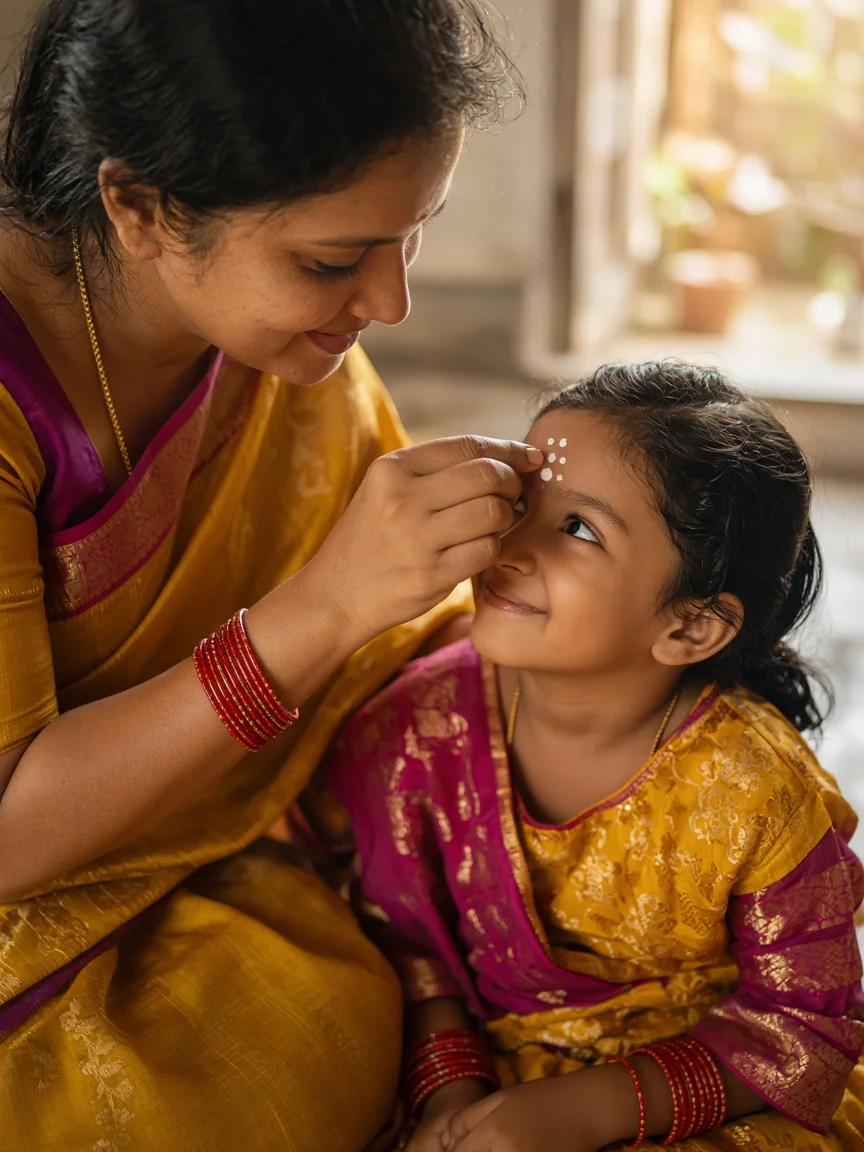
Photorealistic intimate close-up of an Indian woman applying a small chandan-kumkum tilak with white dots on the forehead of a delighted six-year-old girl in mustard-yellow and magenta silk ghagra with red glass bangles during Kanjak puja, warm golden courtyard window light, natural child skin texture, tender caring expressions, shallow depth of field, no text or watermark.
3. Puri, kale chana and halwa bhog
No Kanjak is complete without the bhog. Four girls sit in a row on a red handloom carpet with embossed brass thalis of puffed golden puris, dry kale chana and sooji halwa with cashews, while an adult serves more prasad from behind. In prompts, spell out each dish; a vague plate of food produces generic meals. In real life, photograph the thalis before the children start eating, then capture a candid shot a few minutes later when the smiles come out.
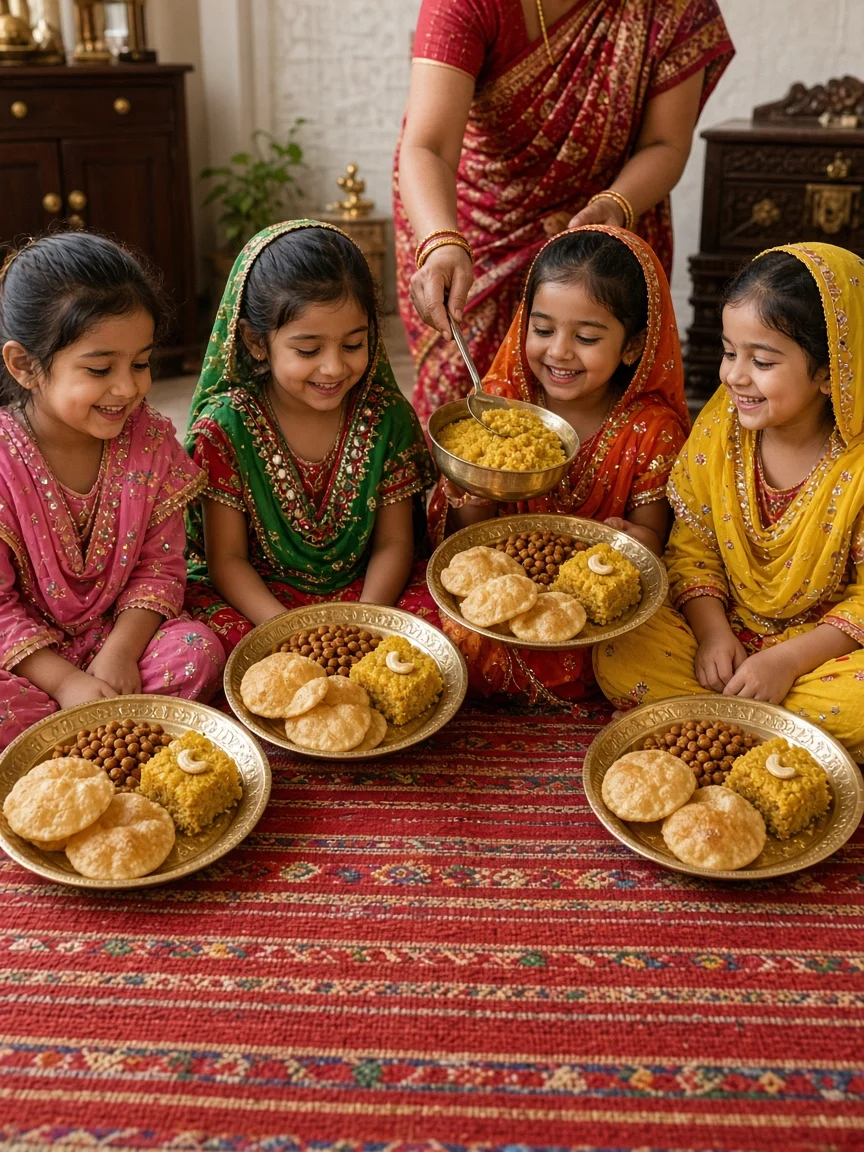
Photorealistic Navratri Kanjak feast scene of four happy Indian girls aged four to seven seated in a row on a red handloom carpet, each with an embossed brass thali of golden puris, kale chana and sooji halwa with cashews, colourful gota-patti chunaris, an adult serving more prasad from behind, warm Indian home interior light, natural child proportions, no text.
4. Grandmother ties the mauli
Moments between generations are often the most emotional photographs of the day. A silver-haired grandmother in a cream cotton saree ties a red and yellow mauli on a small wrist while the child holds a red silk gift pouch and smiles at the thread. Wrinkled, experienced hands next to tiny ones create a powerful contrast. Diyas glow on a shelf in the background, safely away from the pair. If your mother or mother-in-law hosts the puja, this is the shot to print and frame.
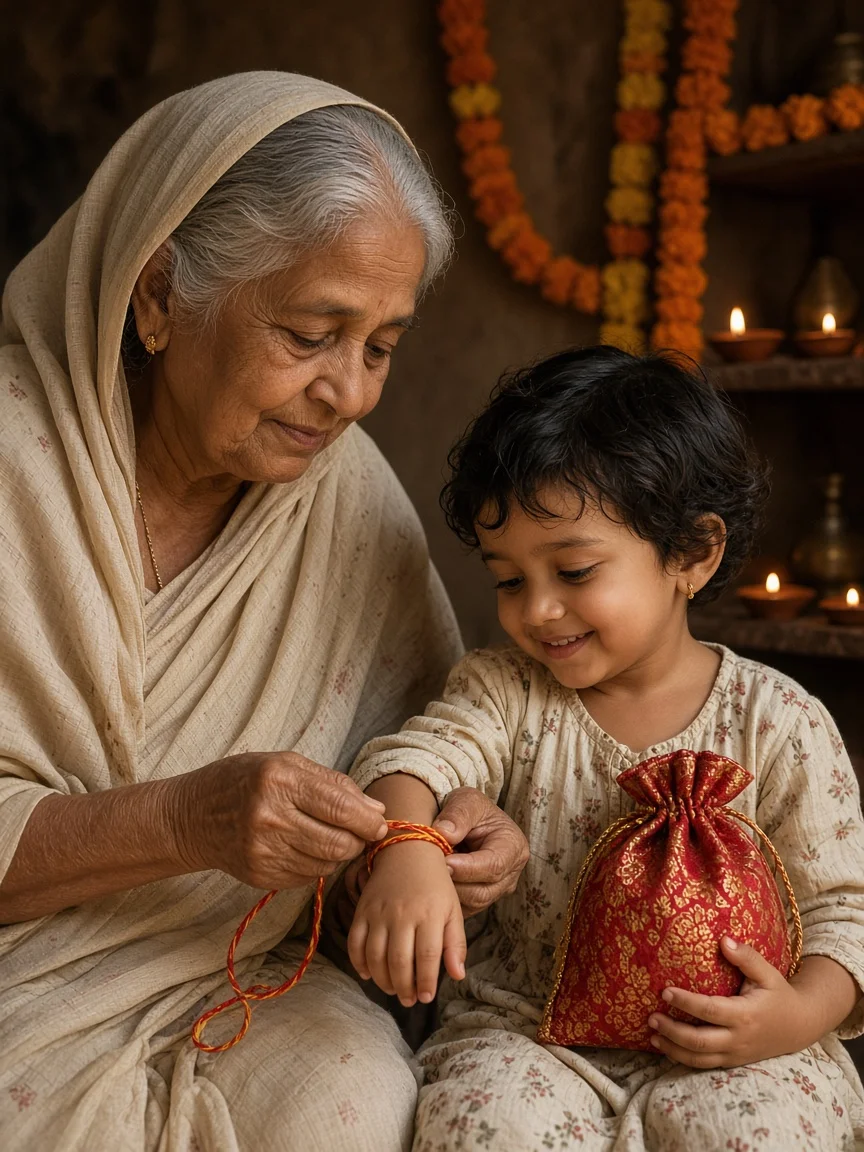
Photorealistic emotional portrait of a silver-haired Indian grandmother in a cotton saree tenderly tying a red and yellow mauli thread around the small wrist of a smiling four-year-old girl holding a red silk gift pouch, terracotta diyas on a distant shelf and marigold garlands behind, warm natural chiaroscuro, wrinkled caring hands beside small child hands, no text.
5. Draping Mata ki chunari
The red chunari with gold gota border is the sacred emblem of Maa Durga, and draping it over each kanya's head is a tender moment. In this image a woman lifts the shimmering chunari over a smiling five-year-old in a green and pink brocade lehenga. Morning sunbeams catch the sequins, giving the photograph a festive sparkle. Shoot slightly from the side so both faces are visible and the fabric is caught mid-motion.
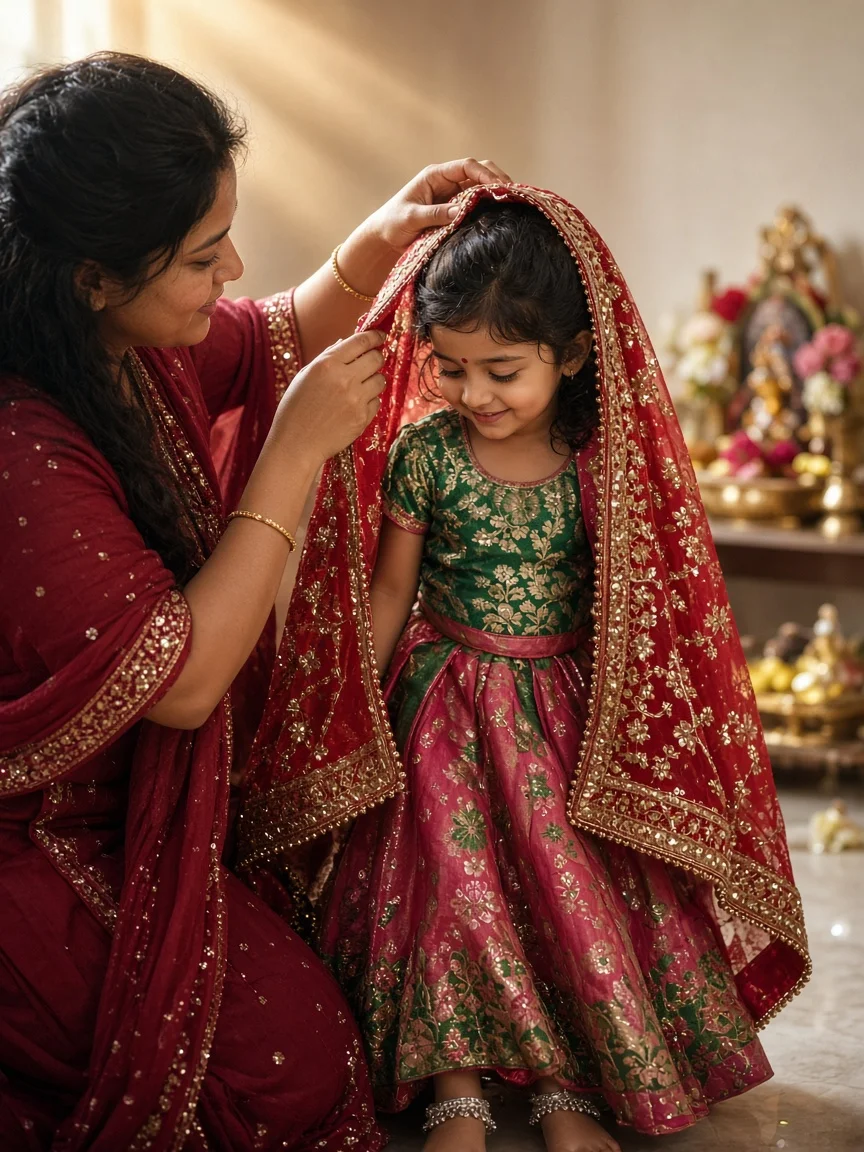
Photorealistic candid portrait of an Indian woman gently draping a crimson and gold gota-kinari Mata ki chunari over the head of a shy smiling five-year-old girl in green and pink brocade lehenga with tiny red bindi and silver payal, soft morning sunbeams catching the sequins, home puja room background, natural child skin, shallow depth of field, no text.
6. Charan Sparsh blessing
Charan Sparsh, touching the feet for blessings, shows the philosophy of the ritual most clearly. A father and mother bow with folded hands before a six-year-old seated on a carved stool decorated with mango leaves and marigolds, and she raises her small right hand in a gentle abhaya mudra, the open-palm gesture of blessing and fearlessness. A low camera angle emphasises the child's calm presence. Ask the parents to pause in the bow for a few seconds so the photographer can focus, because this moment passes quickly in real life.
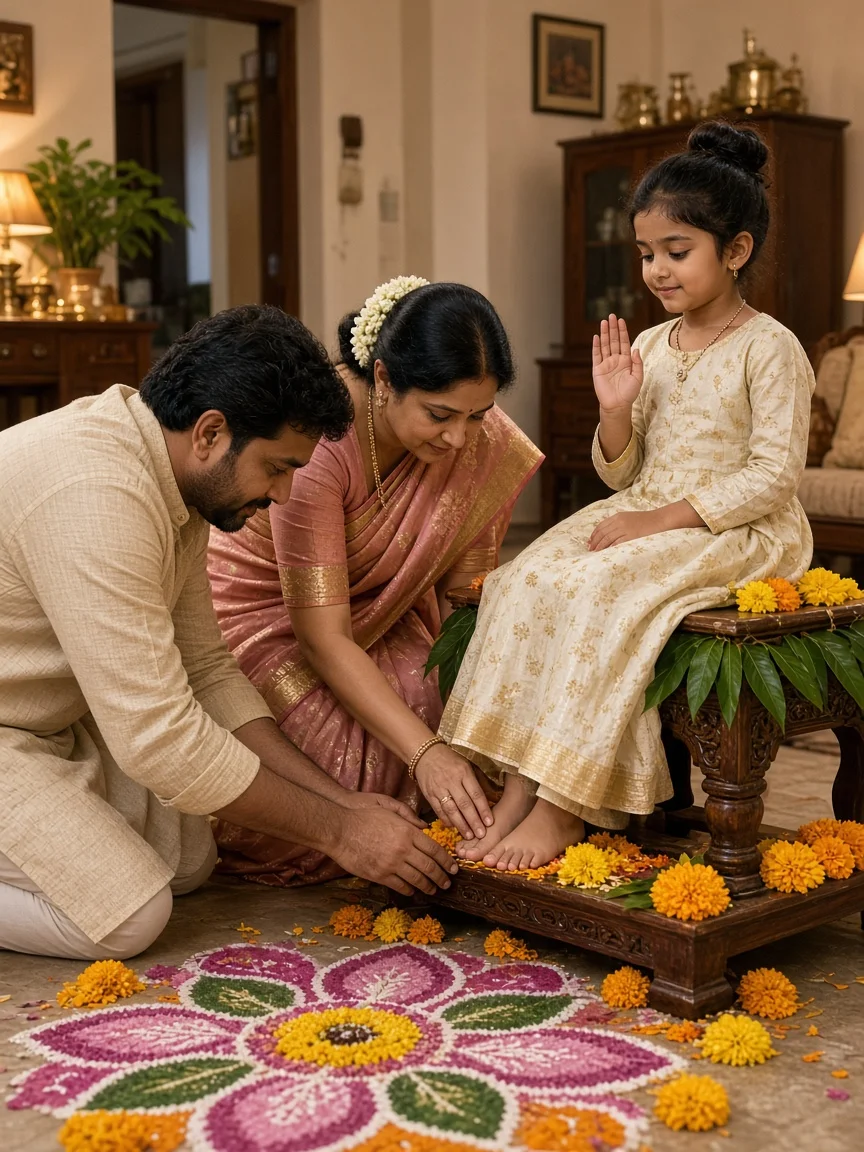
Photorealistic heartfelt Kanya Pujan family portrait of an Indian father and mother in festive kurta and saree bowing with folded hands to touch the feet of a serene six-year-old girl seated on a carved wooden stool decorated with mango leaves and marigolds, she raises her small right hand in a gentle blessing gesture, rangoli floor, warm living-room light, no text.
7. Kanya aarti with a brass thali
The aarti adds warm flame light to the morning. In this scene a mother in a red-bordered silk saree holds a brass aarti thali with a small ghee diya in front of three girls in mirror-work chaniya cholis, who stand with folded hands. The flame is held at a safe distance, and the girls are well clear of it, which matters in real life because chunaris and synthetic fabric catch fire easily. Light incense haze in the background adds depth without hiding faces.
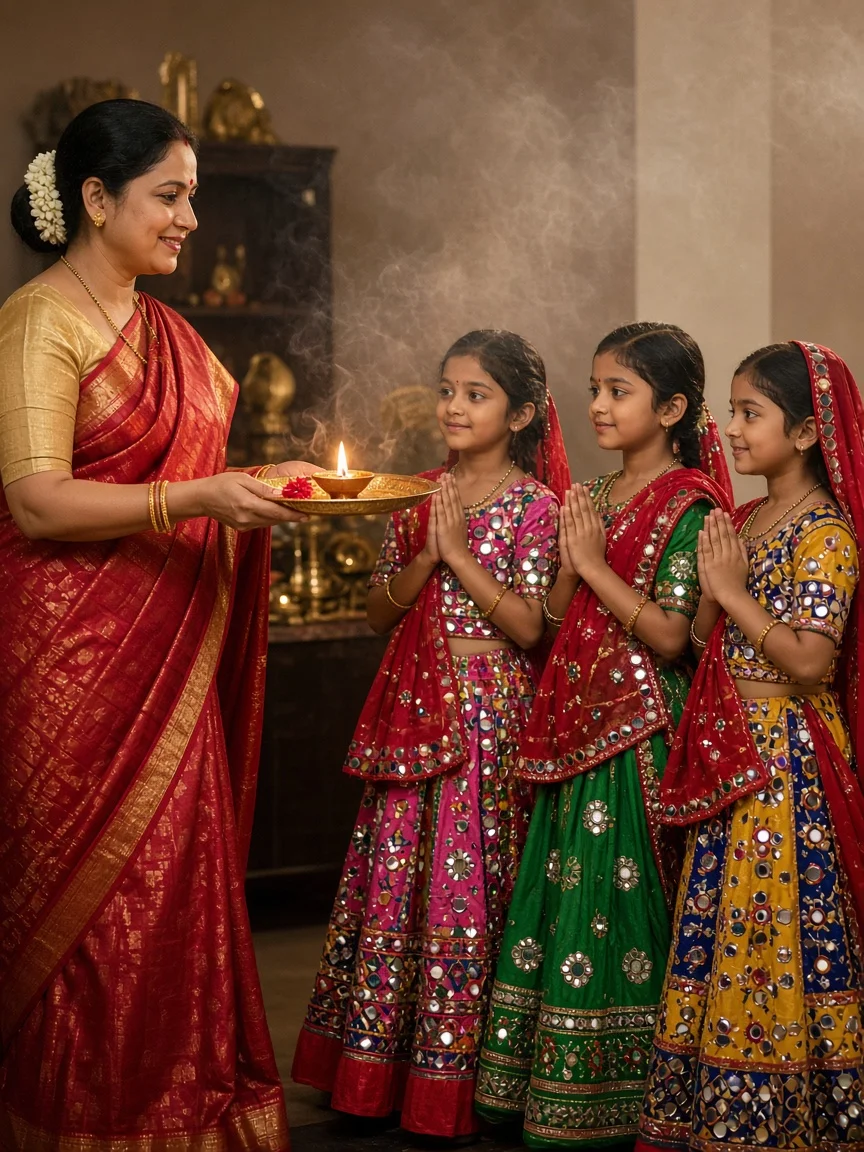
Photorealistic festive scene of an Indian mother in a red-bordered silk saree holding a brass aarti thali with a small ghee diya at a safe distance in front of three little girls in colourful mirror-work chaniya cholis and red chunaris standing with hands folded, soft warm glow on faces, light incense haze, girls well clear of the flame, no text or watermark.
8. Kanjak gift pouches
The end of the puja brings the giggles. Three girls on a sunny verandah open red velvet gift pouches filled with glass bangles, hair ribbons, pencil boxes and fruit, while a smiling woman hands out one more. Candid joy is the goal here, so in a real shoot, simply keep the camera ready on burst mode and let the children react. In prompts, naming the exact gifts keeps the props culturally right instead of generic toys.
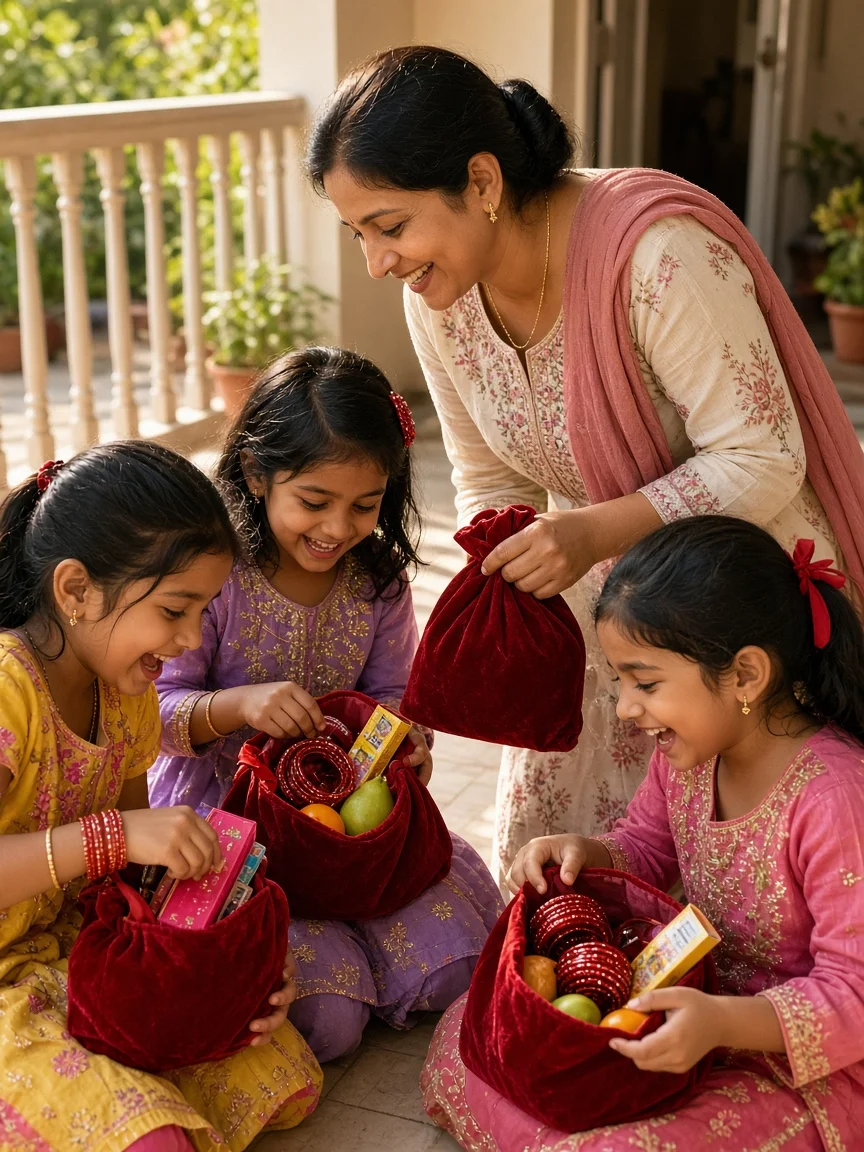
Photorealistic cheerful candid of three little Indian girls on a sunny home verandah excitedly opening red velvet Kanjak gift pouches with glittering red glass bangles, hair ribbons, pencil boxes and fruit, while a smiling Indian woman in a festive salwar suit hands over another pouch, golden late-morning light, genuine laughter, natural child proportions, no text.
9. Bal Durga editorial portrait
Some families like to dress one daughter as Bal Durga, the little goddess, for a separate portrait, sometimes called the Bal Devi look. This studio-style image shows a five-year-old in a child-sized red and gold Banarasi drape, a small tiara and jasmine in her hair, holding a decorative miniature brass trishul prop against a warm sandstone arch. In our image the prop has pointed tines, so treat it purely as a photo prop: in a real shoot, choose a lightweight cardboard or blunt plastic trishul, and let the child hold it only while an adult is close by.
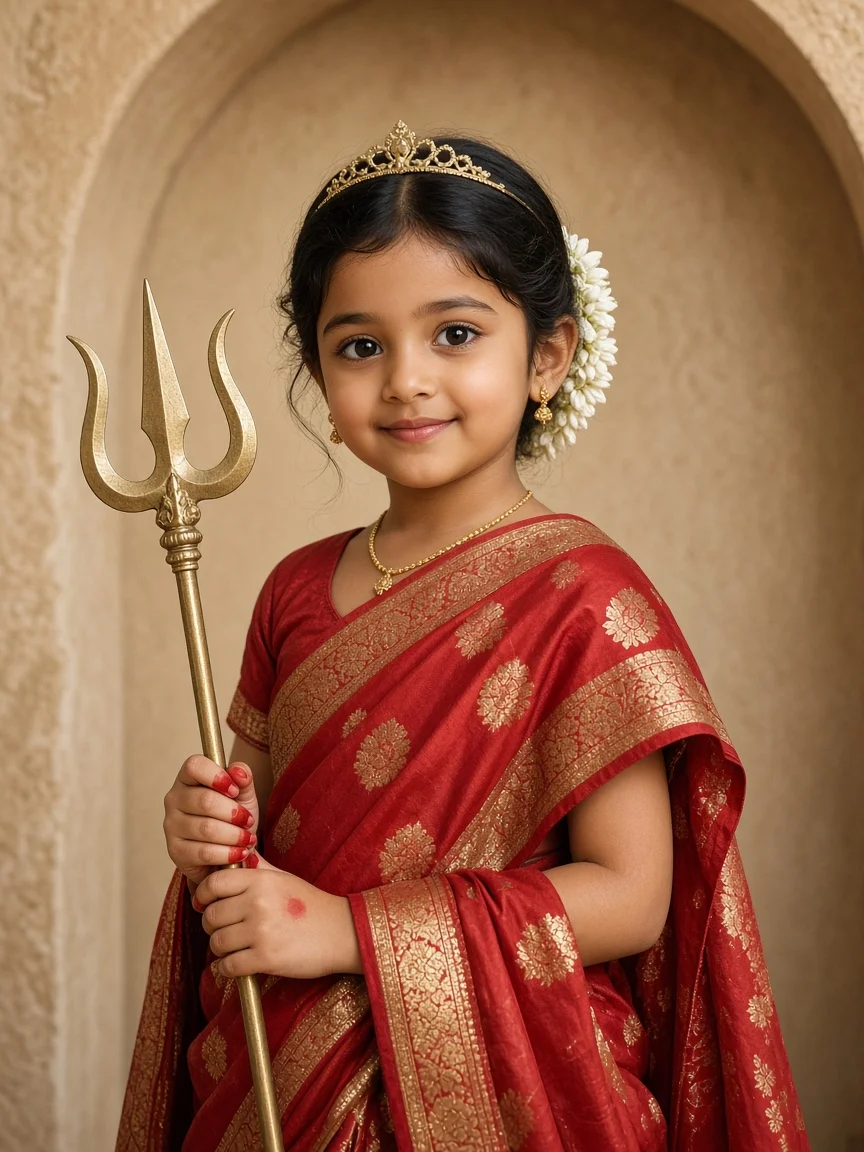
Photorealistic fine-art Navratri portrait of a five-year-old Indian girl styled as Bal Durga in a child-sized red and gold Banarasi silk drape, small gold-tone tiara, white jasmine in her hair and alta on fingertips, holding a lightweight decorative miniature brass trishul prop, sweet calm smile, minimalist warm sandstone arch background, soft studio light, natural child features, no text.
10. Haveli courtyard Kanya Pujan
For a grand scene, move the ritual outdoors. Seven girls in Bandhani and Leheriya lehengas sit on low cushions around petal rangolis and terracotta kalash pots in a Rajasthani haveli courtyard, while two women in sarees serve them, and marigold strings hang between carved stone pillars. This wide frame suits a society or temple Kanjak where many families celebrate together. Shoot from a slightly raised position, such as a step or balcony, so every child's face is visible.
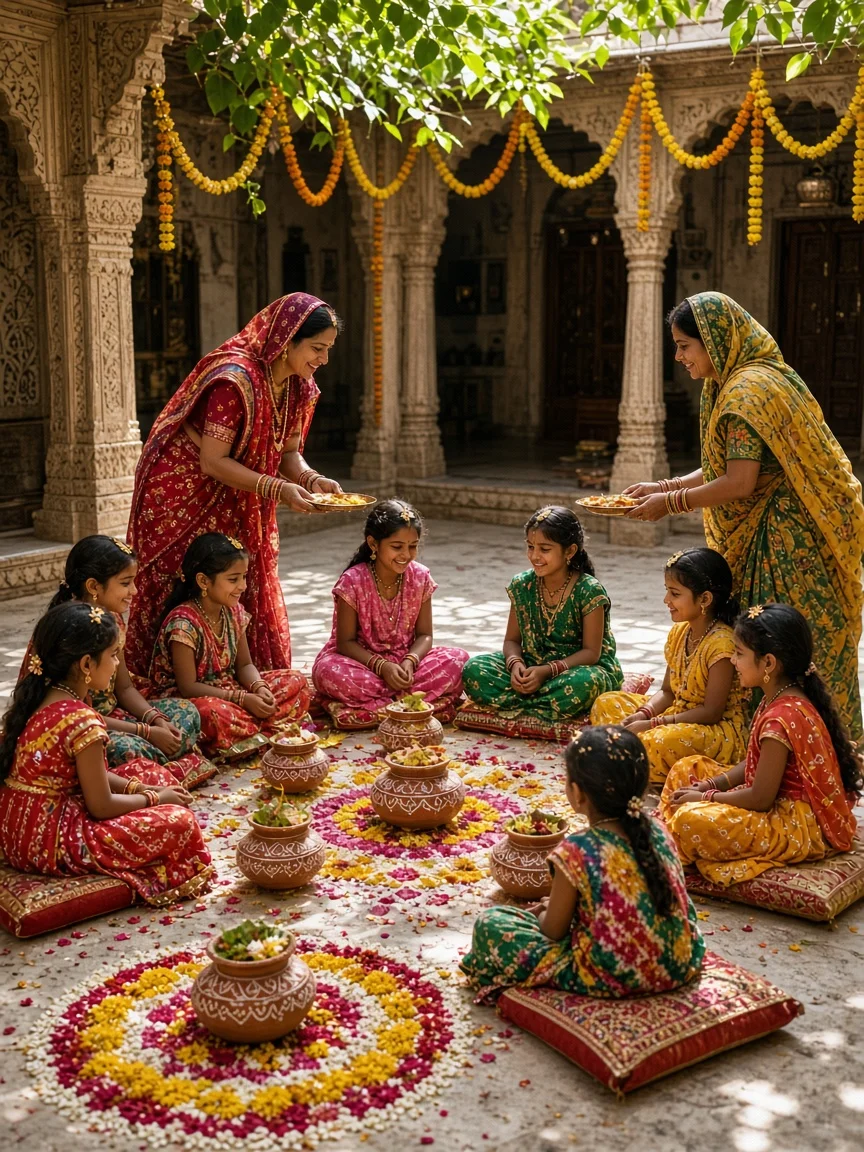
Photorealistic wide outdoor Kanya Pujan celebration in a Rajasthani haveli courtyard: seven young girls in Bandhani and Leheriya lehengas seated on low cushions around flower-petal rangolis with terracotta kalash pots, two Indian women in sarees serving them, marigold strings hanging from carved stone pillars, dappled daylight through peepal leaves, joyful atmosphere, no text.
Using your daughter's photo safely
Many parents want to see their own child in these scenes. It can be done well, but children's images deserve extra care:
- Only your own child: use photos of your own daughter, or of a child whose parents have clearly agreed. Never use pictures of other people's children from social media or school groups.
- Private sharing first: consider sending AI portraits to family on WhatsApp rather than posting them publicly. Images of children on public profiles are easily copied.
- Check the face: AI may make a child look older or add makeup. If that happens, add natural child face, no makeup and age five to the prompt.
- Label edits: if you post publicly, add a small AI edit note so friends know it is not a real studio photo.
- Remove location clues: avoid house numbers, school badges or street signs in real photos you share.
To use the reference photo, upload a clear, front-facing daylight picture of your daughter, paste the prompt and add: Keep her face, features, skin tone and hair exactly the same as the uploaded photo, with a natural child face and no makeup. Generate a few versions and choose the most natural one.
Tips for real Kanjak photos at home
AI images are fun, but the real moments matter most. A little planning makes the morning easier to capture:
- Assign one photographer: a teenager, an aunt or a neighbour who is not serving food can follow the whole ritual.
- Clear one wall: seat the girls against a plain or decorated wall near a window, not in front of a cluttered cupboard.
- Prepare props early: keep the urli, chunaris, mauli, thalis and gift pouches ready before the girls arrive.
- Shoot at their level: kneel or sit; it changes everything with children.
- Use burst mode: children blink and move, so take several frames for each moment.
- Do not stop the ritual for photos: the kanyas are guests, and the puja is a prayer. Capture what happens rather than staging everything.
If some children are shy, start with group shots at the bhog, when they are busy eating, and move to close-ups later when they are comfortable with the camera.
Choosing an AI tool for child portraits
In our tests, Gemini produces natural Indian skin tones and understands ritual details such as Charan Dhulai and Kanjak bhog well. ChatGPT follows long prompts closely and is careful with children's images, which is reassuring, although it sometimes refuses photos it finds unclear; a well-lit, simple photo helps. Grok is fast for trying variations. Many creators also use Midjourney or FLUX for very detailed fabric and food textures, but these do not always accept reference photos as easily. Whatever tool you choose, keep prompts kind and specific, and do not try to work around safety filters for children.
Gifts, food and decoration ideas
Small touches make both real and AI photos feel richer. Red potli pouches with a coin, glass bangles, colourful hair clips, a small notebook and crayons are popular, practical gifts. Fruit such as bananas and apples adds colour to thalis. For decoration, marigold torans on doors, mango leaves, a small kalash with coconut and a simple rangoli near the seating area are enough. A row of matching chowkis or cushions makes group photos neat, and a brass urli with petals for Charan Dhulai looks beautiful in close-ups.
More family and festive prompt guides on GAWKIN
If you are planning more photos of your daughter, our 1 month baby photoshoot prompts for girls cover gentle home milestone ideas. For Rajasthani styling like the haveli courtyard, see the Rajputi poshak prompts for girls. The festive season continues with the Diwali AI prompt guide and the Bhai Dooj Gemini prompts, both of which use the same warm diya lighting. Mothers-to-be can try the traditional maternity photoshoot ideas at home, and if you love classic saree portraits for yourself, the Kerala kasavu saree prompts are a good next step.
Final thoughts
Kanya Pujan is a morning of small feet, bright chunaris, warm halwa and big smiles. It honours girls as the goddess herself and reminds adults to serve with humility. Whether you use these Durga Ashtami Kanya Pujan photoshoot prompts to create an AI keepsake, or as a shot list for real photographs next Navratri, focus on the relationships: the mother washing feet, the grandmother tying the mauli, the parents bowing for blessings. Keep the children safe and comfortable, share their images thoughtfully, and let the joy of the day lead the pictures. Jai Mata Di.
Frequently asked questions
What is the best Durga Ashtami Kanya Pujan photoshoot prompt?
A Charan Dhulai scene works beautifully: a mother washing a five-year-old girl's feet in a brass urli with rose and marigold petals, the girl seated on a red chowki in a scarlet lehenga and gota-patti chunari, soft morning window light, an 85mm look and natural child skin texture.
What is the difference between Kanya Pujan and Kanjak Puja?
They are the same ritual. Kanya Pujan is the general name, while Kanjak or Kanjak Puja is the common term in Punjab, Delhi and Haryana. Both honour young girls as forms of Maa Durga on Ashtami or Navami of Navratri.
Can I use my daughter's photo in a Kanya Pujan AI prompt?
Yes, if it is your own child. Upload a clear front-facing photo and add: Keep her face, features, skin tone and hair exactly the same, with a natural child face and no makeup. Share the results privately with family where possible, and never use other children's photos.
What food is served at Kanya Pujan?
The traditional bhog is sooji halwa, puri and dry kale chana, served on brass thalis or leaf plates. Some families add sweet boondi served in leaf donas, coconut, fruit or kheer. In AI prompts, naming each dish keeps the food culturally accurate.
What gifts are given to girls at Kanjak?
Popular gifts are glass bangles, hair clips and ribbons, small stationery sets, fruit, a coin or some money, often presented in a red velvet potli pouch along with the chunari.
How many girls are invited for Kanya Pujan?
Traditionally nine girls are invited to represent the nine forms of Durga, along with one small boy as langur. Many families invite fewer, and the puja is equally meaningful.
How do I photograph Kanya Pujan safely with diyas?
Keep the aarti flame in an adult's hands at a safe distance from children's chunaris, place diyas on high shelves, rely mainly on window light, and never ask children to hold lit lamps for a photo.
Related articles
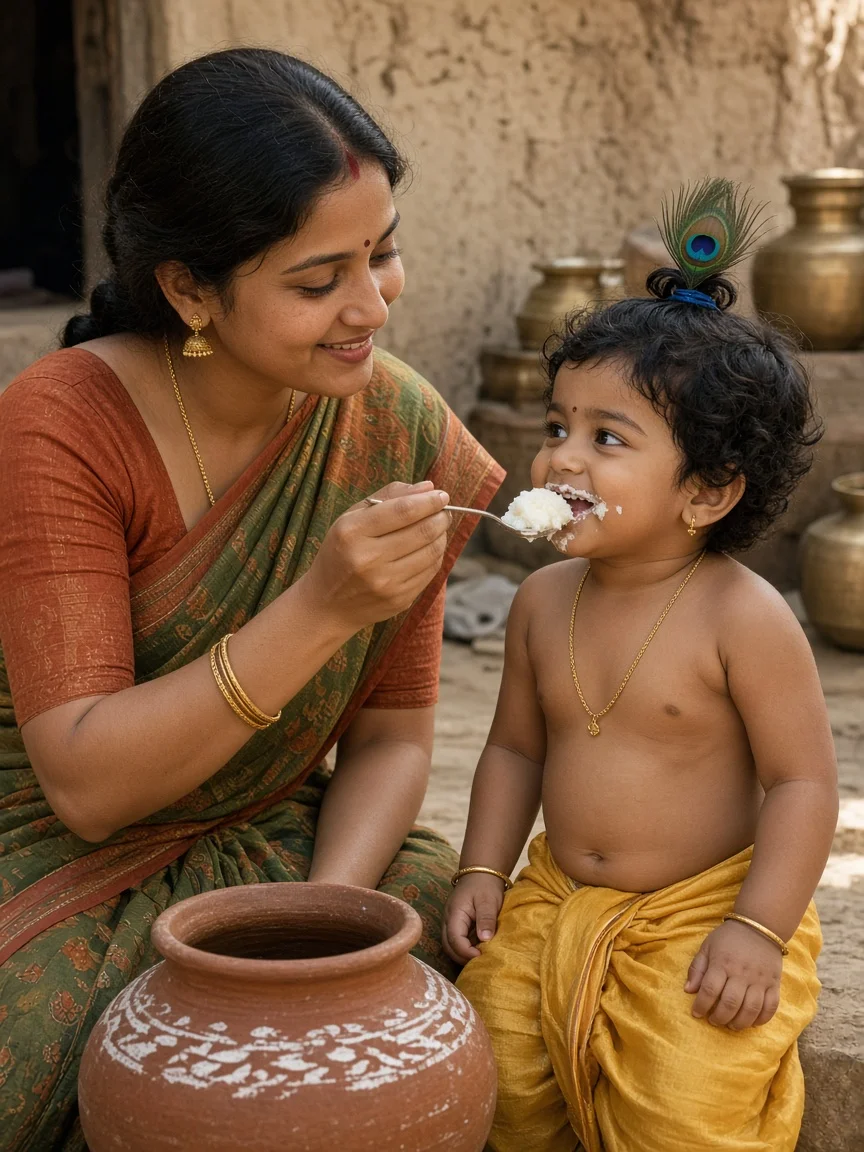
Baby Krishna with Mother Yashoda Prompt: 10 Janmashtami Photo Ideas
Ten baby Krishna with mother Yashoda prompts with images for Janmashtami: Makhan Chor butter feeding, palna lullaby, Gopal with a calf, bansuri on the ghat, mor pankh mirror, shikka pot, Godhuli hug, brass urli, churning curd and butter footprints, plus props, safety and own-baby face tips.
Nancy · · 16 min read
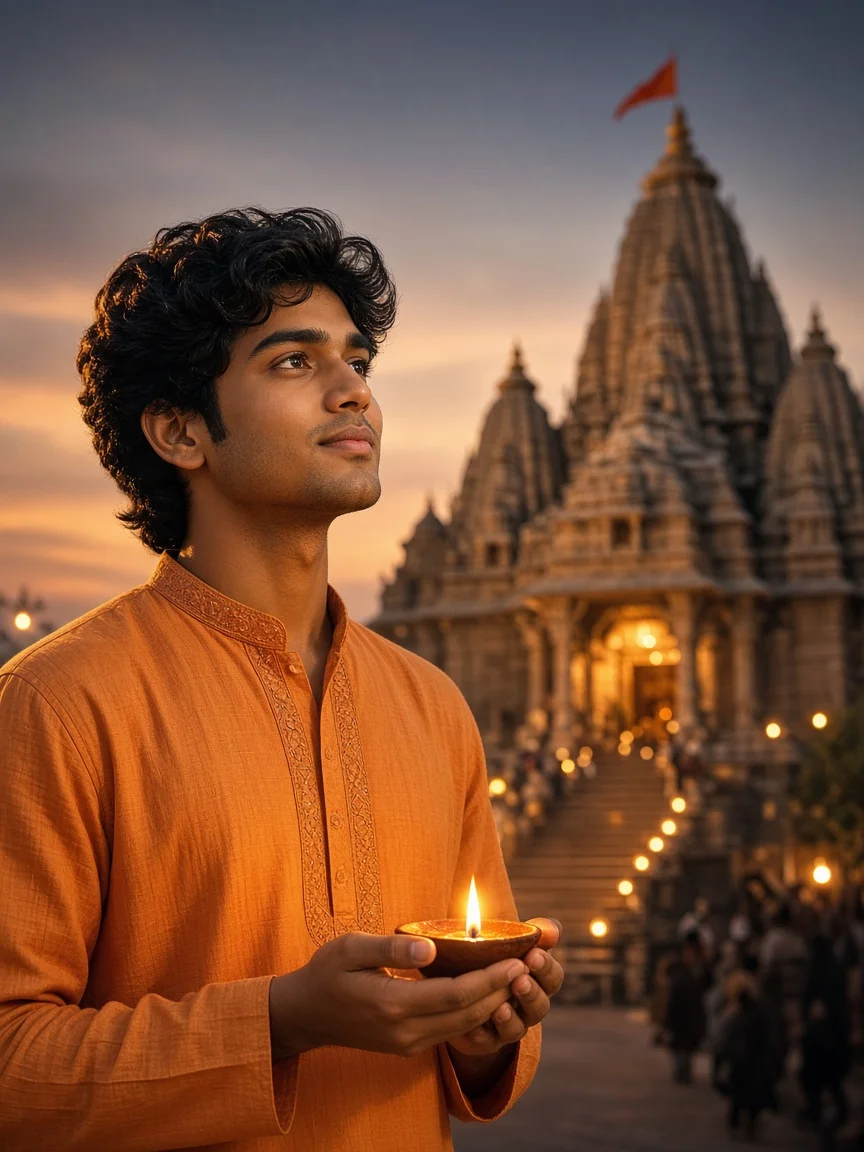
Jai Shree Ram AI Photo Prompt: 10 Devotional Dussehra Portrait Ideas
Ten respectful Jai Shree Ram AI photo prompts with images: temple diya portrait, Ramlila-inspired Kodanda bow, Sarayu ghat aarti, Bal Ram, Ram Darbar couple, cloud double exposure, Surya Tilak, Ram Setu and a Vijayadashami family night, plus iconography, lighting and face tips.
Nancy · · 18 min read
Happy Dhanteras AI Prompt: 10 Gold Kalash & Puja Photo Ideas
Ten Happy Dhanteras AI prompts with images: gold kalash and Kanjivaram, evening aarti, jewellery counter couple, night utensil market, mehndi hands with gold coin, family puja, palace balcony diyas, new bike vahan puja, little Lakshmi with coins and the doorstep Yama Deepam diya, plus meaning, gold lighting tips and fixes.
Nancy · · 17 min read
Gemini AI Photo Prompt Copy Paste Trending Halloween: 10 Spooky-Chic Indian Looks
Ten copy-paste Gemini Halloween prompts with real results for Indian boys, girls and couples: jack-o'-lantern balcony, gothic noir, UV skull face paint, Pierrot at the mela, flash house party, velvet sorceress, masquerade, pumpkin farm, lantern walk and Bhoot Chaturdashi diyas, plus face-lock, lighting and costume tips.
Nancy · · 20 min read
Comments
No comments yet. Be the first!